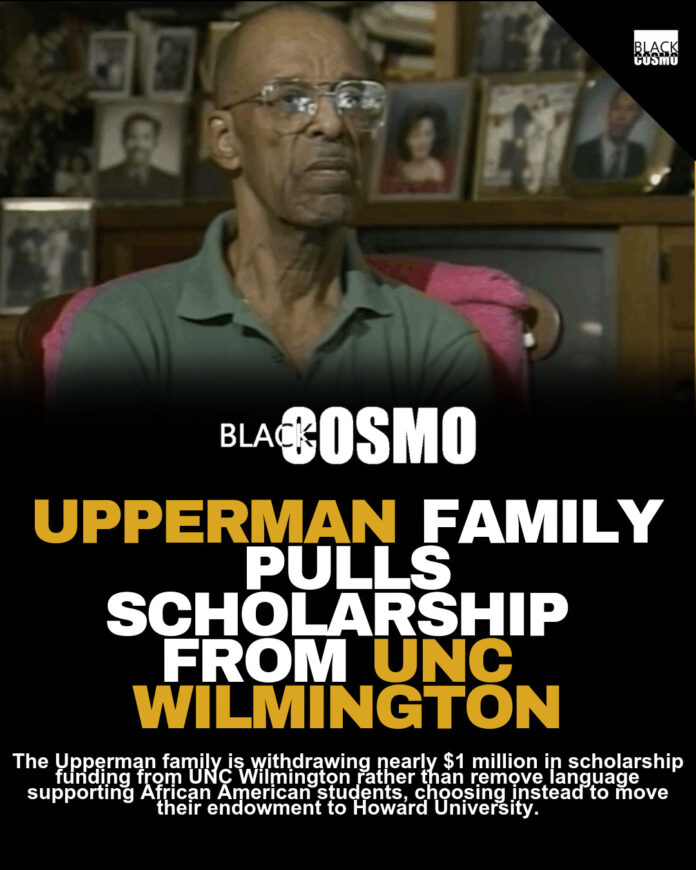
When colleges across the country have largely chosen to rewrite scholarship language to comply with the Trump administration’s restrictions on diversity initiatives, one prominent Black family in North Carolina decided to do something else entirely: take their money elsewhere.
For the first time in nearly 30 years, the Upperman family will not award new scholarships at the University of North Carolina Wilmington after refusing to alter the scholarship’s mission to satisfy the UNC System’s new “equality policy,” according to WHQR News. It’s a decision that comes with real weight. The family remains dedicated to honoring the legacy of their loved one, the late Dr. Leroy Upperman, even if it means pulling a scholarship in his name.
“I discussed it with my adult sons, and we decided the climate may never change,” Upperman’s daughter, Linda Upperman Smith, told WHQR. “There’s no way that we’re going to not follow my father’s wishes.”
Dr. Upperman was a pioneering Black physician whose family helped establish UNCW’s Upperman African American Cultural Center. After university officials asked Upperman Smith to remove language giving special consideration to students who demonstrated a commitment to the African American community, the family took a stand.
Rather than revise the scholarship based on the school’s new diversity, equity and inclusion guidelines, the family voted to stop funding new awards and is exploring moving its roughly $1 million endowment to Howard University, Dr. Upperman’s alma mater, according to WECT.
“One thing about Black folks: we have always figured out a way to make things work,” Upperman Smith said.
The decision stands out at a moment when many universities and donors have quietly modified scholarship language to comply with changing legal and political landscapes. According to UNCW Vice Chancellor Eddie Stuart, 18 active scholarships were found to be out of compliance with the UNC System’s policy, but most donors have opted to revise their agreements rather than withdraw funding.
The Upperman family chose another path.
It’s a notable use of economic leverage by a Black family whose relationship with the university stretches back decades. Beyond scholarships, the family has invested in cultural programming, mentorship and student success at a campus where Black undergraduate enrollment has hovered around 4% to 5% for years, according to Data USA.
Technically, the scholarship did not require recipients to be Black. Instead, it prioritized students with an interest in or commitment to issues affecting African American communities, though recipients were often Black. University officials argued that evaluating that commitment could conflict with some provisions in the new equality policy.
Upperman Smith told WHQR the family’s decision is about preserving donor intent, not simply resisting administrative changes.
“I’m tired, and I said they’re not going to beat me down every time I ran into some kind of roadblock with something; they’re not going to beat me down, and on some level I feel that they’ve won, but that’s only at UNC Wilmington, that they’ve won,” she said. “I put a lot of time, energy, sweat, and tears into the university, and it’s like everything has just crumpled.”
The Upperman family’s move underscores a reality institutions may increasingly face: if donors believe the original purpose of their gifts can no longer be honored, they can take both their money and their legacy somewhere else.
★TR★