
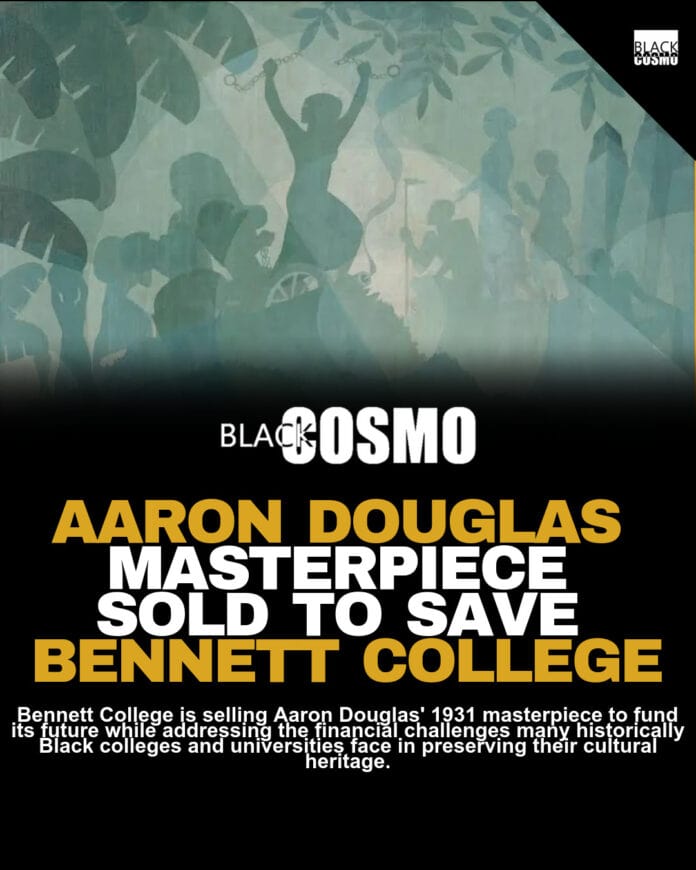
A 1931 painting of Harriet Tubman created to inspire young Black women at Bennett College is heading to auction at Sotheby’s in New York. The masterpiece, valued between $2.5 million and $3.5 million, represents far more than its price tag. It embodies the tension between preserving cultural legacy and the financial survival of historically Black institutions.
Harriet Tubman, created by Harlem Renaissance artist Aaron Douglas, has hung in the North Carolina Museum of Art in Raleigh for nearly 20 years on loan from Bennett College, one of only two all-women HBCUs in the country. The college lacks the conservation resources and museum facilities to properly preserve and display the work, making the decision to sell it both practical and painful.
Douglas didn’t paint a conventional portrait. His vision showed Tubman breaking chains and leading others toward freedom, surrounded by scenes of liberation: a man tilling his own land, a young Black woman reading. For Bennett’s students, the message carried weight. Freedom meant agency over your own future.
The painting was commissioned in 1931 by Chicago philanthropist Alfred K. Stern specifically for Bennett’s campus in Greensboro, North Carolina. For decades, it served as a tangible reminder of the college’s mission. Then financial and logistical constraints made keeping it on campus impossible.
Cassandra Jones Havard, chair of Bennett’s Board of Trustees, framed the decision as bittersweet necessity. “Aaron Douglas’ Harriet Tubman reminds us of the strength and power of women, and proceeds from its sale will help to ensure a vibrant future for the institution and the students it serves,” she said in a statement. The sale aligns with Bennett’s centennial as a women’s college and will support its Women’s Health Initiative, which addresses healthcare disparities in Black communities.
The timing matters. Founded in 1873 and rededicated in 1926, Bennett has weathered decades of financial pressure alongside countless other HBCUs. Smaller endowments, fewer major donors, and less institutional wealth than predominantly white universities have created a persistent resource gap. Many Black colleges hold irreplaceable cultural artifacts—historic documents, archives, important artworks—that tell the story of Black America. Parting with any of them represents a loss.
Yet sometimes survival requires difficult choices. The auction proceeds will fund Bennett’s future at a moment when that future matters more than ever.
★TR★