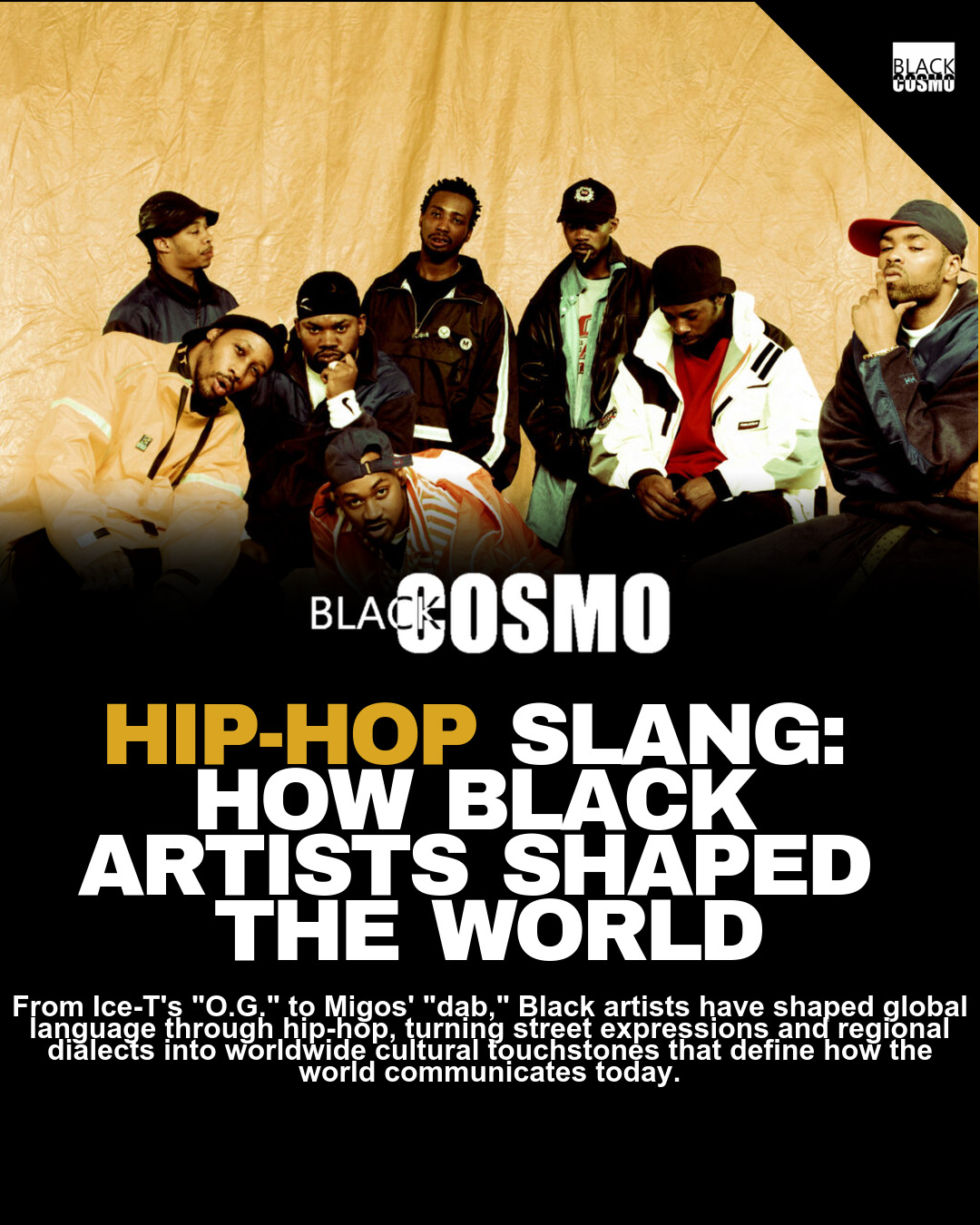
Hip-Hop slang That Changed the World
Language is never neutral. It carries history, power, and the fingerprints of the people who shaped it. From the streets of Los Angeles to the neighborhoods of New York, from Atlanta’s trap houses to New Orleans’ bounce stages, Black artists have been coding the culture’s vocabulary into hip-hop records for decades. What started as regional expressions became global phenomena, adopted by millions who may never know where these words came from. That erasure is real. But so is the legacy.
Ice-T and the ‘Original Gangster’
“O.G.” didn’t originally mean a legend in any field. It identified the original members of Los Angeles street sets, particularly the Original Gangster Crips. Hip-Hop slang like this carried weight beyond the booth. Ice-T’s 1991 album O.G. Original Gangster helped carry the expression into mainstream hip-hop, transforming a regional identifier into a marker of authenticity and respect across the culture.
Wu-Tang Brings the ‘C.R.E.A.M.’
Before Wu-Tang made it an acronym, “cream” was already Black neighborhood slang for money. Raekwon and Inspectah Deck immortalized it on their 1993 track “C.R.E.A.M.”—Cash Rules Everything Around Me. With one classic record, a street expression became a hip-hop institution, spreading across generations who learned the phrase before they even knew the song.
The True Origins of ‘Diss’

“Diss” is short for disrespect, and its rise in hip-hop is inseparable from the culture’s competitive DNA. New York MCs turned the insult into lyrical art form. Spoonie Gee, Roxanne Shanté and MC Lyte established the diss record tradition in the early 1980s, creating a template that would define how hip-hop handled its beefs. By the time Tupac and Notorious B.I.G. collided in the 1990s, “diss” had taken on a much heavier meaning—a word that could carry real consequences.
Ask the West Coast About ‘Shizzle’
There’s wordplay that only makes sense in Black dialect. “Shizzle” is one of those things. But that playful language twist has deeper roots than Snoop Dogg’s mainstream moment. Bay Area rapper E-40 helped popularize the -izzle suffix style, influenced by earlier wordplay traditions in the region. When Snoop made “fo shizzle” a household expression in the early 2000s, he was building on something that had been cooking in West Coast communities for years.
How ‘Beef’ Turned Global

“Beef” wasn’t invented in hip-hop, but hip-hop transformed it. The term already existed as American slang for a grudge or dispute, but rap culture turned it into a public lyrical showdown where reputations were on the line. Notorious B.I.G. captured that street-level intensity in his 1997 single, “What’s Beef?” The song didn’t just name the game—it became the definitive statement on what it means to have conflict in hip-hop.
Who Really Put ‘Boo’ on the Map?
Before “bae” became everybody’s favorite nickname, Black folks were calling their lovers “boo.” Its exact linguistic origins remain debated, but the word had real weight in Black communities long before it hit radio. Atlanta’s Ghost Town DJs gave it a soundtrack with “My Boo,” and then Usher and Alicia Keys solidified it in the culture with their 2004 hit of the same name—a track that ranks among the greatest songs of its decade.
‘Trap’ Music Explodes Out of Atlanta

Who invented trap music is still debated in hip-hop circles. Was it T.I.? Gucci Mane? Young Jeezy? The answer probably belongs to all of them, but the city is undeniably Atlanta. Before it became a musical genre with global reach, the trap was a physical place—a drug house, a hustle, a means of survival in communities where options were limited. Goodie Mob and OutKast used the language before T.I.’s 2003 album “Trap Muzik” helped define the sound and introduced it to mainstream ears.
B.G., Big Tymers & Hot Boyz on ‘Bling’
Before diamonds had a soundtrack, Black New Orleans had a word for their shine. Cash Money Records’ B.G. brought “bling bling” nationwide with his 1999 hit, and suddenly the word became shorthand for jewelry, wealth and unapologetic Black luxury. The song didn’t just introduce a phrase—it introduced an attitude.
‘Turn Up’ for What?

The South wasn’t asking permission to have a good time. “Turn up” grew from Black Southern party language, where getting loud meant getting alive. Atlanta’s crunk movement, led by Lil Jon, carried that energy from the streets into mainstream music, turning a regional expression into a universal call to celebrate.
Let Me See Your ‘Grillz’
Gold teeth had a history in Black style long before they became a pop-culture accessory. In places like Houston and New York City, rappers had been accessorizing their teeth for decades. But it wasn’t until Paul Wall and Nelly put it on the radio with “Grillz” in 2005 that the term reached households across America and beyond.
How One Crazed Fan Ushered in ‘Stan’
One fictional fan became a permanent word in the English language. Eminem introduced Stanley in 2000 with his song “Stan,” depicting celebrity obsession taken to a terrifying extreme. The story was so powerful, so unsettling, that by 2017 the Oxford English Dictionary had officially recognized the word for an obsessive fan. That’s the power of hip-hop—to create cultural concepts that last.
The Motto: ‘Yolo’

The philosophy was older than the acronym. But Drake and Lil Wayne gave “You Only Live Once” a generational anthem through their 2011 hit, “The Motto.” Suddenly, four letters became the excuse for taking chances, making memories and living loudly. Add a hashtag at the beginning, and you had the mantra of an entire generation.
Chicago Drill Brings ‘Thot’ to Black Culture

Chicago drill didn’t wait for the internet to name its vocabulary. THOT emerged from the city’s rap scene in 2012. Katie Got Bandz helped put it on record with “Ridin’ Around and We Drillin’.” Chief Keef, Rapper 600 Breezy and others from the Chicago drill movement have also been credited with popularizing the term, which broke down into “that h*e over there” but eventually took on a life of its own.
Migos and the Original ‘Dab’
The dab didn’t come from a dance studio or a marketing focus group. It emerged from Atlanta’s Black hip-hop scene, with competing claims over who exactly created it. In 2015, Migos helped turn the movement into a worldwide phenomenon with their single, “Look at My Dab.” Suddenly, everyone wanted to know how to do it.
The South Has Something to Say, ‘No Cap’
Folks in Atlanta have been saying “cap,” “capping” and “no cap” for years—meaning they’re not lying about something. But the phrase didn’t break into mainstream culture until artists like Migos, Young Thug and Future repeatedly used it in songs and during interviews. Now it’s everywhere, and most people saying it probably don’t know it came from the South.
★TR★