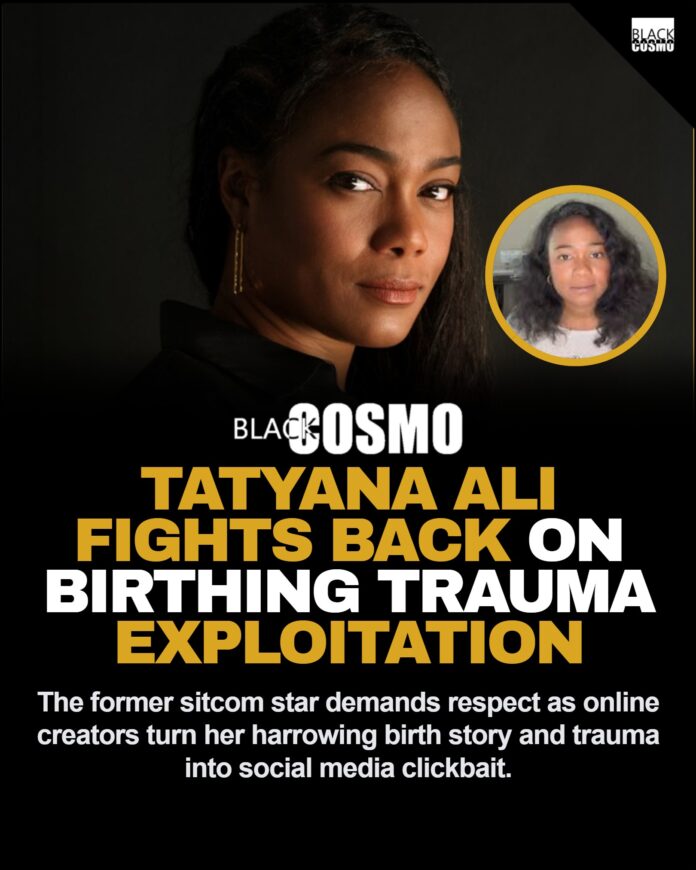
When an artist decides to share an intimate part of their life, they expect the listener to hold that vulnerability with some level of basic humanity. Instead, the internet often does what it always does: it strips the nuance away and packages the pain for a few seconds of engagement. This is the reality facing the former sitcom star as she pushes back against a wave of exploitation. The Tatyana Ali birth story was originally shared as a warning about the medical system, but online spaces have twisted her words into sensationalized clickbait.
The trouble began shortly after Tatyana Ali sat down for an interview on the podcast, Pod Meets World. During the episode, she spoke candidly about welcoming her first son, Edward, in 2016. What was meant to be a healthy delivery quickly deteriorated into what advocates term obstetric violence. Her birth plan was ignored, staff members physically restrained her, and doctors engaged in dangerous, non-standard medical maneuvers when her baby was already crowned. It was a harrowing, deeply personal admission, intended to highlight the systemic issues Black mothers face in hospital maternity wards. Instead of inspiring systemic reflection, some medical content creators and wellness influencers turned her trauma into a commodity.
Ali did not mince words when addressing the creators who ran with her disclosures. She took to Instagram to point out that her life is not fodder for the algorithm. The actress voiced her frustration with medical professionals who should know better, yet chose to post reaction videos and medical commentary without doing basic due diligence. When medical professionals use a patient’s pain to increase their own social media footprint, they cross an ethical line. Ali explained that the most sensational detail of her labor, specifically the claim that her son was pushed back inside her during delivery, became a cheap online hook. She reminded her audience that these painful moments are actual lived experiences, not conceptual tools for building an online audience.
The flattening of the Tatyana Ali birth story on social platforms reveals a wider issue. Black women have historically faced systemic bias in medical facilities, where their pain is frequently minimized or ignored. When someone with a public platform speaks up about these realities, they do so to offer solidarity and shift the conversation around maternal care. They do not do it to provide raw material for digital creators looking to expand their audience. Turning a mother’s trauma into social media currency is an extension of the very disregard Ali faced in the delivery room. It is a secondary violation, where the patient’s voice is stripped away once again, this time by the public.
This pushback is necessary. For years, the digital space has operated under the assumption that anything shared publicly is fair game for dissection and parody. But some experiences demand reverence. Ali’s decision to call out these creators directly forces a shift in how we handle accounts of medical mistreatment online. A birth story is not a trend to be analyzed by amateur commentators or doctors trying to build a brand. It is a real event with real emotional fallout. By standing firm and refusing to let her personal history be reduced to a clickable headline, Ali is reclaiming her narrative.
Ultimately, the conversation about reproductive justice must protect the dignity of those who speak out. When public figures share their pain to help others, their stories should be treated as advocacy, not entertainment. The former sitcom star is drawing a clear boundary, asserting that her past struggles belong to her and her family. Online creators must recognize that maternal trauma is not a script for digital engagement, and medical professionals must prioritize empathy over internet status.
Taking control of her narrative in this manner is a reminder that advocacy requires boundaries. Public disclosure is not an invitation for endless commodification. The exploitation of reproductive pain, particularly of Black mothers, has a long history, and modern social platforms are only the newest venue for this practice. By holding both content creators and healthcare professionals accountable, Ali is demanding a standard of care and respect that extends from the delivery room to the digital sphere. Her insistence on this boundary serves as a crucial intervention, demanding that we listen with care rather than consuming for views.
Editor’s Picks: For those looking to explore systemic issues or capture their own stories, consider these curated selections. Dive deeper into stories of resilience and maternal advocacy with our recommended reading list on women’s health. If you are starting your own advocacy platform or podcast, capture clear audio with a professional condenser microphone for podcasting.