
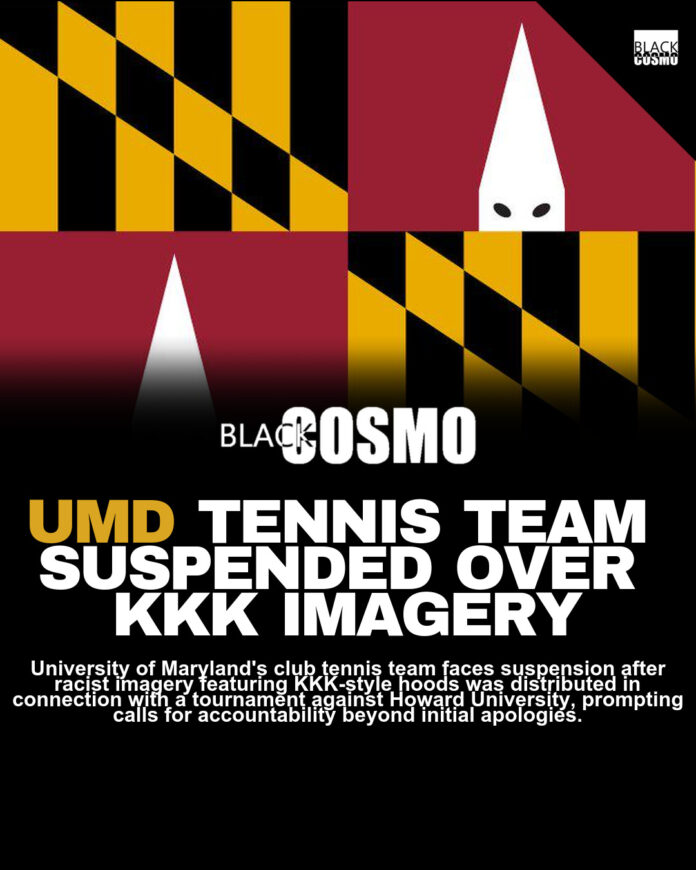
University of Maryland’s club tennis team was suspended indefinitely after racist imagery featuring KKK-style hoods circulated in connection with a tournament involving Howard University, a historically Black college in Washington, D.C. Ku Klux Klan symbols have no business appearing anywhere near college sports, let alone in official materials tied to competition between a predominantly white institution and an HBCU.
For Black athletes, this latest controversy reads as just another reminder of what they’re expected to navigate: perform at the highest level, maintain composure, and somehow feel welcome in spaces where their safety and dignity are treated as negotiable. University of Maryland’s club tennis team incident underscores a persistent problem in college sports.
The university moved swiftly, suspending the team and referring the matter to appropriate authorities for investigation. President Darryll J. Pines apologized to Howard and affected students, acknowledging the harm caused. “We condemned the image in no uncertain terms,” Pines stated. “It was deeply harmful and offensive, and I offer my apology for its detrimental impact on one and all.”
But an apology, however necessary, doesn’t erase what those symbols represent. The Ku Klux Klan embodies generations of violence, intimidation and white supremacy directed at Black Americans. Incorporating those images into sports-related materials is a calculated insult wrapped in historical terror.
This burden falls disproportionately on Black athletes. They’re often expected to remain composed, demonstrate resilience and deliver strong performances even when confronted with racism. It’s a pattern that stretches across decades. LeBron James was told to “shut up and dribble” for speaking about racial inequality. Angel Reese faced racist attacks during the 2024-2025 season. From Jackie Robinson breaking baseball’s color barrier to contemporary players navigating social media harassment, Black athletes are left managing emotional consequences they didn’t create.
Howard University’s interim President Wayne A. I. Frederick was direct about what this controversy actually represents. “There is no place for racism, intimidation, or imagery rooted in hatred and racial violence in collegiate athletics, on our campuses, or anywhere in our society,” Frederick said.
His statement cuts to the heart of what’s at stake. College athletics should provide a space where students focus on their sport, develop skills and represent their schools without being confronted by imagery born from racial violence. It’s not complicated.
The incident also exposes a gap between institutional rhetoric and actual accountability. Academic prestige and diversity initiatives don’t automatically translate into cultural understanding. Universities can tout inclusion efforts while simultaneously failing to address conduct that directly contradicts those commitments.
UMD’s suspension and investigation signal some willingness to respond seriously. But Frederick emphasized that accountability needs teeth. “As institutions of higher learning, we share a responsibility not only to confront acts of racism but also to foster communities where respect for the humanity of others is an expectation, not merely an aspiration,” he said.
That distinction matters. An expectation versus an aspiration. One is structural. The other is wishful thinking. Right now, for too many Black athletes in predominantly white spaces, respect still feels more like the latter.
★TR★