
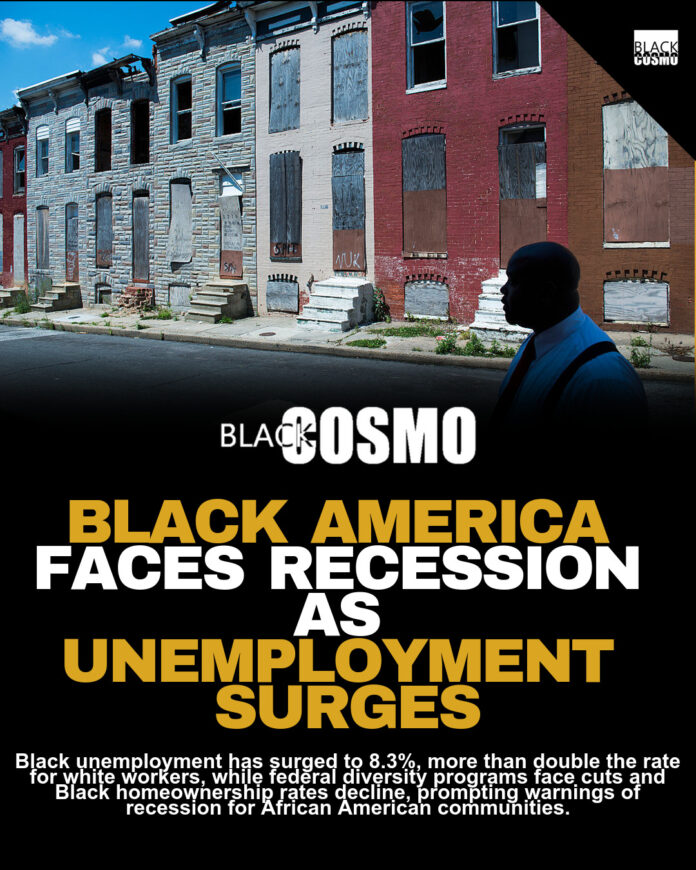
Black unemployment has surged to 8.3% — the highest spike since the Covid-19 pandemic — leaving the jobless rate for Black workers more than double that of white Americans. Pair that with a falling Black homeownership rate and a systematic rollback of DEI initiatives, and the National Urban League’s assessment reads less like commentary and more like a diagnosis: Black America is already in recession.
The data tells a stark story. Black unemployment reached an all-time low of 4.8% in April 2023 during the Biden administration, according to CNN. By November 2025, that progress had evaporated entirely.
Marc H. Morial, president and CEO of the National Urban League, didn’t mince words. He called out the Trump administration’s “deliberate policy choices” that, in his view, systematically dismantled “the very protections meant to advance equity and stabilize communities historically shut out of opportunity.”
The specifics are damning. Federal diversity, equity, and inclusion programs were slashed on Trump’s first day back in the White House in January 2025. Some 327,000 federal jobs were eliminated—not through gradual attrition, but through what the National Urban League characterized as “deliberate cuts that have eroded pathways to the middle class built through generations of civil-rights gains.”
Among those displaced: 700,000 unemployed Black women, a figure that prompted Congresswoman Ayanna Pressley to call the situation “a crisis.”
“The Democratic party, the country, needs to listen to Black women,” Pressley said. “And Black women right now, this is a crisis. The same way Black girls have been criminalized and pushed out of our schools, Black women have been pushed out of the federal workforce because we have been overrepresented in the federal agencies that this so-called Department of Government Efficiency is working actively to dismantle.”
Pressley is calling on the Federal Reserve to investigate the impact and develop strategies to address what she framed as a targeted problem. “If any other group had 700,000 unemployed people, there would be analysis and there would be strategy to resolve it,” she said.
The economic damage extends beyond employment numbers. Black homeownership fell to 43.9% in the first half of 2025—a sharp decline driven by soaring interest rates and the rising unemployment rate, according to Redfin. Years of progress were essentially erased, and the racial wealth gap widened further.
Black-owned businesses are facing their own squeeze. The administration proposed a $204.5 million budget cut to the Community Development Financial Institutions (CDFI) Fund—a roughly 63% reduction—while also targeting the 50-year-old Minority Business Development Agency (MBDA) for dismantling. These programs have long been critical for minority entrepreneurs who face barriers with traditional lenders and lack capital and technical assistance.
The Joint Center for Political and Economic Studies issued a warning that doubles as a call to action. “Instead of aggressive leadership in dismantling structures of racial inequality, we are witnessing regressive leadership that is slashing government employment and agencies designed to address predatory economic practices that disproportionately harm Black communities,” the center said. “The systematic withdrawal of protections, investments, and accountability mechanisms that have historically assisted Black communities from economic shocks combined with a substantive increase in Black unemployment all point to 2025 as a regression and recession for African Americans.”
★TR★