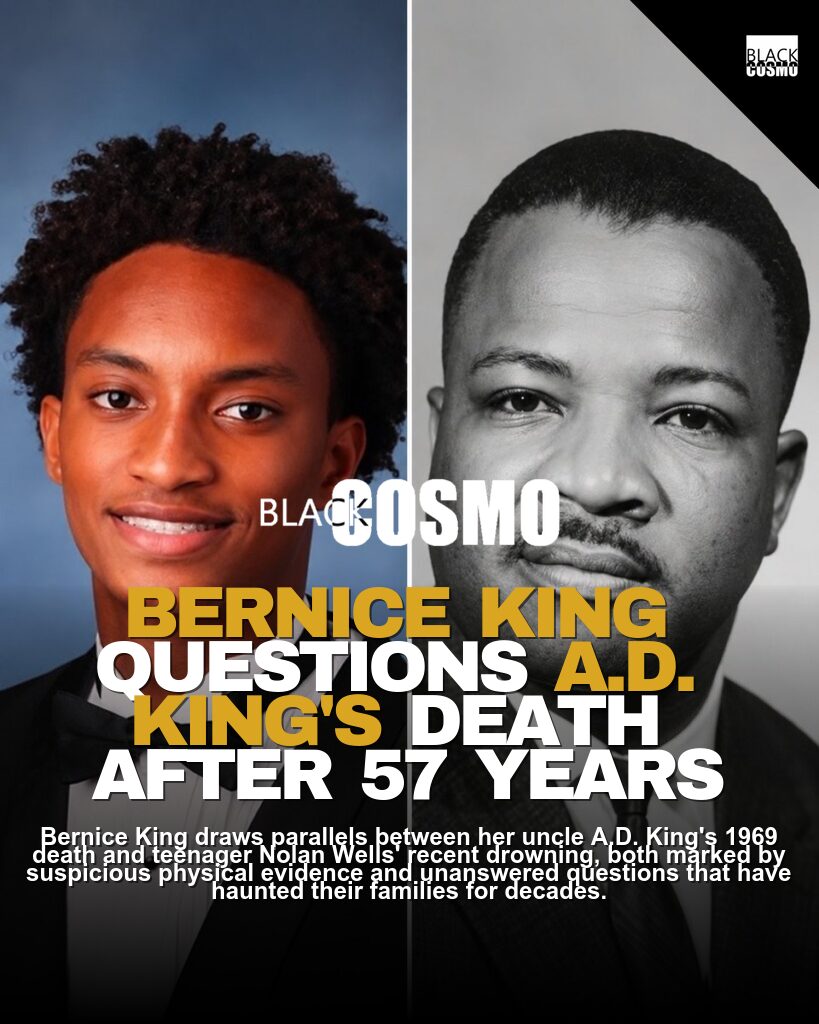
Bernice King sees painful echoes in the death of Nolan Wells. The questions surrounding the teenager’s drowning at Horn Island last July Fourth mirror unanswered details from her uncle’s death more than half a century ago—a family tragedy that still haunts the King legacy.
Her uncle was the Rev. A.D. King, Bernice King‘s and Martin Luther King Jr.’s younger brother. When A.D. was found dead in his swimming pool in July 1969 at age 38, authorities called it an accidental drowning. But the official verdict never convinced his family.
The similarities Bernice King outlined are specific and unsettling. Both men were strong swimmers. Both had head bruising. Neither had water in their lungs. A.D.’s cause of death remained officially undetermined, much like Wells’ case now.
A.D. King was a minister and civil rights activist who graduated from Morehouse College alongside his older brother and participated in Birmingham demonstrations during the movement’s pivotal moments. After Martin’s assassination in 1968, A.D. became pastor of Ebenezer Baptist Church in Atlanta. He was a target because of who he was and what he stood for.
When his body was discovered at his Atlanta home, questions immediately surfaced. His widow, Naomi King, was direct about her suspicions. She told the Seattle Times the physical evidence didn’t align with an accidental drowning: no water in his lungs, bruising on his forehead, marks around his neck, and the position of his body.
“He was murdered,” Naomi concluded decades ago. The family’s voice went largely unheard.
A.D. had lived a life marked by danger. He was arrested during a lunch counter sit-in in 1960. He and his wife survived a bombing at their family home. The target on his back came with the territory of being a King and a minister who refused to stay silent.
Now, more than 50 years later, Bernice King is drawing a connection not to definitively link the two deaths, but to illuminate a troubling pattern. Nolan Wells disappeared during a Fourth of July boat trip with friends. His death was ruled a drowning, yet Mississippi’s grand jury declined to bring indictments. His family, supported by civil rights attorney Ben Crump and Rev. Al Sharpton, continues pushing for transparency and answers.
The national conversation around Wells’ case has centered on how the justice system treats deaths involving Black people and the racial tensions embedded in that system, particularly in the South.
“I pray Nolan’s family receives a thorough, transparent investigation and the answers they deserve,” Bernice King wrote on X. “I pray they do not have to live with decades of unanswered questions as my family has.”
That statement captures the real weight here. A.D. King’s death left his family stuck in limbo—not with a clear answer, but with persistent doubt. It’s a specific kind of pain: the unanswered question that becomes part of your family’s story, passed down, never resolved.
The Wells family finds itself in similar terrain. Even without formal charges, the questions linger. What happened on that island? Why does the physical evidence seem inconsistent with official conclusions? Will there be accountability?
Bernice King’s message isn’t that we should assume foul play in either case. It’s simpler and heavier than that: Black families deserve truth. They deserve investigations that take their concerns seriously. They deserve to not have to wait decades for answers that may never come.
“Grief is already a heavy burden,” King said. “Families deserve truth, and their loved ones deserve to be remembered for the fullness of their lives.”
★TR★