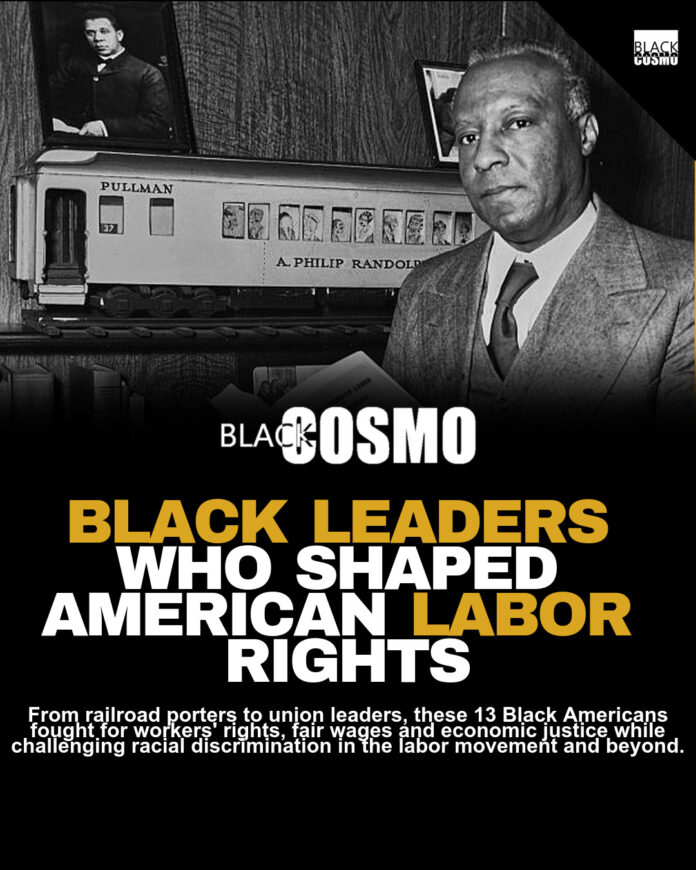
The Black labor movement represents decades of organizing, resistance and vision. These 13 trailblazers pushed unions to confront racism, demanded economic justice alongside civil rights, and built institutions that still matter today.
A. Philip Randolph
Randolph founded the Brotherhood of Sleeping Car Porters, the first major Black-led labor union in America. He didn’t just fight for better wages and working conditions for porters. He weaponized organized labor as a platform for racial equality, pushing the labor movement itself to confront discrimination and using his power to challenge segregation at every level.
Bayard Rustin

Rustin was the strategic mind behind much of the civil rights movement’s organizing, but his commitment to labor was equally deep. He worked closely with unions throughout his career and co-founded the A. Philip Randolph Institute, cementing the link between Black freedom and workers’ rights.
Addie L. Wyatt

Wyatt started as a meatpacking worker and rose to become the first Black woman elected as an international vice president of a major U.S. labor union. She broke through barriers that seemed immovable at the time, proving that Black women belonged at every level of union leadership.
William “Bill” Lucy
As secretary-treasurer of AFSCME and co-founder of the Coalition of Black Trade Unionists, Lucy spent decades pushing organized labor to address racial inequality as seriously as it addressed wages and benefits. He made it impossible for unions to claim they supported racial justice while remaining segregated or indifferent to the specific struggles of Black workers.
E.D. Nixon
Nixon worked as a Pullman porter and organized within the Brotherhood of Sleeping Car Porters in Montgomery, Alabama. When Rosa Parks was arrested in 1955, Nixon didn’t hesitate. He posted her bail and helped launch the Montgomery Bus Boycott, showing how labor organizing and civil rights resistance were inseparable in practice.
Dorothy Lee Bolden
Domestic work was invisible labor, unregulated and exploitative. Bolden spent years doing that work before founding the National Domestic Workers Union of America in 1963. She fought for the workers nobody else was organizing, demanding that Black women who cleaned homes and raised other people’s children receive legal protections and fair wages.
Coleman A. Young
Before he became Detroit’s first Black mayor, Young was a labor organizer with the UAW. He fought racial discrimination inside factories and pushed the union to do more than talk about solidarity. His commitment to workplace justice shaped his entire career in public office.
Paul Robeson

Robeson used his immense talent and platform to champion workers and organized labor. He regularly performed at labor rallies, stood with striking workers and spoke openly about the connections between racial oppression and economic exploitation. His willingness to risk his career for these beliefs made him a bridge between the Black freedom struggle and the labor movement.
Martin Luther King Jr.

By the end of his life, King had moved beyond voting rights to embrace economic justice as inseparable from racial liberation. His Poor People’s Campaign and his support for striking sanitation workers in Memphis revealed how deeply he understood that racial equality meant nothing without economic opportunity and dignity at work.
Claudia Jones
Jones connected racism, capitalism and workers’ struggles in ways that were decades ahead of her time. The U.S. deported her for her politics, but she continued her work from Britain, organizing Black workers and arguing that Black liberation required economic liberation. She later invented the Notting Hill Carnival, transforming Caribbean culture into a permanent fixture of London’s identity.
Hubert Harrison
Harrison was a Black socialist, orator and organizer who helped shape the early 20th-century labor movement. Known as the “Black Socrates,” he articulated the radical vision that racial equality could only be achieved through economic transformation and workers’ power.
James Forman
Forman pushed SNCC to think seriously about economic inequality alongside voting rights. After his work with the civil rights movement, he turned toward militant labor organizing in Detroit, joining forces with the League of Revolutionary Black Workers. He understood that the next phase of Black liberation had to center on workplace power.
Fannie Lou Hamer
Hamer’s activism in Mississippi fought for voting rights, but she knew that political power without economic independence was incomplete. She advocated for Black farmers and workers to access land and jobs as part of the broader freedom struggle. Black labor movement history includes her vision that real freedom required both the right to vote and the right to economic dignity.
★TR★