
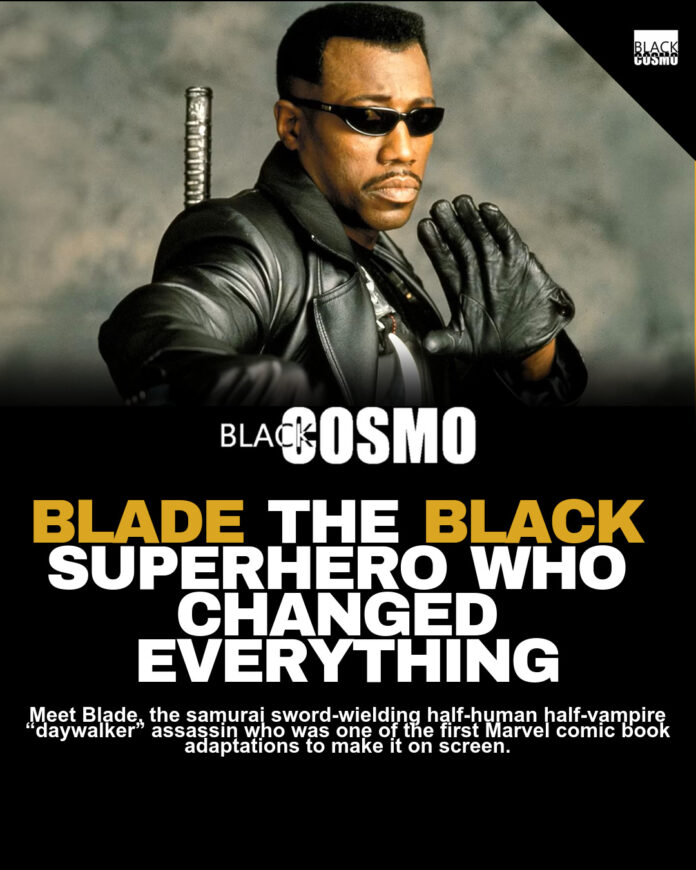
Blade is one of those films that changed the game before anyone was ready to admit it. The samurai sword-wielding, half-human, half-vampire “daywalker” assassin gave us something Hollywood had never delivered: a Black superhero at the center of a dark, stylish, high-stakes world — and he made it look effortless. Wesley Snipes embodied the role with such intensity that nearly 30 years later, the character still stands alone. You can draw a straight line from Blade to Black Panther, Luke Cage, Black Lightning, and every Marvel adaptation that followed. This is where it started.
Blade holds a stack of firsts. First Black movie superhero on the big screen. First film to incorporate an interactive website puzzle as part of its storytelling. And one of the earliest mainstream portrayals of the underground 90s American rave scene — a culture that eventually evolved into the festival circuits and EDM events that took over what we used to just call clubbing. That opening blood rave alone cemented Blade as a cultural artifact.
The Backstory
Blade’s mother (Sanaa Lathan) was bitten by a vampire just before giving birth. That bite triggered a genetic anomaly in her son — he inherited all of the vampire’s strength, but kept his humanity. He can walk in daylight. He uses that power to hunt vampires, driven by guilt over what he is and what he might become. But the gift comes with a price: a relentless bloodlust he can only suppress with regular doses of a specially formulated serum.
As a Black man, Blade started life on the margins. As a Black human-vampire hybrid, he’s doubly displaced — belonging fully to neither the human world nor the vampire one. His hybridity is his power and his burden. His nemesis, Deacon Frost (Stephen Dorff), is similarly an outsider — bitten rather than born vampire, he’s constantly pushing to prove his worth to the Vampire Council, led by Gitano Dragonetti (Udo Kier). Frost is obsessed with cracking an ancient vampire scripture to unlock a ritual — La Magra — that would trigger a human apocalypse and usher in total vampire dominance.
The two storylines collide as Frost races to complete the ritual while Blade works alongside hematologist Karen Jensen (N’Bushe Wright) to find a cure for the vampire disease. In a twist soaked in biblical metaphor, Blade discovers he is the prophesied chosen one — his blood the very key needed to unleash La Magra’s full power through Frost as its vessel. A Black vampire messiah. The irony runs deep.
Why It Still Matters
In 1998, seeing a sci-fi horror film with a cast this rich in Black and brown talent was genuinely rare. It still is. A 2017 UCLA Annenberg study found that 70% of speaking roles in Hollywood films went to white actors. Even by today’s standards, Blade is an outlier for representation and diversity — which says a lot about how little the industry has moved in over two decades.
But Blade goes deeper than casting. The allegory of a man caught between two worlds — human and vampire, Black and hybrid, insider and permanent outsider — gives the film layers that don’t fade. Scholar Frances Gateward, writing in “Daywalkin’ Night Stalkin’ Bloodsuckas: Black Vampires in Contemporary Film,” reads Blade as a critique on miscegenation, equating Frost’s hunger for domination and genocide with a white supremacist logic, even as the vampires themselves are a diverse group. The symbolism holds up.
Blade and Identity
For writer Sezín Devi Koehler — multiracial Sri Lankan/Lithuanian American, author, and cultural critic — Blade was one of the first times she saw someone like herself reflected on screen. Raised across Asia and Africa, mixed in multiple directions, she recognized Blade’s perpetual “otherness” immediately. Monsters as metaphors resonated. By the end of the film, Blade stops trying to force himself into one category and accepts the full complexity of who he is. That arc hits differently when you’ve lived it.
Long Live the Legend
What’s remarkable is how well Blade holds up — not just emotionally, but visually. The blood rave still delivers. The fight choreography is clean and cinematic. The high-speed chases and comic-book camera work look crisper in HD than they had any right to. Blade was built for today: today’s politics, today’s screens, today’s audiences who are finally being given space to see themselves in genre film.
In another 20 years, this film will still be socially and culturally relevant. The hope is that by then, Hollywood will have finally caught up to what Blade figured out in 1998.
Stream Blade on Netflix.


