
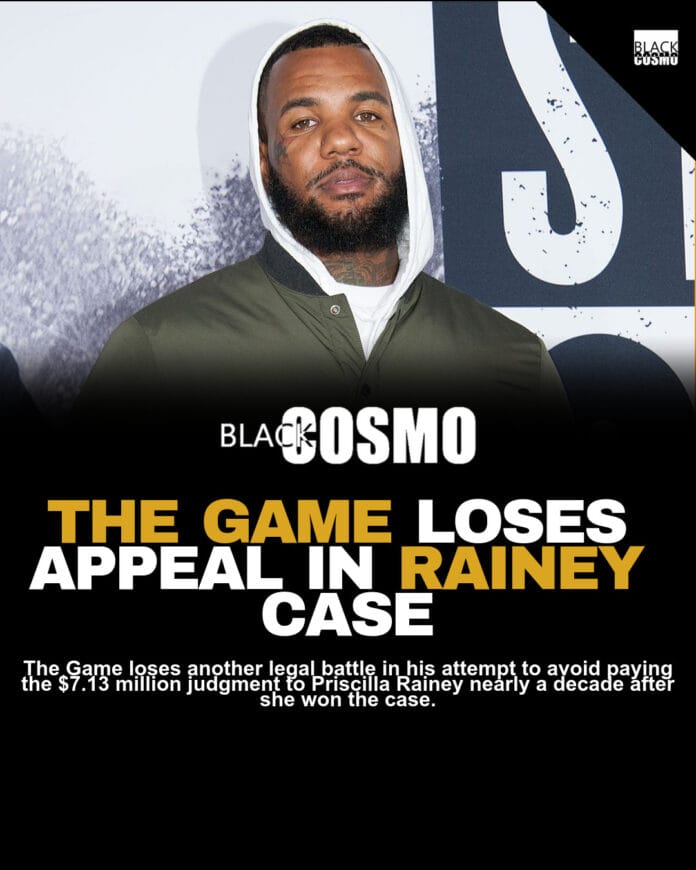
Nearly a decade after Priscilla Rainey won a multimillion-dollar judgment against The Game, her efforts to collect it are still moving forward. This case has become a significant example of mass incarceration accountability in the entertainment industry, touching on broader issues of justice and responsibility.
A California appeals court has ruled against the rapper in his latest challenge, preserving a 2023 enforcement judgment connected to the $7.13 million award Rainey won in court. The mass incarceration system’s complexities extend beyond criminal cases, and this ruling shows how civil judgments can hold powerful figures accountable.
The Game, whose real name is Jayceon Terrell Taylor, argued that he did not receive proper legal notice of Rainey’s 2021 collection lawsuit. His lawyers questioned the mailed documents and the decision to publish a summons after repeated attempts to serve him in person.
Judges were not persuaded. “Summons are not designed to place defendant on notice of the legal theories supporting the action,” the court wrote, adding that their purpose is to provide notice of the case and a deadline to respond.
The court also ordered The Game to cover Rainey’s appeal costs.
Rainey first sued Taylor in 2015 after appearing on his VH1 dating series She’s Got Game. She accused him of sexual battery during production, allegations he denied. Her story reflects the experiences shared by many women navigating power imbalances in entertainment spaces.
A federal jury later found the rapper liable and awarded Rainey $1.13 million in compensatory damages plus $6 million in punitive damages. This verdict represented validation of her claims and a form of justice rarely seen in these circumstances.
Her collection efforts have since reached Game’s property, business interests and “The Game” trademark—which he’s not happy about. In the past, he has claimed that all of his assets were in his manager, Wack 100’s name. The ongoing battle over asset collection remains a reminder of how wealthy individuals sometimes attempt to shield their wealth from court-ordered judgments.
★m★