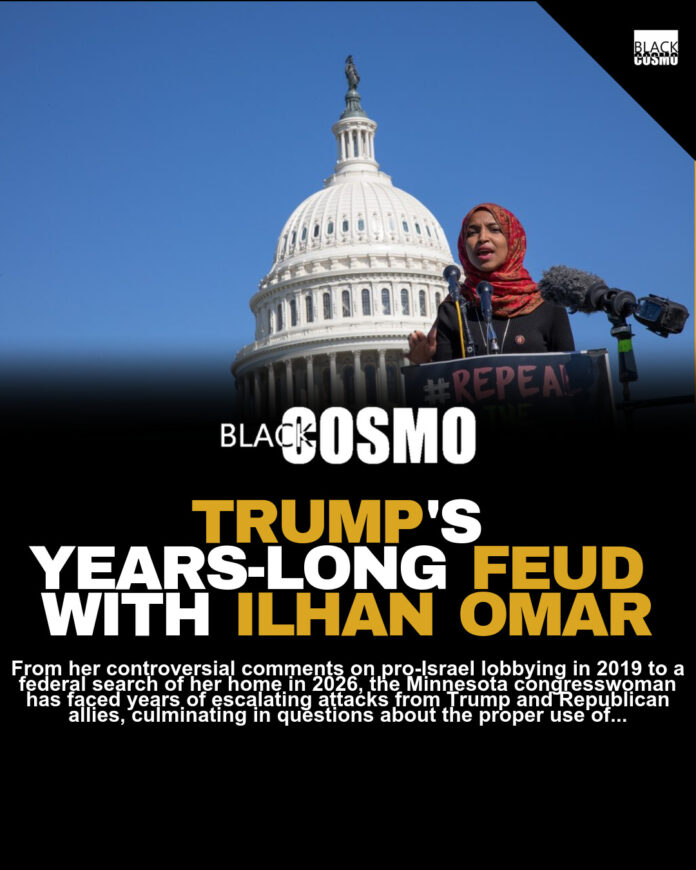
Born in Somalia, shaped by the refugee experience, and unapologetic about who she is, Omar has made one thing clear: she will always answer her critics and defend her record. The Ilhan Omar saga spans years of controversy, federal investigations, physical attacks and political weaponization. To understand where we are now, you have to start at the beginning.
February 2019: Omar Becomes a Republican Target
Ilhan Omar had barely settled into Congress before a controversy over her comments on pro-Israel lobbying made her a Republican talking point. Omar apologized for her words, but the backlash kept growing. Trump and GOP lawmakers seized the moment, setting the stage for a feud that would stretch across his first presidency and beyond.
The dispute became a preview of a familiar pattern: Omar’s words sparked controversy, while Trump turned that controversy into political ammunition.
July 2019: Trump Tells Congresswomen to “Go Back”
That same year, Trump targeted Omar and three other progressive Democratic congresswomen, telling them to go back to the countries they came from. Three of the four were born in the United States, while Omar was born in Somalia and became a U.S. citizen in 2000. As Trump turned a criticism of his political opponents into a question of who belongs in America, critics condemned his social media posts as racist.
At a 2019 rally in Greenville, North Carolina, Trump attacked Omar as the crowd erupted into chants of “Send her back!” The scene became a defining moment in the feud, showing how his attacks on Omar’s background could resonate with supporters.
July 2019: The House Calls Out Trump
The House voted to condemn Trump’s remarks targeting the four congresswomen as racist. The president later said he was unhappy with the “Send her back” chant, but the controversy had already become a national flashpoint. For Omar, the episode underscored the stakes of being a Muslim, Somali-born congresswoman at the center of a political movement increasingly defined by fights over immigration and national identity.
August 2019: Israel Blocks Omar’s Visit

By August 2019, Israel had barred Omar and fellow congresswoman Rashida Tlaib from entering the country, citing their support for the Boycott, Divestment and Sanctions movement. Trump publicly supported the decision. The episode added another chapter to the battle over Omar’s views on Israel, with critics accusing her of unfairly targeting the country and supporters defending her right to challenge its government and U.S. policy.
September 2019: Trump Amplifies the 9/11 Controversy

Trump amplified attacks on Omar over her remarks about September 11, 2001, helping push the controversy back into the national spotlight. Omar said the president’s rhetoric was putting her safety at risk. The episode came after months of hostile attention directed at her Muslim identity and Somali background, intensifying concerns about threats against a sitting member of Congress.
2020: Omar Remains a Republican Campaign Target
As Trump campaigned for reelection in 2020, Omar remained a convenient symbol in Republican attacks on progressive Democrats. Her positions on immigration, policing, health care and foreign policy made her a frequent target. The political fight was no longer limited to individual remarks: Omar had become a national figure in the broader battle over what the Democratic Party stood for and what Trump wanted voters to fear about it.
2021-2022: The Feud Outlasts Trump’s First Term

Trump left the White House in 2021, but the political conflict surrounding Omar didn’t disappear. Republican lawmakers continued criticizing her comments on Israel and foreign policy, while Omar challenged what she saw as selective outrage. It reflected a wider partisan battle over progressive lawmakers, with Omar repeatedly placed at the center of arguments about patriotism, immigration and the boundaries of acceptable political speech.
January 2023: Republicans Give Omar the Boot

House Republicans voted to remove Omar from the Foreign Affairs Committee, citing her past comments about Israel. Omar rejected the effort and argued that Republicans were applying a political double standard. The vote gave the long-running feud a concrete consequence inside Congress: with the GOP controlling the House, criticism of Omar became a fight over who would have a seat at the table.
2024: Trump Brings Omar Back Into the Immigration Fight
During his 2024 campaign, Trump continued using Omar as a symbol in his attacks on immigration and progressive Democrats. His rhetoric about Somali immigrants drew criticism from Democrats, who warned against turning one lawmaker into a target for an entire community. Trump and his allies framed their criticism around immigration policy and Omar’s public positions, keeping her firmly in the campaign crosshairs.
2025: Trump Returns, and the Stakes Change
Trump’s return to the White House brought a renewed focus on immigration enforcement and Somali communities in Minnesota. Omar continued to criticize the administration’s policies, while officials raised questions about her immigration history and paperwork. The allegations introduced a new dimension to the feud: the administration was no longer simply attacking Omar from the campaign trail but operating with the powers of the federal government.
December 2025: Trump Comes for Minnesota’s Somali Community
Trump’s attacks didn’t stop with Ilhan Omar. He turned his fire on Minnesota’s Somali community, using dehumanizing language, demanding immigrants be sent “back” and linking Somalis to allegations of fraud. The rhetoric landed as federal immigration enforcement ramped up in the Twin Cities, leaving Somali families and business owners fearful of raids, detentions and being profiled by federal law enforcement. Most Somali Minnesotans are U.S. citizens, and allegations against individuals are no excuse to smear an entire community.
December 2025: ICE Stops Omar’s Son and Demands Proof He’s American
Even Ilhan Omar’s son wasn’t spared from the Trump administration’s immigration crackdown. Omar said ICE agents pulled him over after a stop at Target and asked him to prove his citizenship. He showed his passport and was released. ICE’s acting director denied the agency had any record of the stop. Omar called out racial profiling as federal agents zeroed in on Minnesota’s Somali community.
In a letter to the Department of Homeland Security, Omar wrote, “It is clear to me that this surge came in direct response to Trump’s racist comments about Somali people, and about me in particular.”
January 27, 2026: Someone Sprays Omar, Trump Chimes In
Omar was calling for Homeland Security Secretary Kristi Noem to resign or face impeachment when a man rushed the podium and sprayed her with a mysterious liquid during a town hall. She refused to let the attack end her event, telling the crowd, “We will continue.” Trump’s response? He called Omar a “fraud” and suggested she had arranged the attack herself. Omar, meanwhile, made clear that intimidation wasn’t going to stop her.
October 2026: Federal Agents Search Omar’s Home

Federal agents searched Omar’s Washington, D.C., residence under a judicially authorized warrant as part of a criminal investigation reportedly connected to immigration paperwork. Omar called the action an abuse of power and the latest escalation in Trump’s campaign against her. A search warrant is not proof of criminal wrongdoing, but the episode immediately raised questions about the investigation’s scope, timing and political fallout.
October 13, 2026: Trump Turns Up the Heat Again
Following the search, Trump attacked Omar at a rally in Ohio, criticizing Somalia and linking Omar to his broader claims about Minnesota. A crowd chanted “Deport.” Omar said the government was being weaponized against her, while the administration maintained that the investigation concerned alleged wrongdoing. After years of public attacks, the confrontation had reached a moment where political rhetoric and federal investigative power collided.
October 2026: The Feud Leaves More Questions Than Answers

A watchdog complaint asked federal authorities to investigate whether the timing of the search violated the Hatch Act, which limits certain political activities by executive-branch employees. The complaint was an allegation, not a finding of a violation.
After years of Trump and GOP attacks, Omar’s case now raises a bigger question: where does political combat end, and the proper use of government power begin?
★TR★