Pastor Jamal Bryant delivered a pointed sermon about Black people renouncing their Greek organization ties while staying silent on Trump’s policies. The Atlanta pastor’s words struck a nerve online, sparking a debate that reveals deeper tensions within Black communities about accountability, institutional loyalty, and political engagement.
Bryant didn’t hold back. While acknowledging that anyone has the right to leave their fraternity or sorority, he questioned the selective morality at play. How, he asked, could people renounce the Divine Nine—Alpha Phi Alpha, Alpha Kappa Alpha, Delta Sigma Theta, Kappa Alpha Psi, Omega Psi Phi, Phi Beta Sigma, Iota Phi Theta, Zeta Phi Beta, and Sigma Gamma Rho—without finding “enough Holy Ghost conviction or discernment” to denounce Trump’s harmful policies? Pastor Jamal Bryant framed the contradiction plainly: “You watch people pledge allegiance to him, and none of you tap-dancing Negroes denounced that!”
The sermon itself presented a more nuanced position than the viral snippets might suggest. Bryant was explicit about his opposition to hazing, physical abuse, and the emotional or spiritual damage that sometimes accompanies pledging. That criticism stands. But he then pivoted to the decades of community work these organizations have produced: cancer research funding, Black business development, youth mentorship, and on.
His central argument crystallized in this question: How do people have such vigor for criticizing the organizations fighting for change while remaining quiet about the systems that necessitate that fight in the first place? “Be careful of Black people who use their platforms to demean the DNA of those who fought for your liberation and fought against oppression,” he said.
To underscore his point, Bryant invoked the Greek affiliations of civil rights icons—Dr. Martin Luther King Jr., Shirley Chisholm, John Lewis, Maya Angelou, Zora Neale Hurston, Rosa Parks. He suggested that none were under “demonic spells” but were instead channeled by God to “fight the demon of white supremacy.”
The internet split immediately.
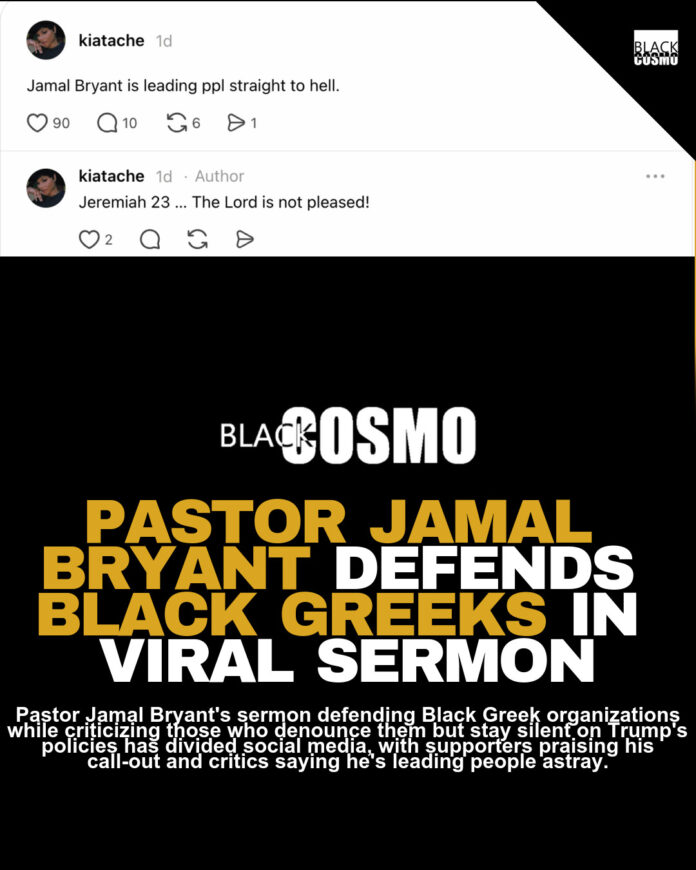
Critics didn’t hold back. “Jamal Bryant is leading ppl straight to hell,” one Threads user wrote. Another invoked scripture: “Jamal Bryant is in error and leading his entire congregation astray. I pray he repents and begins teaching the truth of God’s Word instead of speaking things that lead people away from sound doctrine. ‘Woe be unto the pastors that destroy and scatter the sheep of my pasture!’ — Jeremiah 23:1.”
On TikTok, the skepticism sharpened. “He rebukes President Trump—but a lifelong fraternity member, he won’t rebuke that wickedness!” one user shot back. Another added, “Someone really needs to sit him down! But all those in his congregation that he is leading away from Jesus, that blood is on his hands.”
Defenders, meanwhile, saw something different in his message.
“Not a Jamal Bryant fan, but everything he said in this sermon is 100% accurate,” one Threads commenter wrote. “The Divine 9 are a target for racists because of the service gaps we’ve filled within our communities that should be managed by our government with our tax dollars. We became a bigger target because of our ability to organize for our political interests, so they use false Christian teachings wrapped in white supremacy to convince Black folk that the orgs that have been so vital to Black survival are evil.”
Another defended Bryant’s core point: “Regardless of how you may feel about Black fraternities and sororities, it speaks volumes when some people renounce their membership but are silent about the evils that this administration is doing to Black people, people of color, and other marginalized groups. Bravo to Pastor Jamal Bryant for pointing this out and making it plain. Good on him for calling out Black preachers who embrace white Christian nationalism.”
What emerged wasn’t a simple disagreement. The fracture runs deeper—between different visions of where Black critique should be directed, which institutions deserve scrutiny, and what real accountability looks like in a moment when Black political power feels increasingly fragmented.
★TR★