
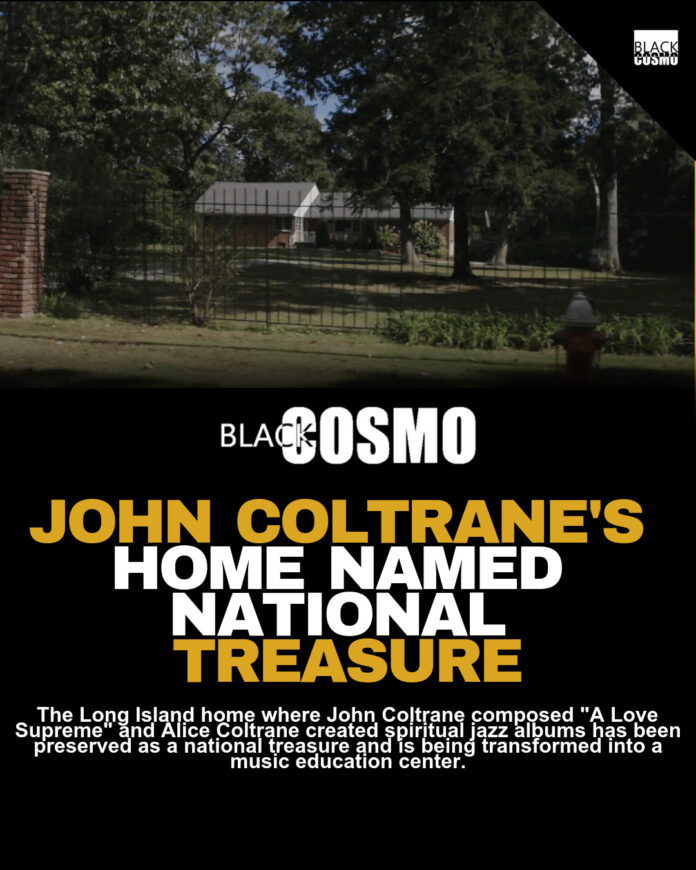
Just weeks after what would have been John Coltrane‘s 100th birthday, The Root took a closer look at the sacred space where magic first sparked and where it still transcends six decades later.
Imagine walking into a quiet Long Island home and knowing two legends reshaped music inside its walls. That’s the sanctuary where Coltrane composed “A Love Supreme”—one of the greatest masterpieces in jazz history—and where Alice created spiritual jazz albums that changed the course of music forever. On a 3.4-acre property at 247 Candlewood Path in Dix Hills, John Coltrane and his wife built something far more valuable than real estate. They built a sanctuary.
Two Legends. One Roof.
The Coltranes lived at this 1952 ranch-style home from 1964 to 1973, finding refuge 30 miles east of Manhattan during one of the most prolific periods in jazz history.
“A Love Supreme” (1965)

In summer 1964, John Coltrane retreated to the second-floor bedroom where he would spend days in isolation. Alice later recalled how he was “pondering the music he heard within himself.” What emerged from that solitary creative process became one of music’s most enduring works—the four-part devotional suite that would transform jazz into something spiritual and universal.
From a Long Island Bedroom to the World

When Coltrane finally descended the stairs, Alice said he looked like “Moses coming down from the mountain.” But instead of carrying stone tablets, he held the drafts for “A Love Supreme”—a work that would redefine what jazz could be. The album was recorded in a single session that December in Englewood Cliffs, New Jersey, and later nominated for a Grammy. Today it remains widely considered the greatest jazz album ever made.
Alice’s Haven

After John’s death from liver cancer in 1967, Alice didn’t abandon the home. She transformed the basement into a state-of-the-art recording studio—complete with original acoustic tiling and mid-century wood paneling. There, she processed grief and motherhood into her own revolutionary spiritual jazz albums. Records like “A Monastic Trio” (1968) and “Ptah, the El Daoud” (1970) were born in that basement, each one a testament to her spiritual journey and artistic vision.
Rescue from Demolition

By the early 2000s, the home sat vacant and vulnerable. A developer acquired the property in 2002 with plans to demolish it, subdivide the land, and build new homes. But in 2004, Steve Fulgoni, an engineer and music store owner, stepped in. He picked up a newspaper dated July 17—the anniversary of John’s death—and decided something had to be done. Fulgoni founded the Friends of the John & Alice Coltrane Home and launched an international campaign to save it.
National Recognition

Fueled by passionate volunteer support, the home was preserved and designated as a local, state, and national historic site. In 2018, it was named a National Treasure by the National Trust for Historic Preservation—recognition that had previously eluded it despite its immense cultural significance.
A Living Legacy

The Town of Huntington purchased the property and transferred stewardship to the Friends of the Coltrane Home. As of 2024, renovations are underway to transform the site into a cultural center and educational hub. The plans include recording studios, performance spaces, and meditation rooms—all designed to honor the Coltranes’ contributions to music, spirituality, and social change.
On September 23, 2026, the world commemorated what would have been John Coltrane’s 100th birthday through Coltrane 100, a year-long global celebration. That same year, the home opened its doors to inspire generations of dreamers and musicians. What once nearly vanished is now preserved as sacred ground—a place where two artists created works that continue to move the human spirit.
★TR★