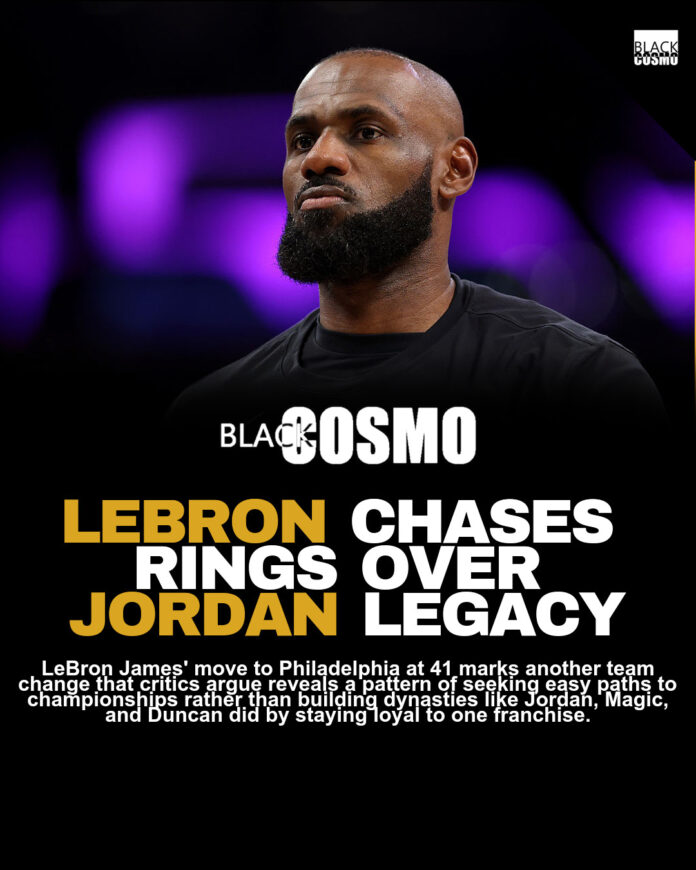
LeBron James is heading to Philadelphia to chase one more championship alongside Jaylen Brown and Joel Embiid. But while the move signals his refusal to accept decline, it also crystallizes a career-long pattern that fundamentally separates him from the all-time greats. Michael Jordan built his legacy by staying in Chicago through adversity. LeBron has built his by finding the next contender. And when you trace his entire career through that same lens, the GOAT debate stops being close.
For decades, NBA greatness meant something specific: staying with your team, surviving the losing seasons, and ultimately transforming the franchise that drafted you. That’s the weight carried by Jordan, Magic, Bird, Duncan, and Curry. They didn’t just win championships. They built legacies that couldn’t have existed anywhere else.
LeBron James chose a different path. When Cleveland couldn’t reach the Finals, he left for Miami to pair with Dwyane Wade and Chris Bosh. When Miami’s window closed, he returned to Cleveland to team with Kyrie Irving and Kevin Love. When that failed, Los Angeles called. Now, at 41, he’s made the exact same calculation one final time.
Some will point out that he’s been doing this for years. That’s precisely the problem. Each era came with a convenient narrative. Miami came before his first ring. Cleveland was a homecoming. Los Angeles could pass as a business decision. But Philadelphia strips away every remaining excuse.
At the end of his career, with nothing left to prove except his legacy, LeBron chose the same shortcut. When every chapter ends identically, it stops looking like circumstance. It starts looking like choice.
Yes, Cleveland’s front office failed him early. Nobody disputes that. But GOAT conversations aren’t really about general managers. They’re about what players do when adversity arrives.
If you constantly change teams because someone else built a better roster, you’re not proving you’re the greatest. You’re proving you’re exceptional at finding the easiest path to a championship. That’s a skill. Just not the one that defines all-time greatness.
Jordan stayed in Chicago. Magic stayed in Los Angeles. Bird never left Boston. Duncan built his entire legacy in San Antonio. When Curry blew a 3-1 lead in the Finals, he didn’t look for an exit. He took his lumps and figured out how to win anyway.
LeBron asked a different question: Why build something difficult when you can join something already built?
That’s a valid philosophy. It’s just not one that makes you the greatest player ever to touch a basketball.
★TR★