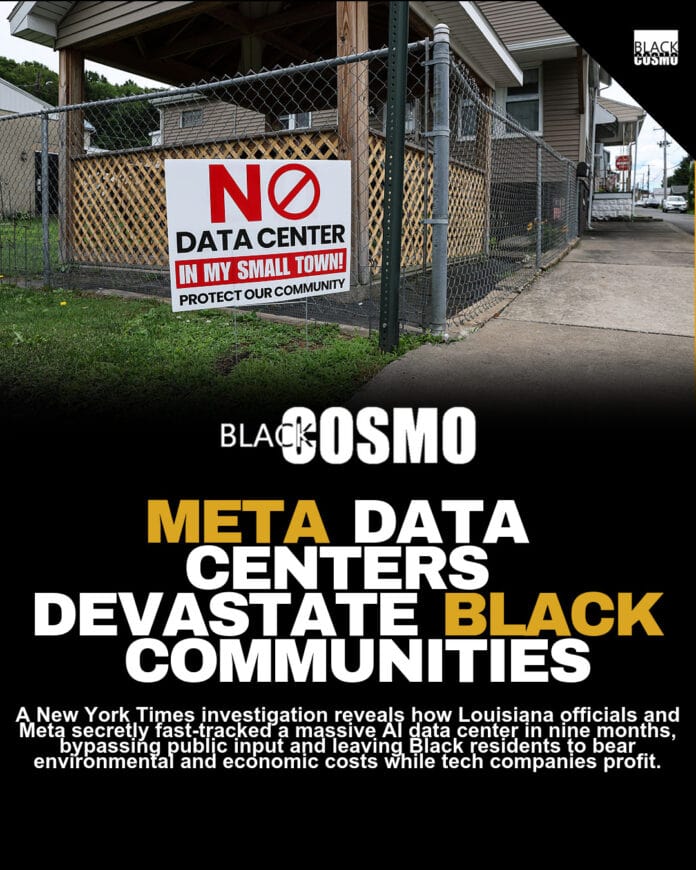
Nine months. That’s all it took for Louisiana Gov. Jeff Landry, Meta executives, Entergy Corporation, and local officials to quietly orchestrate one of the largest AI data centers on the planet.
Now the secret’s out. A bombshell New York Times investigation just exposed what really happened behind closed doors to fast-track a project that local Black residents will shoulder the burden for in ways both visible and invisible. The Times combed through corporate filings, tax records, land deeds, and meeting transcripts, interviewing dozens of residents across New Orleans, Silicon Valley, Baton Rouge, and Richland Parish. What emerged was a pattern of corporate leverage and public betrayal. The project sailed through without any public meetings and without an independent administrative judge confirming whether it actually served the public’s interest.
It’s a familiar story in the American South. Longtime Black residents either get forced out or stuck dealing with pollution—air, noise, water depletion—while Silicon Valley pockets the profits.
“Black communities face the highest impact from AI and data centers because they’re already disproportionately impacted by climate change, which is driven by CO2 emitted in part by the energy production involved in running data centers,” according to the Climate Justice Alliance.
The energy demands these facilities require could spike utility prices in areas where Black households already struggle to pay bills. The NAACP has launched a nationwide campaign to “stop dirty data centers” in response to the mounting damage.
“As data centers expand, communities across the nation face new environmental and climate justice challenges including water contamination and depletion, air pollution, excessive energy use, quality of life concerns, and inequitable siting of the development,” the NAACP said.
The organization has called for pausing new and expanding AI centers “until communities have start-to-end transparency regarding projects, environmental health monitoring for air, water, and soil, and comprehensive oversight measures in place.” These backroom deals aren’t confined to Louisiana.
In Southwest Memphis, the Memphis Community Against Pollution is fighting back against Elon Musk’s plan to build the world’s largest supercomputer on Paul Lowry Road. Blindsided by city officials, MCAP, Protect Our Aquifer, and Young Gifted & Green launched a joint petition demanding transparency and exposing the environmental racism and health risks threatening Black families in the historic community.
“This approval is a disheartening failure for the Shelby County Health Department and is showing a blatant disregard for our health and environment while avoiding the enforcement of air quality legislation,” the organization said.
The fallout from the AI center boom cuts deeper than environmental damage. It directly threatens Black families’ livelihoods. According to the Climate Justice Alliance, AI automation threatens to eliminate food service and hospitality jobs—industries where Black workers are disproportionately represented—widening the existing wealth gap.
Health standards and job security vanish with little accountability.
Artificial intelligence doesn’t exist in abstraction. It lives next door in massive buildings the size of city blocks. Unlike traditional web servers, data centers pack thousands of supercomputers running around the clock, consuming vast amounts of electricity. The heat generated requires millions of gallons of water and constant power just to prevent equipment failure.
“Large data centers can consume up to 5 million gallons per day, equivalent to the water use of a town populated by 10,000 to 50,000 people,” according to the Environmental and Energy Study Institute. Those numbers explain why Meta and state officials kept Louisiana’s AI data center plans under wraps. The community didn’t learn about it until everything was finalized, the Times reported.

Non-disclosure agreements between Meta, Entergy, and government representatives kept even voting lawmakers completely in the dark about what they were approving. Meta’s secret deal triggered a cascade. Just months later, in February, Amazon announced a staggering $12 billion data center expansion in northwest Louisiana, following the same playbook.
★TR★