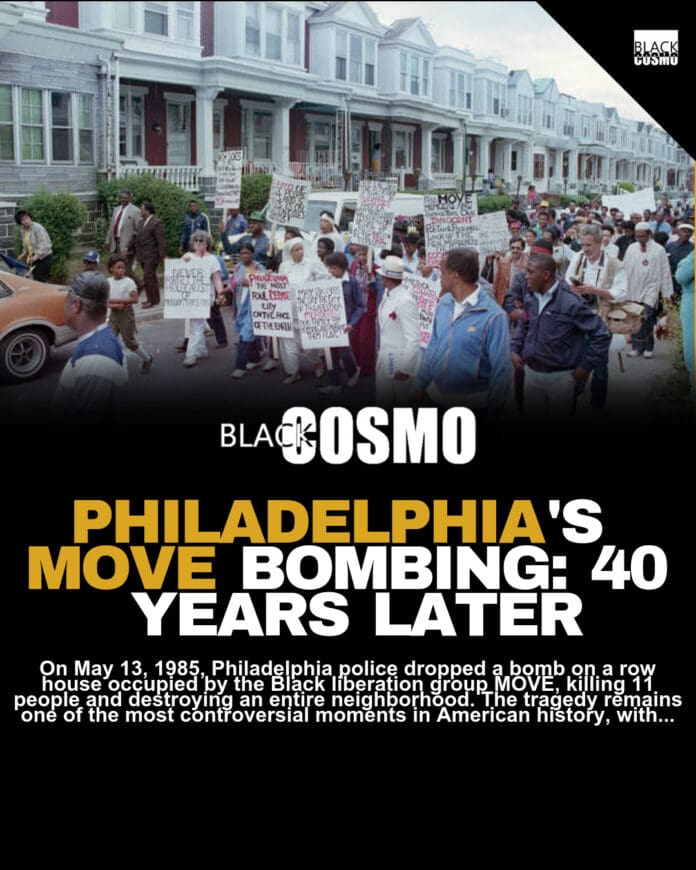
Philadelphia became the first—and only—American city to drop a bomb on its own residents. The target was MOVE, a Black liberation organization that had spent years clashing with city officials. What followed would become one of the most devastating and controversial chapters in modern American history.
As America reflects on 250 years of its history, the tragic MOVE bombing of 1985 stands as a painful reminder that some of the nation’s darkest chapters aren’t buried in the distant past. We’ve gathered 13 facts that trace the events of that day, the lives forever changed by it, and the legacy that continues to shape the discussion more than four decades later.
What Was MOVE?
MOVE was a Black liberation organization founded in Philadelphia in 1972 by John Africa, born Vincent Leaphart. The group advocated for Black liberation, environmentalism, animal rights and a back-to-nature lifestyle. They were deeply committed revolutionaries, largely associated with the Black Power movement.
Why Was MOVE So Controversial?
MOVE’s outspoken advocacy for Black liberation and its rejection of many modern societal norms often put the group at odds with West Philadelphia neighbors and law enforcement. Their anti-technology philosophy, confrontational activism and years of clashes with city officials fueled escalating tensions that ultimately culminated in the 1985 bombing of the organization’s West Philadelphia headquarters.
The Decision Makers Behind the Tragedy

The bombing happened on May 13, 1985, during President Ronald Reagan’s second term in office and while W. Wilson Goode served as Philadelphia’s first Black mayor. Goode later acknowledged the decision to use an explosive was one of the greatest regrets of his administration.
The Day Everything Changed
On the morning of May 13, hundreds of police officers surrounded MOVE’s row house at 6221 Osage Ave. in West Philadelphia to serve arrest warrants and evict members after negotiations broke down. What began as a standoff would soon become one of the darkest days in the city’s history.
The Bombing That Shocked the City

After a lengthy exchange of gunfire during a violent standoff, Philadelphia police dropped a military-grade explosive from a helicopter onto MOVE’s row house. City officials then allowed the resulting fire to burn, believing it would destroy the home’s fortified bunker and force those inside to surrender.
A Neighborhood Engulfed in Flames
The fire quickly spread beyond the MOVE house, consuming dozens of nearby homes despite desperate pleas from residents and firefighters. By the time the flames were extinguished, 65 homes had been destroyed and an entire city block had been reduced to rubble.
The Lives Lost
Eleven people were killed in the fire, including MOVE founder John Africa and five children reportedly ranging in age from 7 to 13. Only two people inside the house escaped alive: Ramona Africa and 13-year-old Birdie Africa, whose legal name was Michael Moses Ward.
Families Were Left With Nothing

The bombing displaced more than 250 residents who had nothing to do with MOVE, many losing homes, treasured belongings and generations of family history overnight. For neighbors, the tragedy became a painful reminder that entire communities often bear the cost of government decisions.
The Fight for Accountability

In the months that followed, a special investigative commission concluded the city’s decision to drop the bomb and allow the fire to burn was “unconscionable.” Despite the criticism, no city officials or police officers were criminally charged for the deaths.
The Survivor Who Refused to Be Silent
Survivor Ramona Africa, one of the two people who escaped the fire, has spent decades speaking about the tragedy and demanding accountability. “I don’t care what they said, there was no justification for what they did,” she told Vice. “I never imagined that the government would drop a bomb on a row house in Philadelphia. I was there when police dropped a bomb on me and my family on May 13, 1985, and killed 11 of my family members.”
A Long-Overdue Apology Comes 35 Years Later

Thirty-five years after the MOVE bombing, former Philadelphia Mayor W. Wilson Goode publicly apologized for the city’s role in the tragedy. “The decision to drop explosives on a house filled with people was indefensible,” Goode stated, acknowledging that the event would remain on his conscience for the rest of his life.
“Today I would like to apologize again and extend that apology to all who experienced, and in many cases continue to experience, pain and distress from the government actions that day,” he added.
Why the MOVE Bombing Still Matters Today

More than 40 years later, the MOVE bombing remains a painful reminder of how race, power and government accountability continue to shape conversations in America. As the nation reflects on 250 years of its history, the tragedy challenges us to confront the parts of the past that still echo today—from racial injustice to the ongoing fight for equal treatment and accountability.
Remembering the Full Story
The MOVE bombing challenges the nation to remember not only its triumphs but also the moments that tested its values. Reckoning with tragedies like MOVE helps ensure the lives lost, the families forever changed and the lessons of May 13, 1985, are not forgotten.
★TR★