
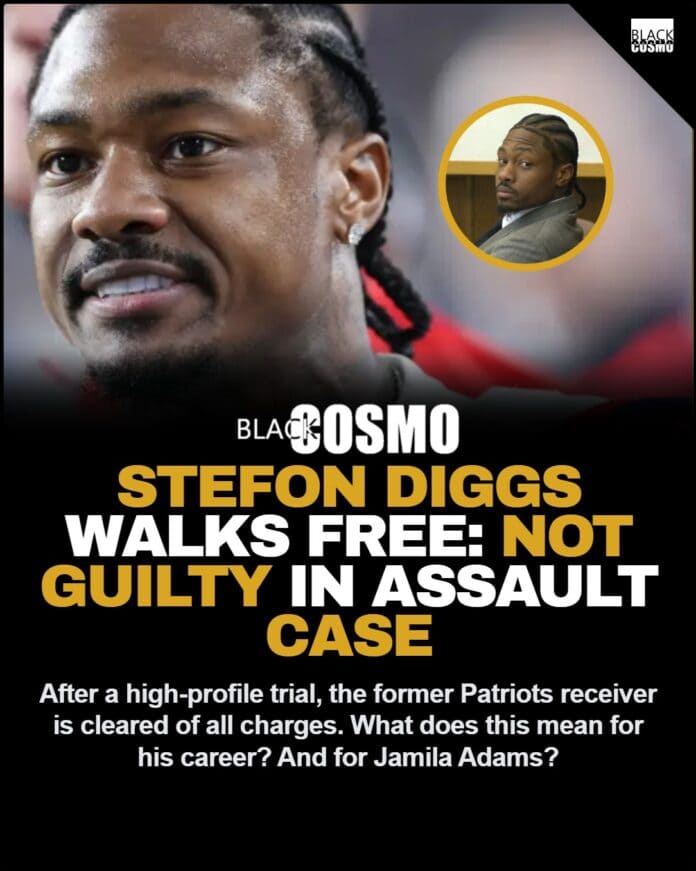
Former New England Patriots wide receiver Stefon Diggs walked out of a courtroom a free man after a jury cleared him of assault and strangulation charges. The swift 90-minute deliberation shut down a high-stakes legal battle involving his personal chef, Jamila Adams, but leaves lingering questions about power, reputation, and the unforgiving court of public opinion.
The accusations stemmed from a December 2025 altercation that quickly commanded the attention of the sports world. Adams alleged the NFL star smacked and attempted to choke her during a dispute. From the moment the charges dropped, Stefon Diggs stood firm on his absolute innocence, categorically denying any physical violence took place.
The Anatomy of a Ninety-Minute Verdict
Inside the courtroom, prosecutors tried to paint a picture of unchecked aggression, relying heavily on Adams’ account of the confrontation. The defense hit back hard, pivoting the focus onto glaring inconsistencies in the testimony. Diggs’ legal team systematically dismantled the prosecution’s narrative, framing the allegations as baseless and driven by ulterior motives rather than facts.
To counter the prosecution’s claims, defense attorneys brought forward character witnesses to testify about Diggs’ temperament behind closed doors. They painted a portrait of a disciplined athlete rather than a volatile aggressor. “He’s always been a calm and collected individual,” one witness testified under oath. “I’ve never seen him act violently toward anyone.”
Dismantling the Prosecution’s Case
When the jury retreated to deliberate, legal analysts prepared for a long wait. Instead, they returned in just an hour and a half—a remarkably short window for a high-profile assault case. That speed sent a clear message. The jury found the state’s evidence glaringly insufficient to clear the high bar of reasonable doubt.
A 90-minute decision means the room lacked heavy debate. The defense did not just poke holes in Adams’ story. They managed to thoroughly compromise her credibility in the eyes of the jurors. For Black Cosmopolitans watching from the sidelines, the trial served as a masterclass in high-stakes legal maneuvering, where every detail and shifting timeline carries massive weight.
The Unforgiving Aftermath of the Gavel
The immediate legal threat is dead, sparing Diggs from prison time and a career-ending felony conviction. Surviving the criminal justice system is only half the battle for a modern public figure. The allegations leave a permanent digital footprint, creating a chilling effect that could make corporate sponsors and luxury brands hesitate before signing a new endorsement check.
We also cannot ignore the heavy power dynamics baked into this trial. The verdict offers total relief for the athlete, but the unaddressed tension between a wealthy public figure and an employee remains. Cases like this frequently expose the uphill battle accusers face when confronting defendants armed with top-tier legal representation and deep financial resources.
The Shadow Beyond the Courtroom
The trial barely scratched the surface of a much deeper, messier story about personal conflict, employer-employee boundaries, and the harsh realities of the justice system. It forces a hard look at how the public digests allegations of violence against women when the accused wears a famous jersey. The legal victory is absolute, but public perception operates on an entirely different set of rules.
As the media circus packs up, the reality of what a “not guilty” verdict actually signifies takes center stage. One veteran legal commentator broke down the final outcome with blunt precision: “This verdict doesn’t necessarily mean that the alleged incident didn’t happen. It simply means that the prosecution failed to prove Diggs’ guilt beyond a reasonable doubt.” The gavel has dropped, but the cultural jury remains out.