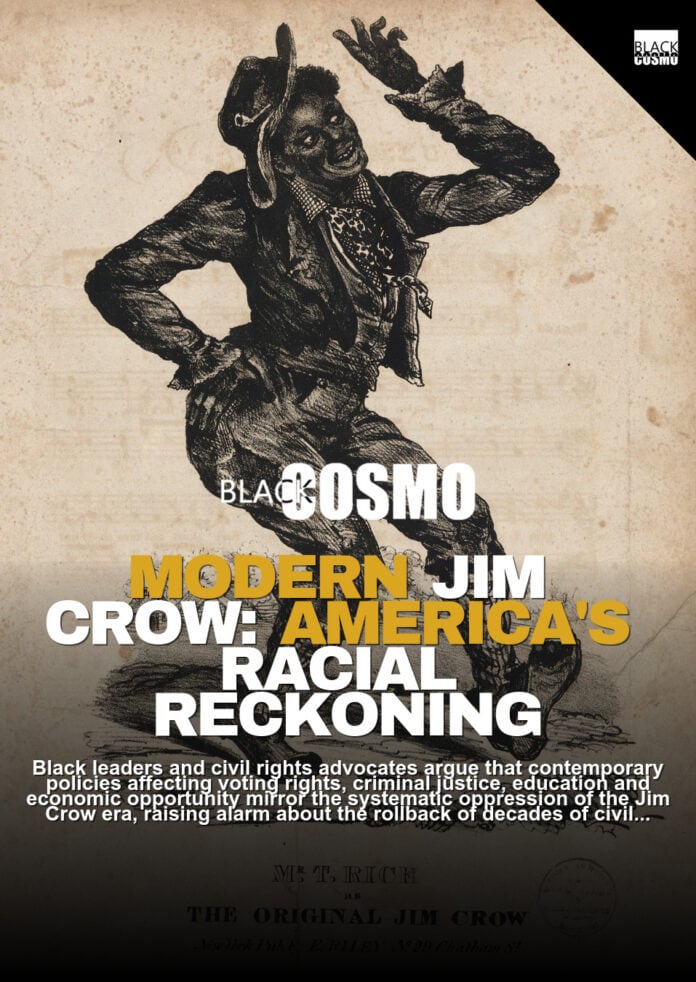
There are chapters in American history that Black Americans look back on with something between horror and disbelief. Eras defined not just by law and policy, but by lived fear, systemic violence, and collective resistance. Jim Crow stands among the most devastating systems of racial control the country has ever produced.
While schools teach Jim Crow as something historical, something closed off and finished, its actual impact on Black life remains poorly understood. From voting restrictions and economic exclusion to segregated schools, housing, and public spaces, its control was absolute. Now, with ongoing attacks on civil rights protections—including the Supreme Court’s gutting of the Voting Rights Act—many Black leaders and scholars are asking a uncomfortable question: what would Jim Crow look like in 2026? The answer, according to civil rights activists, may be closer than we think. In fact, some argue we’re already living in a Jim Crow era, just without the explicit legal language.
What Was Jim Crow?

The system began after Reconstruction ended and persisted until the mid-1960s, according to the National Park Service. Backed by local enforcement and federal neglect, it shaped nearly every dimension of Black existence. Every part of life—from education to employment, from where you could eat to where you could sit—was controlled by law and terror. Cultural narratives reinforced it all, routinely dehumanizing Black people in everyday speech, media, and public discourse.
The system touched everything. Mass media casually deployed racial slurs. Segregation wasn’t just policy; it was performance, a constant public reminder of who mattered and who didn’t.
Mass Incarceration

The 13th Amendment outlawed slavery everywhere except prison. That exception has shaped everything that came after. Prison reform activists trace a direct line from that clause to mass incarceration to what they call the school-to-prison pipeline. The pipeline describes policies and disciplinary practices that push students—especially Black students—out of classrooms and into the criminal justice system.
Zero-tolerance policies, suspensions, expulsions, and heavy police presence in schools disproportionately affect students of color. According to the American Civil Liberties Union, Black students get referred to law enforcement at rates far above their representation in school enrollment. Underfunded schools, racial bias in discipline, and harsh enforcement all contribute to higher dropout rates and increased odds of future incarceration. It’s mass incarceration dressed up as education policy.
School to Prison Pipeline
Michelle Alexander, author of the 2010 book “The New Jim Crow,” laid out the mechanics during a 2012 NPR interview. “People are swept into the criminal justice system—particularly in poor communities of color—at very early ages, typically for fairly minor, nonviolent crimes,” Alexander told Fresh Air’s Dave Davies. “[Young Black males are] shuttled into prisons, branded as criminals and felons, and then when they’re released, they’re relegated to a permanent second-class status, stripped of the very rights supposedly won in the civil rights movement—like the right to vote, the right to serve on juries, the right to be free of legal discrimination in employment, and access to education and public benefits. Many of the old forms of discrimination that we supposedly left behind during the Jim Crow era are suddenly legal again, once you’ve been branded a felon.”
Police Brutality

Jim Crow policing and modern policing share the same root: racial control. During the Jim Crow era, police openly enforced segregation, intimidated Black Americans, and often looked the other way during racial violence—or participated in it directly. Segregation is now illegal, but Black communities still face disproportionate police violence, racial profiling, and harsher law enforcement treatment. The 2020 killings of George Floyd and Breonna Taylor reignited those historical comparisons. While Jim Crow racism was written into law, today’s disparities are coded into systemic bias, policing practices, and institutional inequalities that many argue continue to devastate Black communities.
Ending DEI

President Donald Trump has made dismantling diversity, equity and inclusion efforts a priority. Rev. Al Sharpton, speaking to us about the push, cut through the rhetoric. “They came up—they being the private sector—they came up with DEI,” he said. “We never called it DEI. We asked for fairness and equity. They named something. Now they want to end something they named like we asked for it. What we asked is for fairness.”
Targeting HBCUs

After a far-right conservative was killed, at least a dozen historically Black colleges and universities received violent threats. The FBI later determined the threats weren’t credible, but campuses were forced into lockdowns, canceled classes, and ramped up security anyway. “HBCUs receiving threats after a white nationalist was killed feels painfully unsurprising,” Alabama State University student Sam Barnett told the Hilltop. “The threats are likely to continue because many conservatives and Republicans see the incident as a direct attack against them.”
Economic Decline

Black unemployment is rising faster than the national average, alarming economists who see it as a warning signal. Labor Department data shows Black workers losing jobs while overall unemployment stays relatively stable. Analysts point out that Black workers, disproportionately employed in federal government, logistics, and entry-level service jobs, are often the first casualties when hiring slows. Federal workforce cuts tied to Trump’s efficiency push, cuts to diversity programs, and broader economic uncertainty are all factors. Economists call it a “canary in the coal mine”—an early indicator that the broader job market may be weakening.
Slashing Black Voting Power

Alanah Odoms, executive director of the American Civil Liberties Union in Louisiana, described the Supreme Court’s decision to gut Section 2 of the Voting Rights Act as “a real assault and a demolition.” She explained how racial gerrymandering works in practice: “Black people being packed into a district so their power across surrounding districts would be limited, or being cracked across districts so they would never have enough power to elect a candidate of their choice.” During Jim Crow, literacy tests and poll taxes kept Black voters from the ballot box. The methods have changed; the intent remains.
Segregated Housing

The Fair Housing Act of 1968 made housing segregation illegal. Fifty-eight years later, racial housing segregation persists in different forms. Return to the Land, a relatively new settlement in Arkansas, openly markets itself as a whites-only “private membership association” for people with “traditional views and European ancestry.” Applicants submit to an extensive screening process including a video interview to verify ethnic background and family lineage. Black people, Jewish individuals, LGBTQIA+ people, and those of mixed-race backgrounds are excluded from membership.
Small Number of Black Congress Members, SCOTUS

During Jim Crow, Black representation in Congress and on the Supreme Court was nearly nonexistent. Thurgood Marshall became the first Black Supreme Court justice in 1967. Since then, only two Black justices have served: conservative Justice Clarence Thomas and liberal Justice Ketanji Brown Jackson. Within the Republican Party, all four Black representatives are set to leave their positions by 2027, widening the racial gap in GOP leadership. Ongoing redistricting efforts in the South, aimed at diluting Black voting blocs, have already displaced several Black leaders from historically Black districts. The result: fewer Black representatives in Congress.
Department of Education

Trump administration education policies are already affecting Black students and civil rights protections in schools. The Office for Civil Rights has failed to adequately address racial discrimination complaints involving Black students. Staffing cuts, office closures, and reduced federal oversight of schools have disproportionately harmed Black students, who have historically borne the weight of educational inequality. With the administration pushing to shut down the Department of Education, Black students face reduced funding and attention at exactly the moment they need it most—a replay of the educational abandonment that characterized the Jim Crow era.
Lynching Concerns

During Jim Crow, lynching was a routine terror tactic. Black people were hanged from trees, yes, but also beaten, tortured, shot, and burned—sometimes at police hands. In 2026, civil rights activists argue that Black people are still being lynched. FBI data shows Black Americans are disproportionately targeted in racial hate crimes. Within the past five years, police brutality cases and the deaths of Black men like Javion Magee and Trey Reed have reignited concerns about modern-day lynching.
Modern-Day Examples

Mississippi Rep. Bennie Thompson spoke out after the death of Trey Reed, a 21-year-old student found hanging from a tree. “While the details of this case are still emerging, we cannot ignore Mississippi’s painful history of lynching and racial violence against African Americans,” Thompson said. Robert Brooks, another Black man, was beaten to death by New York correctional officers in 2024. Of the 10 guards charged, seven pleaded guilty to manslaughter or lesser charges. Two were acquitted at trial. One was convicted.
These aren’t historical examples. They’re happening now. The patterns are familiar. The stakes remain impossibly high.
★tr★