
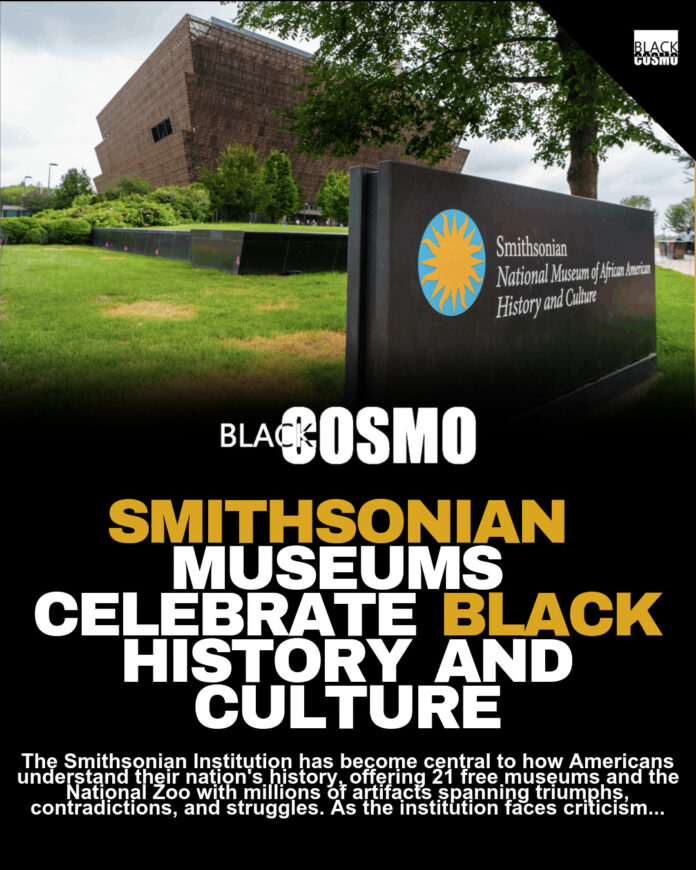
The Smithsonian Institution has long been America’s attic—a repository of the nation’s triumphs, contradictions, innovations and struggles, preserved for future generations. But that mission has faced mounting pressure as President Donald Trump has become increasingly critical of how the Smithsonian Institution presents American history.
A recent White House Domestic Policy Council report declared the institution “cannot be trusted to tell America’s story honestly and in a way that is inspiring, unifying, and worthy of our great republic.” The Smithsonian has pushed back, reaffirming its commitment to research and historical accuracy—even when that means confronting some of America’s most uncomfortable truths. The tension has underscored just how central the Smithsonian remains to shaping public understanding of the nation’s past.
With 21 museums, the National Zoo, and millions of objects in its collections, the Smithsonian is far more than a tourist destination. It’s a living archive of American culture, creativity, and resilience.
Free Visits
The Smithsonian Institution operates over 21 museums, most of them located in Washington, D.C., and most offering free admission. This includes landmark institutions like the National Museum of African American History and Culture, the National Postal Museum, and the Anacostia Community Museum, which documents the rich and often overlooked history of D.C.’s historically Black neighborhoods.
National Museum of African Art

Nestled in the center of the National Mall, the National Museum of African Art often gets overlooked by visitors heading to more prominent monuments. But inside, you’ll find a sophisticated celebration of African visual art and cultural expression spanning centuries. Founded in 1964 in a home that once belonged to Frederick Douglass, the museum continues to expand its reach. Exhibits like “Here: Pride and Belonging in African Art” explore artistic traditions through the lens of LGBTQ+ communities across the continent, offering fresh perspectives on identity and belonging.
The National Air and Space Museum

The National Air and Space Museum’s main building opened in 1976 and transports visitors into a time capsule of American achievement in flight and space exploration. Beyond the iconic spacecraft and rockets, the museum thoughtfully chronicles often-overlooked stories like those of the Tuskegee Airmen and Bessie Coleman, the first international Black pilot. These narratives remind us that American progress wasn’t built by a single demographic.
National Portrait Gallery

The National Portrait Gallery holds more than 26,000 portraits spanning American history and culture. The collection ranges from U.S. presidents to postmaster John T. Jackson and civil rights icon John Lewis. Former President Barack Obama and First Lady Michelle Obama’s portraits remain among the most visited works, drawing crowds who find meaning in seeing themselves represented at the highest levels of national recognition.
Smithsonian Summer Camp

Beyond museum visits, the Smithsonian offers extensive summer camp programming for families seeking hands-on learning experiences centered on art, science, and cultural exploration.
National Gallery of Art

The National Gallery of Art houses an extraordinary collection of work by Black artists whose contributions shaped American art across generations. Aaron Douglas’ powerful “Into Bondage,” Alma Thomas’ vibrant abstract paintings, Jacob Lawrence’s vivid narratives, Gordon Parks’ iconic photography, and contemporary works by Kerry James Marshall and Kara Walker demonstrate the depth and range of Black artistic vision. The museum’s dedicated Black Artists Guide helps visitors navigate more than two centuries of artistic excellence, from pioneering portraitists to today’s most influential practitioners.
The National Museum of American History
The National Museum of American History houses iconic artifacts, but its Entertainment Nation exhibition puts pop culture at the forefront. “Roots to Pop” explores how movies, music, television, sports, and theater have shaped American identity through over 200 objects. Dorothy’s ruby slippers from “The Wizard of Oz,” Prince’s legendary “Yellow Cloud” guitar, Selena’s performance costume, the original Muppets, and Star Wars costumes for R2-D2 and C-3PO are among the highlights. The exhibition makes clear that entertainment doesn’t just reflect America—it helps define it.
Hirshhorn Museum and Sculpture Garden

The Hirshhorn Museum and Sculpture Garden is dedicated to contemporary art that provokes thought and challenge assumptions. Yayoi Kusama’s immersive Infinity Mirror Rooms have become cultural phenomena, drawing visitors into meditative spaces. Works by Jean-Michel Basquiat, Mark Bradford, Barbara Kruger, and Auguste Rodin round out the collection. The outdoor sculpture garden features monumental works set in natural surroundings, offering visitors a space to contemplate how modern and contemporary artists use creativity to question, inspire, and reimagine the world.
Anacostia Community Museum

For nearly 60 years, the Anacostia Community Museum has preserved stories that traditional history often sidelines. Founded in 1967 as the Smithsonian’s first neighborhood museum, it documents the history, culture, and resilience of Black communities and other historically marginalized groups. The museum also celebrates D.C.’s local culture, including a dedicated space for go-go legend Chuck Brown. Visitors can see Brown’s Gibson guitar and learn about his journey as the “Godfather of Go-Go.” The museum’s “Lorton Reformatory: Beyond Time” exhibition deepens these connections, revealing how music, community, and local history intersect.
International Spy Museum

You can’t fully understand American history without confronting its espionage operations. The International Spy Museum explores covert activities across continents, examining the tactics, risks, and moral complexities of the intelligence world. Importantly, the museum also acknowledges Black spies who played critical roles during the Revolutionary War and continue to serve in the CIA today—a history often erased from mainstream accounts.
Smithsonian American Art Museum
At the Smithsonian American Art Museum, artist Sir Isaac Julien presents a five-screen moving-image installation titled “Lessons of the Hour” that doesn’t simply revisit Frederick Douglass—it insists we haven’t caught up to him. Julien layers period reenactments, historical documentation, and poetic visuals over a haunting soundscape to resurrect one of the country’s most brilliant minds. More than a century after Douglass’ death, his words about democracy’s unfinished work speak directly to the present moment. The work functions less as a portrait of the past than as a challenge to now.
National Museum of African-American History and Culture

Since opening in 2016, the National Museum of African American History and Culture has drawn visitors from all backgrounds and perspectives. Unlike other Smithsonian museums with broader mandates, this one focuses specifically on Black history, culture, and legacy. The museum features compelling exhibits on historically Black colleges and universities (HBCUs) and preserves personal artifacts like a dress sewn by Rosa Parks herself—objects that ground abstract historical narratives in lived experience.
Smithsonian Gardens

Smithsonian Gardens provides a tranquil counterpoint to the bustling museums. The Mary Livingston Ripley Garden, pollinator-friendly landscapes, and themed gardens throughout the grounds connect visitors to science, culture, and conservation. These aren’t mere decorative spaces—they’re living exhibitions that demonstrate the beauty and necessity of environmental stewardship.
National Postal Museum

The National Postal Museum demonstrates how even the smallest historical objects carry significant stories. Its virtual exhibition “The Black Experience” uses U.S. postage stamps as a lens into African American achievement and history. The collection celebrates figures across civil rights, science, arts, literature, sports, and exploration—Frederick Douglass, Harriet Tubman, Ida B. Wells, Jackie Robinson, Bessie Coleman, and countless others honored through the mail their legacies inspired.
National Museum of Natural History
The National Museum of Natural History brings science and discovery into accessible, engaging spaces. Exhibits explore human origins, mammals, ancient Egypt, and more. The David H. Koch Hall of Fossils–Deep Time takes visitors billions of years into Earth’s past. The Hall of Geology, Gems, and Minerals showcases the Hope Diamond alongside other geological wonders. The Sant Ocean Hall reveals the complexity of marine ecosystems. Each gallery is designed to inspire curiosity and foster understanding of our natural world.
★TR★