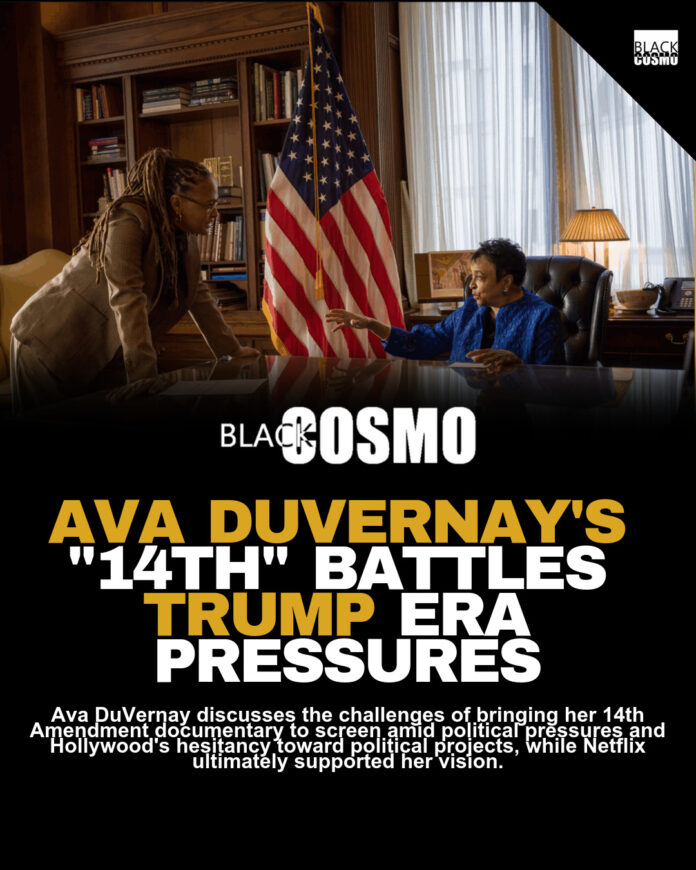
Ava DuVernay is pulling back the curtain on the obstacles her latest documentary faced before hitting screens. As “14th” prepares for its New York Film Festival debut on October 9, the filmmaker has opened up about the pressures that nearly derailed the project, from the political climate surrounding Trump’s second term to Hollywood’s reluctance to back more politically charged work.
The documentary examines the Constitution’s 14th Amendment, which guarantees birthright citizenship and due process, and traces 150 years of conflict over its meaning. By weaving together archival material with current headlines, Ava DuVernay‘s film brings together legal experts, politicians, historians, and cultural commentators to discuss who belongs in America.
Speaking with The Hollywood Reporter, DuVernay explained how the film’s direction kept shifting as new political developments unfolded. What started as a focused look at Trump’s challenge to birthright citizenship expanded as other aspects of the 14th Amendment became increasingly urgent. The creative scope widened to include the stories of Black political leaders caught in the controversy, including former Librarian of Congress Carla Hayden and Smithsonian Secretary Lonnie Bunch.
“This movie kicked my butt because it was like building a plane midflight—so much stuff was coming in every day, everything was happening,” DuVernay said. “All my feelings about everything happening in the past three years—creatively, politically, socially, culturally—are being put into this film.”
The challenges extended beyond the creative process. DuVernay faced pushback from industry gatekeepers reluctant to green-light political projects in the current environment. With streamers delaying or scrapping certain releases and legacy studios consolidating, she worried Netflix might abandon the deal or pressure her to soften the film’s perspective. That concern didn’t materialize, though the experience revealed broader anxieties rippling through the industry.
“I was really hopeful that they would continue to support the filmmakers in the way that they’ve established, and they did,” she explained. “I was hoping they would hold their stance under what has felt like a lot of pressure to do otherwise. In this climate, I would’ve expected a little more ‘helicopter mom.'”
DuVernay also mentioned being cautioned about the content and her perspectives woven throughout the project. She observed that both artists and executives feel less free to take risks right now, and acknowledged her own concerns about the cultural moment.

The Oscar-nominated director was careful to clarify that “14th” isn’t a referendum on Trump himself. She framed him as “a small cog in a wheel that’s been rolling for a very, very long time.” Instead, the film functions as a personal essay reflecting both the history it documents and the turbulent period that shaped its creation.
“COVID, wars, Gaza—it’s been quite a decade, and I don’t think we, as people who experience it, appreciate what we’re living through. They’re going to study this time. My question is, how are we getting our arms around that artistically? This film is like an essay. We were writing through it, about what we discovered, how we felt, and what it means,” she said.
“14th” arrives globally on Netflix December 4, following theatrical releases in select U.S. and U.K. cities beginning November 27.
★TR★