
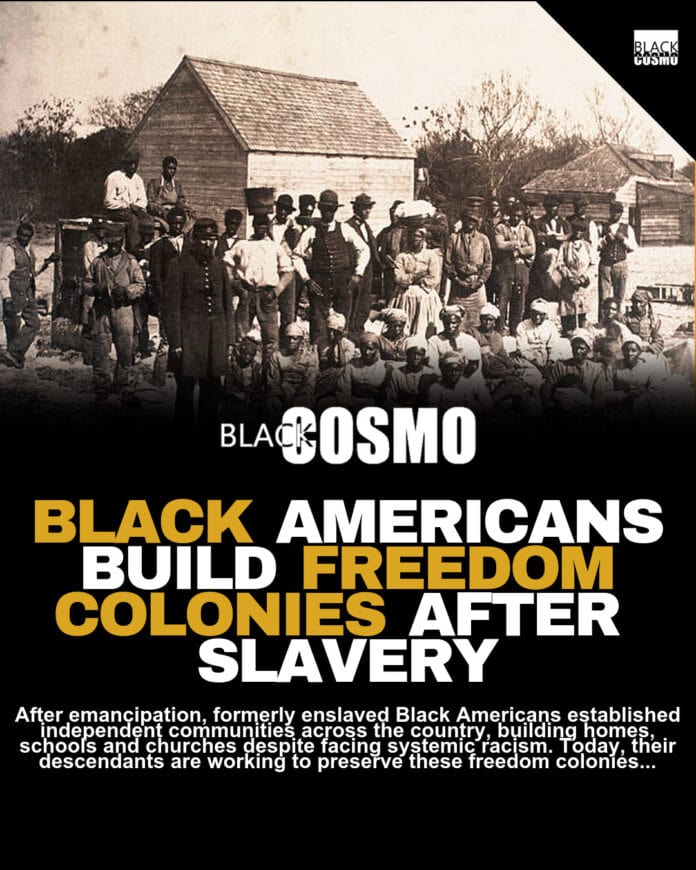
After emancipation, formerly enslaved Black Americans did more than fight to survive. They built communities of their own, acquired land, raised families and created places where they could live with greater independence from the racism of the Jim Crow South. Generations later, their descendants are working to ensure these communities and their histories are not forgotten.
Today, these communities are known as freedom colonies. Their stories offer a closer look at how Black Americans built independent lives after slavery and how their descendants are working to protect what remains. Understanding their legacy means recognizing both the obstacles they faced and the resilience they demonstrated.
Slavery Ends, Millions of Black Americans Are Freed
After the Civil War, slavery was abolished nationwide under the 13th Amendment, but emancipation didn’t automatically provide formerly enslaved Black Americans with the resources needed to establish themselves.
In January 1865, Union General William Tecumseh Sherman issued Special Field Orders No. 15, setting aside certain coastal lands for Black families in 40-acre plots. The policy became associated with the promise of “40 acres and a mule,” later revoked by President Andrew Johnson, who returned much of the land to its former slave owners.
The Struggles of Emancipation

Many formerly enslaved people were deliberately denied the tools they needed to build independent lives. Enslavers often restricted literacy and movement, leaving people with limited access to education and resources. After emancipation, freedpeople faced racial persecution and economic exploitation. Despite promises of land redistribution, many families were left to build their futures with little more than their determination.
“The freed slaves who had virtually nothing but their own labor and their own minds created communities, created schools and went to college,” according to an interview featured in PBS’ “Raise Your Head Up: Freedom Colonies in America” documentary.
What Are Freedom Colonies?
Freedom colonies are “historically significant communities” established by formerly enslaved Black people during Reconstruction and to escape Jim Crow, as the PBS documentary explains.
Residents acquired land, built homes, established churches and schools, and created support systems that allowed families to live more independently. The Texas Freedom Colonies Project has documented 557 known historic Black settlements across Texas. Similar communities emerged across the country, including Eatonville, Florida, and Nicodemus, Kansas.
The Bevilport-Dixie Community

The Bevilport-Dixie community in East Texas was home to generations of hardworking Black families who raised their own food, cared for their households and supported one another during difficult times. Residents passed down practical skills, family traditions and lessons on self-sufficiency, helping younger generations understand the work and sacrifice that built their community. The community recently purchased a facility called the Center For Historical Preservation Association (CFHPA) — or the Community Connection Center — serving as a cultural hub for families to gather.
How Dixie Families Keep Self-Sufficiency Alive

One descendant, Willie King, recalls his grandfather, Albert McCray, as a man deeply committed to teaching younger generations about their history and heritage. His family grew food, raised livestock and cured and preserved meat, relying on the land to sustain them. McCray also taught younger family members practical skills, including milking cows, while instilling the importance of carrying themselves with dignity. His influence remains part of the family’s legacy.
County Line Colony (Upshaw)

County Line — later called Upshaw — is an unincorporated community in East Texas, home to generations of Black families. By the mid 1930s, the freedman settlement had a school, a church, a store and a number of homes. Documentary photographer Richard Orton began documenting the community and its descendants in 1988 as part of a decade-long project exploring freedom colonies.
County Line Holds on Tight to Its Legacy

At its height, County Line had an estimated 250 to 300 residents. However, the community is dwindling, as younger generations have departed to pursue education and employment. Descendant Anita Upshaw Morrison left as a teen with a deep desire to achieve more. But she speculates that folks will eventually make their way back to County Line once they realize they inherited something special.
“My dad used to say, ‘There’s never gonna be any more land.’ It’s very priceless,” Anita said. “Eventually our people are going to realize, ‘We had paradise here and didn’t even know it.’ And start coming back.”
Shankleville Colony
Shankleville was established by Jim and Winnie Shankle, a formerly enslaved couple whose story became central to the community’s history. Their descendants continue to maintain the family’s historic property and gather for reunions, keeping the couple’s legacy alive across generations.
The Love Story Behind the Shankleville Community
Jim and Winnie were enslaved in Mississippi when their enslaver decided to sell Winnie and their children. Jim was left behind but eventually escaped, traveling by night to search for his family. After learning they were in Texas, he continued his journey until he reunited with Winnie.
According to accounts shared by his descendants, Jim amassed approximately 5,000 acres in the Shankleville area. Today, the family continues to preserve the historic homestead, including its house and outbuildings, with the goal of restoring the property to reflect how it looked in the past. The community’s Annual Shankleville Homecoming brings descendants together to celebrate their shared history and raise funds to maintain ancestral cemeteries.
Mount Union Colony (Walnut Hill)
One of over 500 historic independent Black settlements founded in Texas between 1865 and 1930, Mount Union — known as Marble Hill — was established in the 1840s, 16 miles southwest of Carthage in Panola County.
What We Know About Mount Union
While little is known about the present-day state of Mount Union, historical records indicate that the nearby Walnut Hill community was established in the 1840s and grew into a small town with homes, a general store and a cotton gin and mill. By 1900, Walnut Hill had largely disappeared from highway maps, underscoring how some historic communities faded from public record over time, per the Texas Freedom Colonies Project.
Keeping ancestral roots Alive for Future Generations
Descendants are working to preserve these communities by maintaining family land, acquiring community buildings, organizing reunions and holiday gatherings, caring for ancestral cemeteries, and passing family histories to younger generations. At County Line, the Community Connection Center provides a gathering place and a foundation for historical preservation efforts. In Shankleville, descendants are restoring the historic family homestead and maintaining the cemetery grounds through funds raised at homecomings.
These efforts keep families connected to the places their ancestors built while helping younger generations understand the history behind their roots.
A Legacy Worth Protecting
Freedom colonies are an important part of American history that has too often been overlooked. Their stories show how Black Americans built communities, established traditions and shaped their own futures despite the barriers they faced after slavery. Preserving these places ensures that future generations can learn not only what their ancestors endured, but also what they accomplished.
★TR★