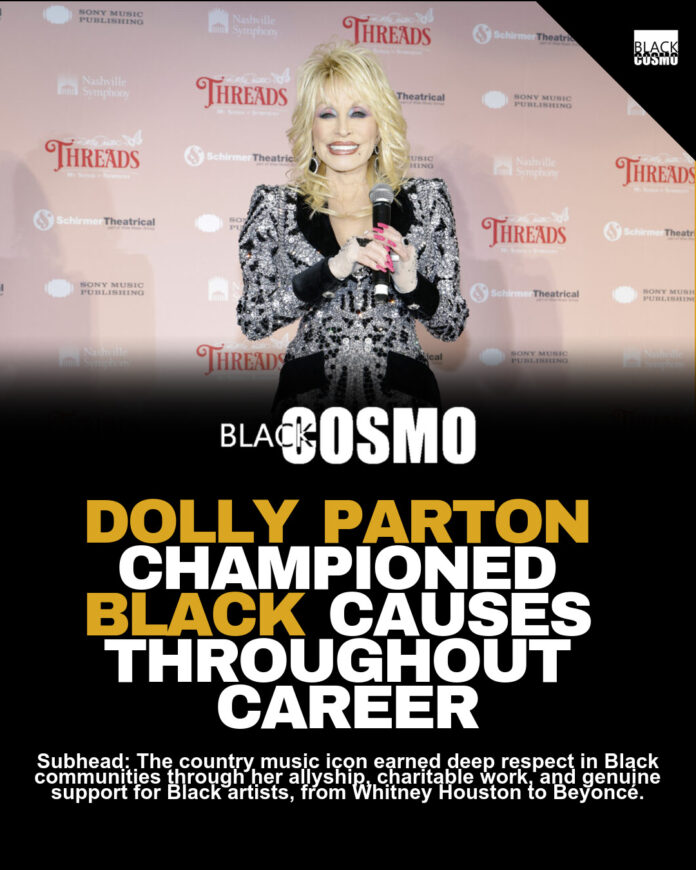
Dolly Parton, the legendary country music icon who captured the hearts of Black America and beyond, has passed away at age 80. News of her death on Tuesday, August 25, in Nashville sent waves of grief through countless communities who held her dear. While no cause of death has been officially determined, her absence leaves an undeniable void in the cultural landscape.
Dolly Parton wasn’t just a country music star. She was an ally, an advocate, and someone who showed up for Black folks in meaningful, tangible ways. From her signature blonde hair and dimpled smile to her fierce business acumen and generous spirit, Parton became a fixture in Black culture—not as an outsider, but as someone genuinely invested in our community. She collaborated with our favorite artists, spoke out on issues that mattered, and used her platform and her money to make a real difference.
When Whitney Houston Made “I Will Always Love You” a Moment
Most people know Parton penned “I Will Always Love You” back in 1974, but Whitney Houston’s 1992 rendition for “The Bodyguard” became the version that defined a generation. What many don’t know is that Parton had submitted the song for consideration and never heard back. When Houston’s version became a cultural phenomenon, Parton could have felt slighted. Instead, she was grateful.
“When Whitney did ‘I Will Always Love You,’ Lord, I mean, that thing generated so much music,” Parton said in a 2017 interview with Harry Connick Jr. “There was a tabloid story saying that Whitney and I were in a big feud; she said it was her song, and I said it was mine. None of that was ever true. I was so flattered, so honored, and so lucky that she did it.”
She Invested Her Fortune in Black Nashville
Houston’s cover generated nearly $10 million in royalties for Parton. Rather than simply pocket the windfall, she did something profound: she invested in a Black neighborhood in Nashville. She purchased a commercial complex in Sevier Park and called it the “house Whitney built”—a direct homage to the woman whose artistry had enriched her life. That’s the kind of generosity that sticks with people.
Standing on the Right Side of History
In 2018, Parton made a deliberate decision to rename her Pigeon Forge dinner show from “Dolly Parton’s Dixie Stampede” to simply “Dolly Parton’s Stampede.” The change wasn’t subtle or performative—it was direct. She recognized that “dixie” carried the weight of Confederate history and the evils of slavery, and she refused to profit from that association. That kind of clarity and willingness to evolve matters.
She Said Black Lives Matter When It Counted
During the height of the George Floyd protests in 2020, when the country felt fractured and many public figures chose silence, Parton used her platform without hesitation. “I do understand people having to make themselves known and felt and seen. And of course Black Lives Matter. Do we think our little white asses are the only ones that matter? No, everybody matters,” she said in an interview that rippled across the internet. Her words were so resonant that Nashville honored her with a mural.
She Championed Beyoncé’s Country Pivot
When Dolly Parton weighed in on Beyoncé’s country singles in early 2024, she didn’t gatekeep or question Bey’s authenticity. Instead, she celebrated her. “I think it was very bold of her,” Parton told E! News in May 2024. “When they said she was gonna do ‘Jolene,’ I expected it to be my regular one, but it wasn’t. But I love what she did to it. And as a songwriter, you love the fact that people do your songs no matter how they do them.” That’s grace. That’s wisdom. That’s a legend recognizing another legend.
Her Fashion Was Unapologetically Extra
Parton’s aesthetic—the wigs, the rhinestones, the refusal to tone it down—resonated deeply with Black culture. Where some saw tackiness, Black folks saw an icon. TikToker Camille Viviana captured it perfectly: “People say she’s tacky, I say she’s iconic: Miss Dolly Parton.” That deliberate excess, that commitment to being fully herself no matter what, was something Black communities understood intimately.
Her Generosity Changed Lives
Through her Dollywood Foundation, Parton launched the Imagination Library in 1995, a program dedicated to promoting literacy by sending free books to children from birth to age five. Millions of kids received those books. Millions of parents watched their children develop a love of reading because of her investment. That’s a legacy you can measure.
She Knew How to Read the Room
In 2021, Nashville offered to erect a statue in Parton’s honor. She declined. At the time, she felt the gesture would be inappropriate given the social climate and the conversations happening around monuments. Most people would have accepted—most people would have wanted the statue. Parton refused. “That’s what you do,” as one TikToker noted. She understood the moment better than those offering the tribute.
She Was Street Smart About Her Money
Parton shared something fundamental with other legendary Black artists like Aretha Franklin: she never lost control of her catalog, her credits, or her earnings. She was a shrewd businesswoman who understood that ownership matters. That kind of financial literacy and refusal to be exploited is something Black communities respect deeply.
She Was Our Delegation Trade-Off
During a viral 2023 moment on social media, Black folks joked about the “Black Delegation Trade-Off”—deciding which of “ours” we’d trade to the white side in exchange for one of their non-problematic members. Parton’s name appeared consistently at the top of the list. Not as a joke, really, but as recognition. She had earned her place in our community through years of showing up, speaking up, and putting her resources where her mouth was.
Rest easy, Dolly. You were one of the good ones.
★TR★