
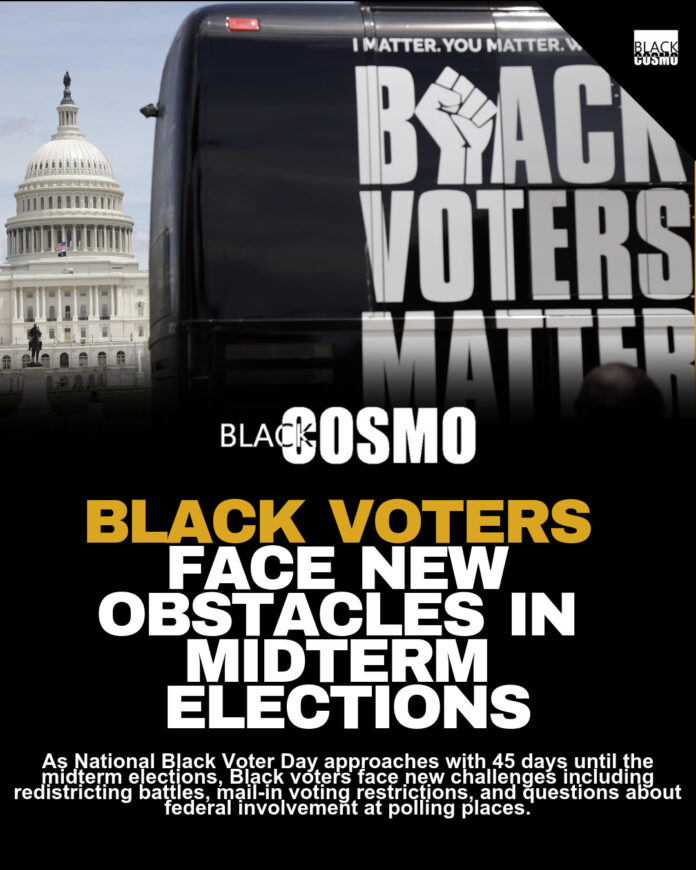
WASHINGTON, DC – JUNE 26: As the U.S. Capitol is seen in the background, a Black man passes by Black Voters Matter’s “Freedom Ride for Voting Rights” bus during a “Rally for D.C. Statehood” at the National Mall June 26, 2021 in Washington, DC. The “Freedom Ride for Voting Rights” bus tour, also known as the “Blackest Bus in America,” has been traveling through cities in key southern states since June 18 as a “national education and outreach campaign to increase support for voting rights legislation, advocate for DC statehood, and build Black voting power.” This year is the 60th anniversary of the launch of the original Freedom Rides from Washington, D.C. throughout the South to challenge segregation in busing and public facilities. (Photo by Alex Wong/Getty Images)
National Black Voter Day arrives this Friday, Sept. 18, as a critical checkpoint before midterm elections. It’s a moment designed to mobilize Black voters, but also to surface the issues that could affect ballot access itself. This year, those concerns include redistricting battles, ongoing challenges to mail-in voting, and questions about federal law enforcement presence at polling places.
The day itself, observed annually on Sept. 18, was launched in 2020 to encourage Black voters to register, plan their voting strategy, and understand the election process. The NAACP and other voting-rights organizations use this platform to remind people to verify their registration and know the specific rules governing their state’s ballots. With National Black Voter Day now established as an annual touchstone, the focus remains on preparation and awareness as voting procedures continue to shift.
With 45 days until the midterms, here’s what Black voters should understand before heading to the polls.
The Redistricting Question
Congressional maps are reshaping voter power this year in ways that could directly impact Black representation. New maps have been adopted or challenged across multiple states, redrawing district boundaries and, in some cases, splintering communities that historically voted as a bloc.
A report by Protect Democracy found that nearly 35 million Americans have been placed into new House districts through mid-decade redistricting. Voting-rights advocates have flagged particular concerns about how these boundary changes could erode Black political representation and dilute voting power in communities that have fought hard for it.
Mail-In Voting Remains Contested
Mail-in voting continues to face federal pressure. In March, President Donald Trump issued an executive order imposing new federal requirements on mail ballots, a move that has faced legal challenges from states and civil-rights organizations. The NAACP and other voting-rights groups have argued that these proposed rules could interfere with valid ballots and create barriers for voters who depend on mail-in options.
The legal landscape keeps shifting. The Supreme Court recently declined to block the administration’s mail-voting effort at an earlier stage of litigation, but a separate federal court injunction continues to block the Postal Service from implementing key portions of its proposed rules. The practical implication: voters should verify their state’s current absentee and mail-ballot requirements, as they may differ from previous election cycles.
Federal Agents at the Polls
FBI Director Kash Patel told lawmakers that the bureau would monitor the midterms through its field offices but stopped short of committing to keep federal agents away from polling places. Election officials across the country are now preparing for possible federal involvement while emphasizing that elections remain primarily state and local operations.
For Black voters, the practical takeaway is clear: know the landscape where you vote. Check your registration status, confirm your district and polling location, understand early and mail-voting deadlines, and verify what identification or documentation your state requires. National Black Voter Day is ultimately about preparation in the face of ongoing uncertainty around voting access and administration.
As election rules continue to be challenged and redrawn, knowing the mechanics of how and where to cast a ballot may matter just as much as knowing what’s on it.
★TR★