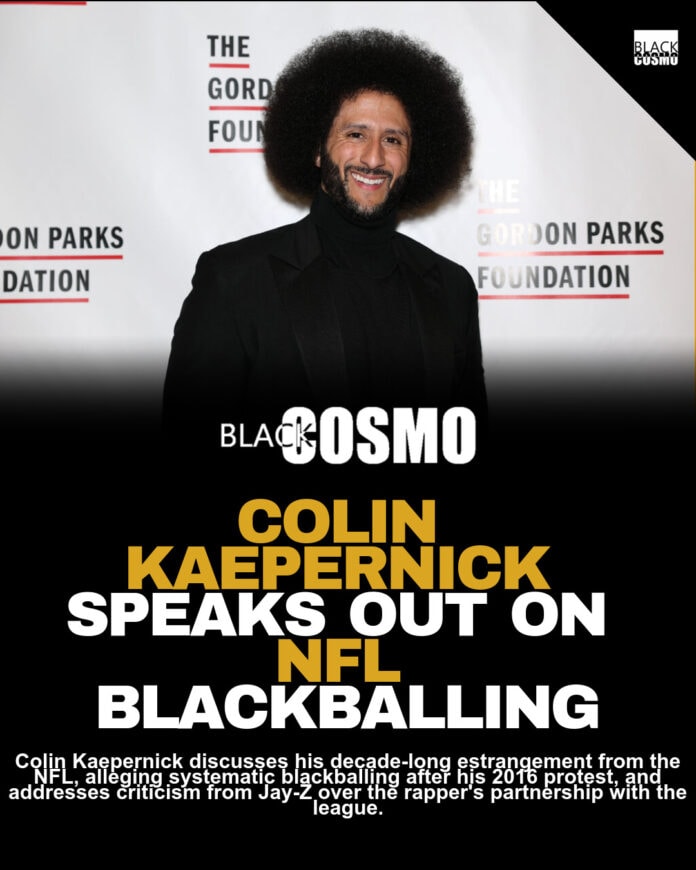
A decade after Colin Kaepernick knelt during the national anthem, sparking one of the most divisive moments in modern sports history, the former quarterback is breaking his silence. In a rare sit-down with NBC News, Kaepernick opened up about the fallout that followed his 2016 protest, his continued fight for reinstatement in the NFL, and his simmering conflict with figures like Jay-Z who he believes have worked against him.
The landscape has shifted considerably since that preseason game in San Francisco when Colin Kaepernick decided to take a stand. An injury had given him time to absorb the weight of Black deaths making headlines, and kneeling felt like the only honest response. What came next was a professional exile that defined the next chapter of his life.
In the interview, Kaepernick laid out what he calls a systematic blackballing. After leaving the 49ers, he says not a single team reached out for workouts. The ones that eventually tried were “shut down” by league leadership. It wasn’t one decisive moment, he explained, but rather the cumulative silence. Coming off a Super Bowl appearance and NFC Championship, the rejection felt intentional.
“There’s not a definitive moment that I would point to,” he said. “Coming on the back of going to a Super Bowl, going to an NFC Championship, setting records, and not a single team would bring me in, even for a workout?”
A former player corroborated his account to NBC, saying plainly: “Everybody believes that he was blackballed. Players knew that this would happen. That was a firm belief around the league.”
When George Floyd, Ahmaud Arbery, and Breonna Taylor’s deaths sparked a national reckoning, NFL Commissioner Roger Goodell released a video condemning racism and admitting the league should have listened to protesting players sooner. Kaepernick saw it differently. The statement, he felt, came only because players forced the issue, not from any genuine commitment to change.
“His response through that video was only because of pressure from players, not because it was altruistic,” Kaepernick told NBC News.
He called the league’s retroactive acknowledgment “laughable” and “disingenuous.” The timing felt particularly hollow given that he was still trying to get back into the NFL while the league claimed it should have listened to him years earlier.
“We had been trying to address the issue that the NFL created with blackballing me for years. To come out and say we should have listened on the back of that, while I’m still actively trying to play in the NFL, it’s so performative,” he explained.
These days, Kaepernick says he’s channeling his energy into work he believes will actually create impact. He’s intentional about when and where he speaks up, avoiding the noise that dilutes a message’s power.
“I try not to just flood things and be a stream of consciousness of everything because it does lose some of the impact. I try to be intentional. When is it the right time and place for me to speak up on something?” he said.
The conversation shifted when Kaepernick addressed his tension with Jay-Z. The rapper took shots at him during a performance at The Roots Picnic in June 2026, suggesting Kaepernick had “took a check” from the NFL and signed a non-disparagement agreement. Kaepernick firmly denied this.

According to Kaepernick, Jay’s 2019 partnership with the NFL drew significant backlash from fans upset that the rapper was working with the league. That fallout apparently still stung in 2026, which is why Jay felt compelled to distance himself.
“What it speaks to is the power of people. The backlash that he received for partnering with the NFL and going counter to people’s interests in 2019 was a major problem for him, so much so that he’s still bringing it up in 2026,” Kaepernick said.
He interpreted Jay’s lyrics as an attempt to ease a guilty conscience and reframe the narrative. The real question, Kaepernick suggested, is why someone in Jay-Z’s position would be comfortable stepping into roles that contradict what people on the ground actually want.
Looking ahead, Kaepernick remains focused on the work itself. Legacy, he knows, will be decided by others. But his intention is clear: create impact, stay intentional, and help build toward the future he wants to see.
★TR★