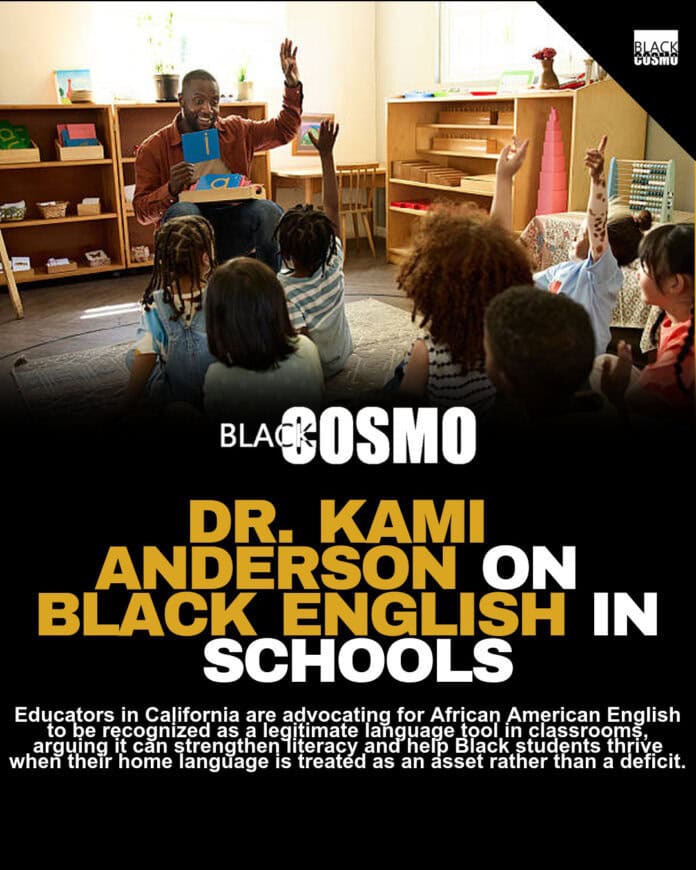
Black folks know code-switching well. Now a growing movement in California is reframing how we talk about Black English and its rightful place in classrooms.
Educators and advocates with Black Californians United for Early Care & Education are pushing to recognize Black English—also known as African American Vernacular English (AAVE) or African American English (AAE)—as something beyond slang or “improper” speech. They argue it should be embraced in preschool classrooms as a tool to strengthen early literacy and improve educational outcomes for Black students. The question becomes: What shifts when the language Black children bring to school is treated as an asset instead of something requiring correction?
Dr. Kami J. Anderson, an intercultural communication scholar with a Ph.D. from Howard University and author of “The Color of Language” (2023), frames the debate over Black English as something deeper than linguistics. It touches on how society recognizes Black culture, identity, and history. She points to a historical pattern of dismissing Black contributions when they challenge mainstream definitions of acceptability.
Why Black English Has Been Misunderstood
“We have historically lacked compassion for those elements of Africanness that have found their way into American society if we cannot see the direct benefit to us,” Anderson said. “We are okay with Africanness in jazz because we enjoy the music. We appreciate a yam because it’s tasty; the Africanness of hip hop linguistically inspires us because we have access to the slang and idiomatic expressions birthed there. But when we look at African American English, we are challenged to accept that Americanness can be more than one thing and acknowledge that our understanding of language rooted in contentious history is uncomfortable.”
Strengthening literacy requires more than student effort. Teachers carry responsibility too, and Anderson emphasizes building meaningful connections matters. One approach: developing understanding of AAE the way educators would with French, Spanish, or Arabic. Teachers needn’t teach AAE, but learning to use it expands their toolkit and helps students progress.
“It is the teacher’s knowledge of AAE that strengthens literacy, because the teacher will have a stronger linguistic foundation to support learning. The student already comes in with it; the teacher has to learn how to use it,” Anderson explained. “From a research perspective, Dr. April Baker-Bell speaks directly to this in her ELA classroom work. Not to mention the historic contributions of Geneva Smitherman, Gloria Ladson-Billings, and other scholars who shaped this conversation.”
AAE as Asset, Not Deficit
Critics worry embracing Black English discourages Standard American English learning. Anderson sees this concern differently. The worry itself carries implicit bias, she argues, one that “assumes a deficit in children that just isn’t present.”
“Embracing AAE considers the whole student in your pedagogy. This is what pedagogical strategies like Universal Design for Learning call for,” she said. “Bilingual education disproved long ago that including home languages limits students’ capacity to use what I call Mainstream American English. An ELA teacher can use AAE to guide students toward academic language, just as a bilingual educator uses Spanish or Urdu.”
She added: “My biggest wish is this: assume the brilliance of Black children who use AAE with ease, not any shortcoming.”
When Students Feel Seen, They Learn Better

AAE represents identity, not just language mechanics. Anderson believes students flourish when they feel genuinely seen and understood. Their use of AAE isn’t something needing correction—it’s an opportunity to connect and expand what students can do inside and outside the classroom.
“They take risks when they feel safe, and they grow when their identities are honored. By accepting the legitimacy of AAE, we communicate that their whole being is welcomed, appreciated, and needed. When we see a child’s ability to speak AAE as an asset rather than a deficit, we show them how to expand their expression, not merely correct it,” Anderson said.
“This work benefits all students. It encourages empathy and compassion for differences, which our society needs. It’s radical work, but it’s also radical love for students, and both build a strong foundation for adulthood,” she concluded.
★TR★