
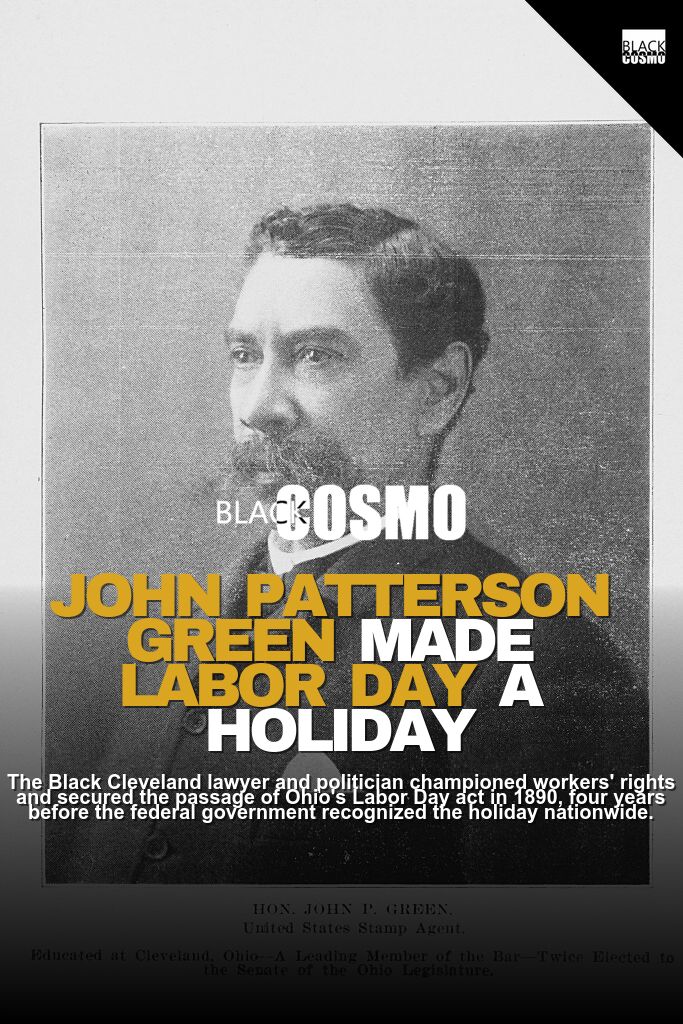
This Labor Day weekend, as millions of Americans settle in for barbecue, rest, and time with loved ones, there’s a name worth knowing: John Patterson Green. The Cleveland lawyer and politician didn’t just work within the system. He built one of the holidays Americans cherish most.
John Patterson Green helped make Labor Day an official holiday in Ohio back in 1890—four years before the federal government got around to it. Yet his story has remained largely hidden, overshadowed by the very movement he helped legitimize.
After law school, Green moved to South Carolina to practice, then returned to northeast Ohio in 1872. He became the first elected Black Republican justice of the peace in Cleveland, holding the post for nine years. By 1881, he’d moved into the Ohio House of Representatives, and by 1892, he was the first Black member of the Ohio Senate. But that political trajectory was really just the setup for what came next.
Born April 2, 1845, Green was the son of John R. and Temperance Green. His family, who had never been enslaved, moved from Newberne, North Carolina, to Cleveland in 1857 seeking better prospects. That move would eventually reshape American labor rights.
By 1892, Green was speaking directly to workers about his mission. “I am in perfect accord and sympathy with the laboring element, for I was once a laborer myself,” he told the clothing salesman’s union when firms tried extending evening hours. “Though I have had a law office on Superior Street for over twenty-one years, I have had no more than six cases from the rich. My patronage has been among the tin pail brigade.”
He continued: “In all my legislative career, I am proudest of the fact that I secured the passage of the act creating Labor Day in Ohio. I am also proud that I voted for the bill to close barber shops on Sunday.”
Green believed Sundays—and by extension, dedicated labor days—should be free from work’s demands. Workers needed time to rest, to learn, to improve themselves. Labor Day became a 24-hour recognition of American workers’ sacrifices and the movements that fought for their dignity.
In the factories and mills of the 1890s, people worked 12-hour days, seven days a week. No breaks. No ventilation. No sanitation. Children worked alongside adults in those same dangerous conditions for pennies. Green’s fight for Labor Day was a direct response to that brutal reality. “We exhaust ourselves in work. We must have more rest,” he said. “Conquer by moral force and your outing will last forever.”
Green lived to see his vision take root. He died in 1940 at 95, having witnessed Labor Day expand from an Ohio concept into a federal institution. Yet his name faded from the public memory.
On September 5, the Coalition of Black Trade Unionists will gather at his gravesite in Cleveland’s Woodlawn Cemetery to remember him. W. Dean Hudson, a Republican state representative from Cleveland’s Glenville neighborhood, sees that recognition as urgent. “Hundreds and hundreds of people participate in the Labor Day parade, but they have no idea who John P. Green is,” Hudson told Signal Cleveland. “Given the climate that we live in now, with books being taken off the shelf and statues taken down, we don’t want our history to be erased.”
★TR★