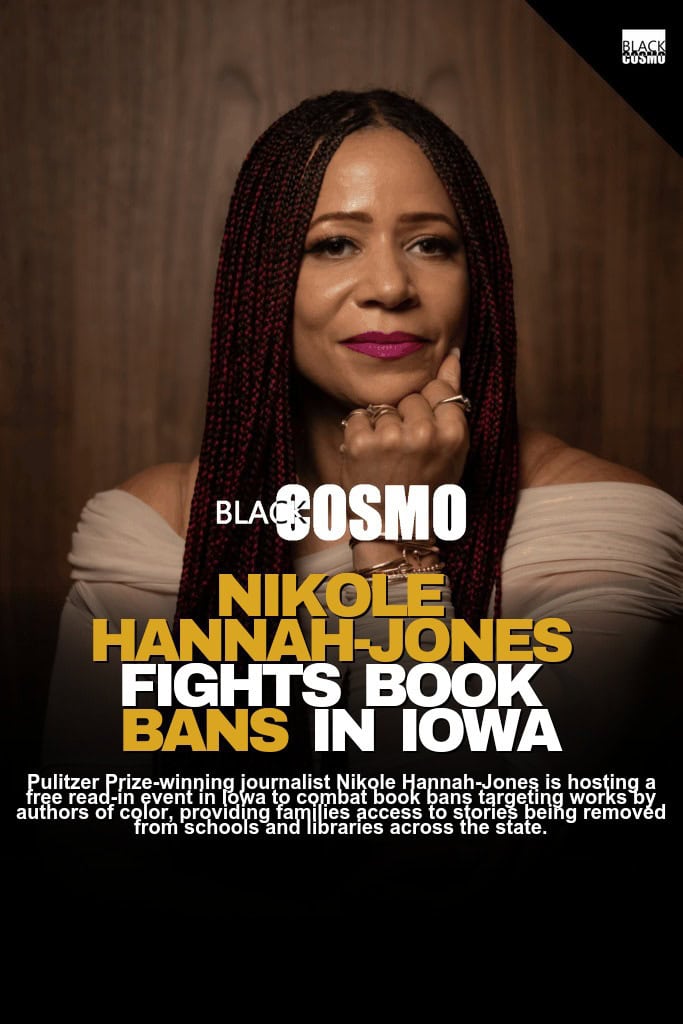
Books by writers of color have become targets in a sweeping campaign by conservative activists to remove titles from libraries and schools across the country. As the Trump administration rolls back diversity, equity, and inclusion initiatives, the removals are accelerating. Iowa now ranks second only to Florida in book challenges, with more than 3,000 titles stripped from shelves under SF 496, a 2023 state law that has removed works by Nikole Hannah-Jones, Maya Angelou, Toni Morrison, and Angie Thomas.
The Root spoke with Nikole Hannah-Jones, the Pulitzer Prize-winning investigative journalist behind “The 1619 Project,” about her efforts to ensure Iowa families and students still have access to books that center Black narratives and experiences.
On July 18, Hannah-Jones will host the 1619 Freedom School Read-In alongside bestselling authors Jason Reynolds, Angie Thomas, and Renée Watson. The free event features panel discussions, author readings, and live conversation, with attendees leaving carrying free copies of the authors’ books. Now in its second year, the Read-In holds particular weight for Hannah-Jones, an Iowa native watching her home state retreat from its legacy as an education leader.
“I was born and raised in Iowa, and I’m a product of Iowa public schools,” she said. “But our state has made a rightward turn since the second election of Barack Obama. We have seen such a massive regression, both in terms of support for public education and the freedom to read.”
Hannah-Jones founded the 1619 Freedom School in 2021 as a free after-school program in her hometown of Waterloo to address literacy gaps and the racial achievement divide. She sees the wave of anti-DEI legislation and subsequent book removals as connected. The targeting is not random: most banned books are either written by writers of color or grapple directly with America’s history of racism. The Read-In offers a counter-movement, keeping local families connected to Black authors and stories being systematically pulled from schools.
Hannah-Jones deliberately recruited Reynolds, Thomas, and Watson, authors whose work resonates with young readers and whose books have faced particular scrutiny in Iowa. Despite Waterloo’s remote location, all three agreed to participate.
“I happen to be friends with lots of great writers. I also think people just want to feel that they can exercise resistance to these efforts to stop our children from being able to read whatever it is that interests them,” she explained.
On the long-term consequences of book bans, Hannah-Jones is direct: she believes lawmakers want to establish a narrative where only stories centered on straight white people deserve shelf space.
“We know that anytime you see a kind of burgeoning autocratic regime, one of the first things they do is target marginalized communities,” she said. “They target books because they help us gain empathy and understanding of people who are different. They also try to control the narrative to justify their power. So when we talk about book bans, it’s not accidental that the books most targeted are books about queer children and queer people and Black Americans. They want to be able to control how we understand our country. They really want to shrink our children’s collective imagination.”
Hannah-Jones views the Read-In as a direct counter to this erasure. She recalls her own childhood spent in Waterloo’s library, where reading opened pathways to worlds beyond her hometown—experiences that eventually sparked “The 1619 Project.”
“I often talk about a Black studies course I took at my Iowa public high school. My teacher gave me the book, ‘Before the Mayflower,'” she recalled. “Without ‘Before the Mayflower,’ ‘The 1619 Project’ wouldn’t exist. That is the book that introduced me to the year 1619 and all of this history that could be told. So I think when you look at me as an example, you understand why these book bans happen, right? It’s to take someone like me and limit what is possible.”
Hannah-Jones emphasizes that access to books should transcend political divides.
“It’s so important to understand that we don’t have to agree with every text. We don’t have to agree with every idea, but we should all be aligned on understanding that a free society does not ban books,” she said. “Whether I like the ideas or not, those ideas deserve to be exposed. I think that this is something that all of us, no matter what our politics are, should be aligned on.”
To register for The 1619 Freedom School Read-In, visit the event page. If you’re unable to attend but want to support the initiative, donations are also accepted.
★TR★