TOPSHOT – US President Donald Trump pumps his fist as he boards Air Force One at Morristown Municipal Airport in Morristown, New Jersey, on June 21, 2025 as he returns to the White House from his golf club in Bedminster, New Jersey. (Photo by Mandel NGAN / AFP via Getty Images)
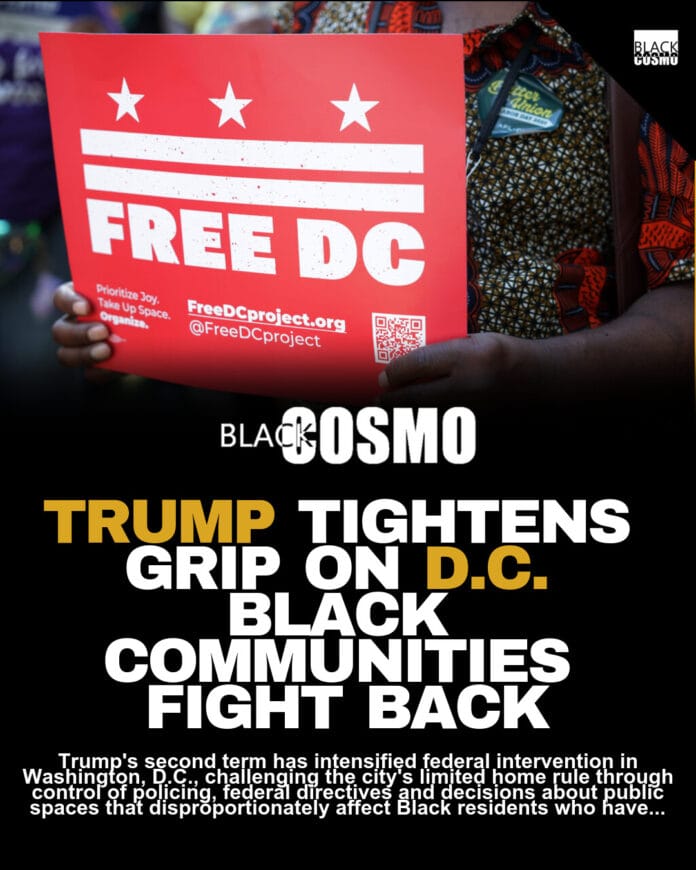
Washington, D.C. was long ago dubbed “Chocolate City,” a recognition of its significance as a place where Black residents built communities, elected leaders and created a cultural legacy that has shaped America for decades. Under Donald Trump‘s second term, a new wave of battles over who controls the capital continues to rock residents and visitors alike.
D.C. has long struggled with its lack of statehood, which many fear has opened the floodgates for the federal government to meddle in local affairs. As Trump expands its reach into policing, public spaces and local decision-making, many D.C. residents see a familiar fight resurfacing: the struggle for power, representation and the right to shape their own home. We’re looking closely at just how far Donald Trump‘s attempt to exert control in the District directly impacts Black residents.
Home Rule vs. Federal Mandates
D.C.’s Home Rule Act gives residents elected local government, but Congress and the president retain extraordinary power over the city. Trump’s second term has exposed those limits through policing decisions, federal directives and intervention in local government, reinforcing critics’ argument that democracy in the District remains incomplete.
Two Different Visions for D.C.: Statehood vs. Federal Control
For decades, many Washingtonians have fought for full statehood, arguing that more than 700,000 D.C. residents pay federal taxes without voting representation in Congress. Trump has taken the opposite approach, repeatedly arguing the federal government should exercise greater control over the city and promising to “clean up” Washington through federal intervention instead of expanding local power.
A Damaging View of D.C.

Trump repeatedly described Washington as “dirty,” “dangerous” and poorly managed, often portraying the city as an example of Democratic failure. Critics say those comments flatten a city of vibrant neighborhoods, culture and Black political leadership into a crime narrative. Supporters argue he’s highlighting public safety concerns that city leaders have failed to address.
National Guard on D.C. Streets

Trump’s deployment of the D.C. National Guard marked another flashpoint in the city’s long-running debate over local control. Unlike states, D.C. lacks a governor, giving the president unique authority over the Guard. The president said the Guard will remain in place until 2029 at a cost of $1.4 billion, according to PBS. Supporters viewed the deployment as necessary for crime reduction, but for Black residents, the policy invoked fears of a return to the “stop and frisk” era.
White House Renovations

The White House has long been intertwined with the history of Chocolate City, serving as both the seat of presidential power and a backdrop to generations of Black Washingtonians’ activism, labor and civic life. Now, with a new East Wing ballroom, redesigned gardens and marble interiors, Trump is remaking the White House to reflect his own aesthetic.
Critics argue the renovations symbolize an administration prioritizing grand projects while federal workers, housing advocates and residents face growing uncertainty. As with much of downtown D.C., ongoing construction means White House visitors should expect detours, fencing and a different experience than in years past.
The Smithsonian Under Pressure

Trump’s administration has pushed for changes at Smithsonian museums and exhibits, arguing they should promote a more “patriotic” interpretation of American history. Historians and museum professionals warn that any political interference threatens scholarly independence, especially at institutions documenting slavery, civil rights and Black history.
The National Mall in Transition
The National Mall, home to dozens of monuments, museums and D.C.’s prized cherry blossom trees, is experiencing significant changes under Trump’s administration. Visitors now encounter a landscape filled with construction fencing, renovation projects and new federal proposals. With the Reflecting Pool work, monument upgrades and Trump’s proposed Triumphal Arch, parts of America’s front yard increasingly resemble an active construction zone rather than the familiar postcard image millions expect.
The Triumphal Arch Proposal

Trump’s proposed 250-foot Triumphal Arch near Arlington National Cemetery has drawn fierce opposition from preservationists and veterans. A federal historic review found it could adversely affect 37 nearby historic landmarks and alter iconic sightlines across the National Mall and Memorial Bridge corridor, according to The Daily Beast.
The Reflecting Pool Misstep

The Lincoln Memorial Reflecting Pool holds significant meaning in Black history. It’s on the steps of the Lincoln Memorial where Dr. Martin Luther King Jr. and thousands of onlookers gathered for the March on Washington and his famous “I Have a Dream Speech.” In 2026, the pool’s proposed makeover hit major problems.
The project, which included a newly painted blue basin intended to improve reflections, instead became the subject of public criticism. Algae and discoloration quickly became talking points, according to the New York Times. The administration defended the project as necessary modernization ahead of America’s 250th anniversary.
Kennedy Center Renaming Fight

After Trump reshaped the Kennedy Center board, trustees voted to add his name to the institution. The move sparked lawsuits, artist boycotts and questions about whether the board possessed the legal authority to rename a congressionally chartered memorial honoring President John F. Kennedy. The controversy led to concerns that Black History Month celebrations would not happen at the center, as many organizations dropped out in protest, according to the Washington Post. Trump’s name was removed in June following a court order.
The Trump Effect on D.C.’s Economy

According to the Economic Policy Institute, mass federal workforce firings, uncertainty around government contracts and tourism disruptions have rippled through Washington’s economy. Federal workers represent a significant portion of D.C.’s workforce, and restaurants, office landlords and small businesses that depend on them have reported new pressures. Large federal construction projects create a different economic activity centered on infrastructure rather than local business.
Renovating Dulles Airport

Although Washington Dulles International Airport is technically located in Virginia, many D.C. residents and outside visitors rely on it for transportation. When the administration proposed a sweeping overhaul of Dulles, critics raised questions about priorities given competing transportation, housing and public service needs throughout the region, according to the Associated Press. Supporters argue the investment modernizes aging infrastructure.
Federal Control of Local Policing

Trump’s decision to seize operational control of D.C.’s Metropolitan Police Department reignited one of Washington’s oldest constitutional battles: who governs the nation’s capital? The city is currently run by Black Democrat Mayor Muriel Bowser. Many saw the move as a direct assault on Home Rule and local democracy, warning it weakened accountability to D.C. residents.
Trump’s Attacks on D.C.’s Black Leadership

Beyond his conflicts with Mayor Bowser, Trump has targeted D.C. mayoral nominee Janeese Lewis George, a Black woman and democratic socialist. Trump has accused her of supporting policies he says would harm the capital and questioned her approach to crime, policing and immigration. The president even threatened to “take over” D.C. if Lewis George becomes the next mayor.
She pushed back, saying many of his claims were inaccurate and framing the fight as a battle over D.C.’s right to govern itself. “Threatening DC because you do not like how our residents vote is an attack on democracy itself,” Lewis George said. “The people of DC elect the Mayor of DC. And they want someone who will stand up to Trump.”
ICE and D.C.’s Migrant Communities

Immigration advocates say expanded ICE enforcement has created fear that extends far beyond undocumented residents. Community organizations report families skipping work, school events and health appointments over deportation concerns. Supporters of tougher enforcement argue stronger immigration laws improve public safety and deter unlawful migration.
The Ongoing Fight for D.C. Power

Washington has changed dramatically over decades, but it remains a majority-Black political and cultural capital in ways that reach far beyond demographics. According to the Census, Black residents make up about 41% of D.C.’s population, down from more than 70% in 1970. The shift reflects decades of displacement and gentrification.
For many residents, the biggest question is whether the people who actually live in D.C. will have the power to shape their own future. As debates over policing, immigration, museums, public spaces and Home Rule continue, many Washingtonians see these fights as part of a much longer struggle over who gets to define and control Chocolate City.
★TR★