Raven-Symoné has said plenty of things over the years that made Black folks collectively pause. But what often gets overlooked in those conversations is the woman before the headlines: a child shaped by extreme discipline, intense parental control, body shaming, and a complicated relationship with a father who essentially built her career. Now, after recently reflecting on serious surgical procedures she underwent as a teenager, it’s worth taking a step back to understand the complex path that got her here.
The story of Raven-Symoné isn’t just about controversy. It’s about what happens when a Black child star is caught between parental ambition, industry machinery, and her own survival.
The Man Behind the Raven Machine
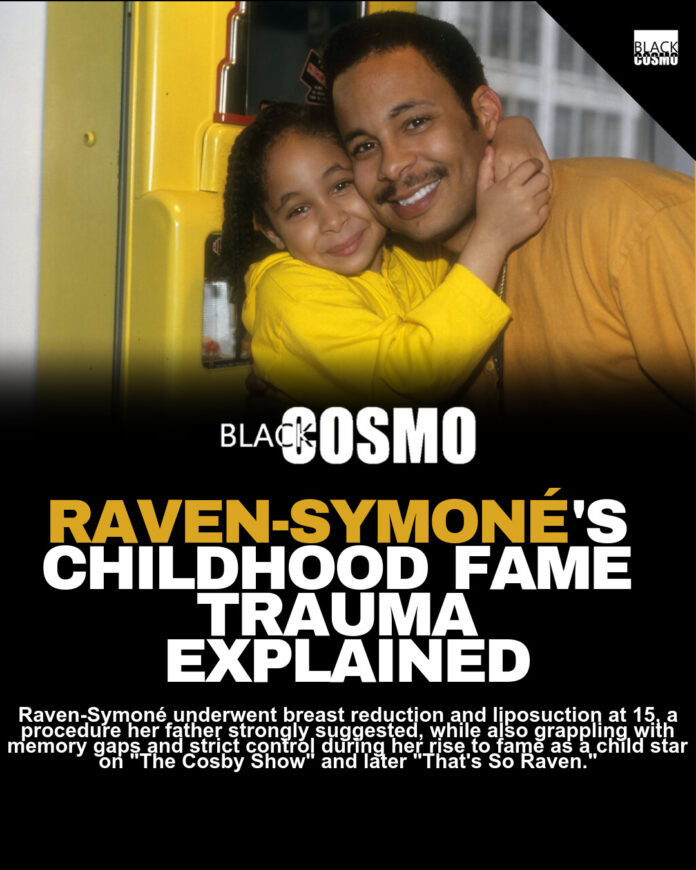
Child stardom requires responsible adults. In Raven’s case, that responsibility landed on her father, Christopher Pearman, who became her manager when she was six months old and shaped every major decision of her early career. But as she grew, so did the blurred lines between parent, manager, protector, and disciplinarian.
The relationship got complicated. Her father encouraged decisions about her body that she’d later regret. Both parents crossed personal boundaries when she was a teenager. On “The View” in March 2015, Raven shared that her parents read her diary when she was 13 and grounded her for an entire year because of what they found.
Yet Pearman wasn’t all harm.
The Good and the Controlling

Pearman took serious steps to protect Raven’s money. He made sure her earnings from “The Cosby Show” were saved instead of spent, keeping her from becoming another broke child star. Speaking to Howie Mandel in May 2023, Raven reflected on that lesson with gratitude.
“I know that there’s money, but it’s not that I’m living in that type of tax bracket on an everyday basis. I’m actually living below my means because it’s about saving for our family,” she explained. “My parents didn’t really come from money. My mom came from Louisiana, and my dad came from Atlanta. I learned how to save.”
But between strict money controls, invasions of privacy, and relentless filming schedules, Raven’s childhood meant adults had more say in her life than she did. Her father managed contracts and bookings. He was also involved in deeply personal decisions about her body and behavior. The person protecting her was the same person controlling her.
“The Cosby Show”: Years She Barely Remembers
In an October 2021 episode of TV One’s “Uncensored,” Raven revealed something unsettling: she remembers almost nothing about filming “The Cosby Show.” She credits her dissociative disorder. Instead of memories, she relies on what she calls the “folklore” her parents told her about that period.
What she does recall are fragments. The smell of soul food from Bill Cosby’s dressing room. Walking down the famous staircase. Playing with the wood before cameras rolled. But once filming started, something switched off. She discovered around age 18, through therapy, that those blank spaces were dissociation.
Every night on set, she was reminded of one thing: she had a job she couldn’t mess up. Fun was forbidden. There were rules everywhere.
“‘Don’t do this, don’t do that.’ It was a lot of rules,” she said. “It’s doing an album at five years old and staying in the studio until 1, 2 in the morning, knowing that this is the next step in your career. You just do what you got to do.”
This reframes her distant tone about those early years. Millions of people have vivid memories of her work. They remember her character. They tell her what her childhood meant to them. She’s trying to reconstruct an experience she barely lived through.
“That’s So Raven” and the Cost of Beauty Standards
That disconnect would surface again when she landed the lead on Disney Channel’s “That’s So Raven.” While audiences celebrated how much the show meant for Black girls seeing themselves on screen, what nobody knew was how harshly Raven’s own image was being judged.
The character was funny, stylish, loud, unapologetically Black. But Raven-Symoné had to fit Hollywood’s narrow beauty standards to keep her star rising. At 15, before she’d even finished puberty, she underwent a breast reduction and liposuction. The breast reduction was “strongly suggested” by her own father.
Recently, on the “Allure Perspectives” podcast, Raven opened up about those procedures with clear regret.
“I should have done it after puberty,” she said. “I mean, they still look good, but it was hastily done. I wish I was stronger to say no.”
In a December 2024 interview, she went deeper: “I went from a triple D all the way down to a B. Someone said I needed to do it in order to get a show. I have scars. I still have scar tissue to this day. And I gained weight after and had to go back for more because my breasts were still too big for others’ feelings.”
Those surgeries, the criticism about her appearance, the pressure to look a certain way—it all shaped her trajectory. She didn’t become the massive Disney star that actresses who came after her became.
Understanding the Woman Before the Controversy

Without this context, it’s easy to forget how much Raven was carrying as a kid. “The Cosby Show” made her recognizable. “That’s So Raven” turned her into the center of a full Disney machine, complete with hit music, merchandise, and millions of viewers who saw themselves in her. Keke Palmer recently pointed out that Raven wasn’t just a child actor—she was essentially her generation’s Olsen Twins.
But that pressure doesn’t disappear when cameras stop rolling. Raven spent decades being told what to say, how to look, what to eat, and how to perform. She grew up under constant public watch. That doesn’t excuse things she’s said as an adult. But it does offer context. It gives us a framework for understanding who she became.
The real question isn’t why Raven says what she says or behaves how she behaves. It’s what happens when the world makes decisions for a Black child before she’s old enough to make them herself. Surviving childhood fame, strict parenting, and worldwide criticism is one thing. Figuring out who you really are after the curtains finally close is another entirely—one that probably deserves more grace than we’ve been willing to offer.
★TR★