
Thirty years ago, 1996 proved to be a watershed moment for hip-hop narrative. In a single 12-month run, 2Pac laid down double-album street gospel on All Eyez on Me, The Fugees wove multi-layered neighborhood chronicles on The Score, and Eminem dropped raw character studies on his debut Infinite. Three decades after that legendary stretch blew open the boundaries of what a verse could paint, we looked back across the culture’s full timeline to gather the greatest masterclasses in hip-hop storytelling.
Storyteller: Common
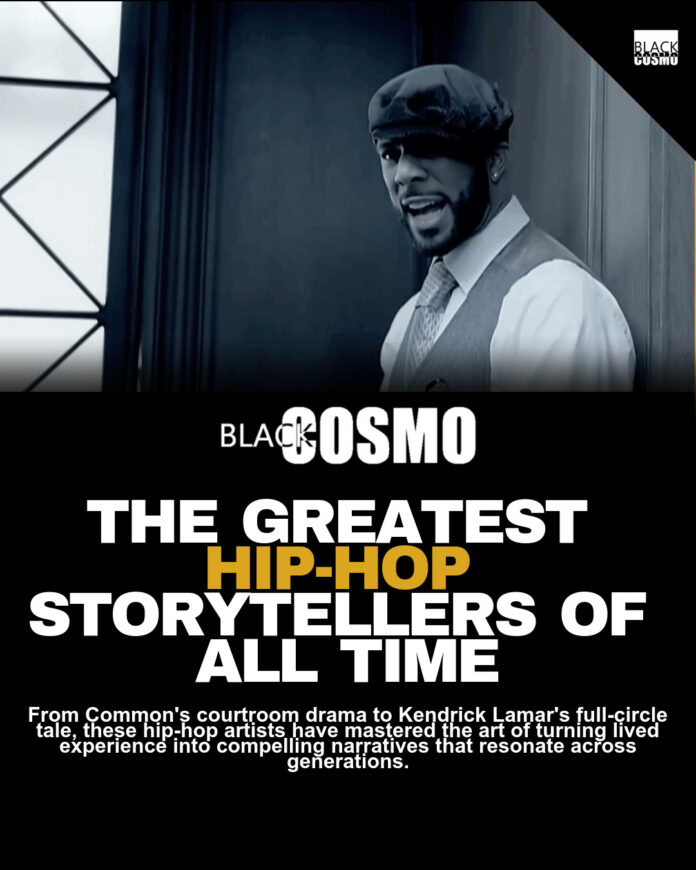
As a rapper and poet, Common has mastered wordplay and vivid storytelling through rhyme. From the streets of Chicago to Hollywood, his lived experience has turned reality into art. “Testify” stands as one of his most compelling stories—a courtroom drama twisted into a revenge plot that deserves serious study. His ability to turn personal struggle into visceral narrative made this track a standout.
The Story: “Testify”
In “Testify,” Common tells the story of a man facing life in prison for a crime he didn’t commit. The lyrical flow carries you through the weight of injustice, the courtroom’s cold reality, and what it means to face a future stolen by circumstance. It’s vinyl storytelling at its finest.
The Storyteller: Grandmaster Flash & The Furious Five

In the early days of hip-hop, Grandmaster Flash and the Furious Five established a unique form of storytelling, using lyrical precision to capture the unfiltered reality of life in the city. They weren’t performing—they were reporting.
The Story: “The Message”
“The Message” brought the realities of street life to the foreground, turning everyday struggles into one of hip-hop’s most timeless narratives. Poverty, addiction, survival, and dignity all moved through these verses with unflinching honesty. The song became a blueprint for what socially conscious rap could accomplish.
The Storyteller: Eminem

One of Eminem’s most recognizable gifts is turning his reality into complicated characters with genuine emotional weight. His narratives pull you into scenarios that feel lived-in, messy, and frighteningly real.
The Story: “Stan”
“Stan” remains a masterclass in narrative structure. The track reveals how obsession spirals into something darker, something dangerous. It’s both poetic and chilling—a record that showed hip-hop could be a delivery system for genuine horror. The ending haunts you decades later.
The Storyteller: J. Cole

J. Cole’s passion for storytelling has captivated audiences since the start of his career. His records move between introspection and social observation, grounding bigger ideas in personal moments.
The Story: “Neighbors”
In “Neighbors,” Cole draws on a real incident where law enforcement prepared to raid his North Carolina home based on false claims from neighbors. The track addresses racial profiling, assumptions, and what happens when your own neighborhood becomes a source of fear. The accompanying visual brought those feelings into sharp focus—the record wasn’t just music, it was documentation.
The Storyteller: Nas

When it comes to lyrical flow and storytelling, Nas creates worlds that feel almost cinematic. The Queens rapper builds complete narratives where you can see the details, smell the air, understand the stakes.
The Story: “I Gave You Power”
“I Gave You Power” presents a creative shift: the story unfolds through the perspective of a handgun. As Nas traces its violent journey through the hood, we’re forced to confront the object itself as a character. The record is brilliant precisely because it refuses easy answers about who bears responsibility for the harm that weapon causes.
The Storyteller: Notorious B.I.G.

If you needed a lesson in street code, Notorious B.I.G. is the artist to study. His records moved with the weight of someone who understood the cost of the life he was describing.
The Story: “The Warning”
“Warning” puts you in the middle of genuine threat. Someone is warning B.I.G. that his life is in danger, and the track chronicles what comes next—how you prepare, how you process fear, how you keep moving when the ground feels uncertain. The production mirrors the paranoia, and the lyrics cement it.
The Storyteller: 2Pac
In the early 90s, 2Pac was more than a West Coast rapper; he was a poet who could transform life lessons into rap lyrics that stuck. His catalog is filled with personal stories that capture the reality of his world—poverty, violence, resilience, and humanity all tangled together.
The Story: “Brenda’s Got A Baby”
“Brenda’s Got A Baby” turns one young woman’s story into something heartbreaking and real. Poverty, teenage pregnancy, and an unforgiving world all move through this narrative. Brenda becomes everyone we know who didn’t have the resources to escape her circumstances. The song doesn’t offer solutions; it offers witness.
The Storyteller: Kendrick Lamar

Kendrick Lamar has positioned himself as one of hip-hop’s most sophisticated storytellers. He moves between personas—Kung Fu Kenny, K.Dot—connecting personal experience, social commentary, and cultural critique into something that feels both intimate and urgent.
The Story: “DUCKWORTH.”
“DUCKWORTH.” steps outside the typical Kendrick narrative. It tells how his father, Ducky, and Anthony “Top Dawg” Tiffith crossed paths years before Kendrick signed with TDE. The unlikely connection creates a full-circle moment that reframes everything—how chance encounters shape our lives, how kindness can be your saving grace, how a single moment of mercy can echo through generations.
★TR★