
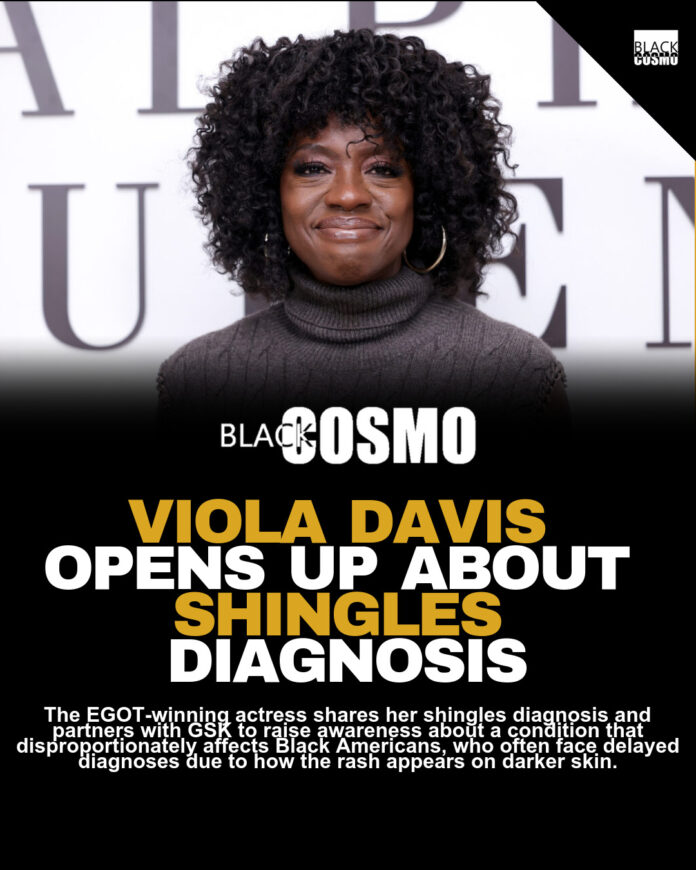
Viola Davis is opening up about a health challenge most people avoid discussing: a shingles diagnosis. Her candid revelation surfaces a larger gap in how Black Americans talk about a disease that affects millions of us, often in ways we don’t fully recognize.
The EGOT-winning actress shared her story during a recent interview with PEOPLE, discussing her partnership with GSK for their “Shingles, Actually” campaign—an initiative designed to spark honest conversations about aging and help adults 50 and older understand their shingles risk. Viola Davis described the moment she discovered something was seriously wrong with her body, tracing it back to shortly after she adopted her daughter, Genesis.
“I was a new mom,” she recalled. “I was riding off my Oscar nomination after ‘The Help.’ Working, working, working, running myself into the ground. Then I woke up with flu-like symptoms and an extraordinarily painful rash. I’d put it at a nine out of 10.”
The pain started on her stomach, wrapped around to her back, then returned with three blisters on her upper back. The nerve pain made even basic movements difficult—laying down, getting up, walking. When Davis initially suspected a poisonous spider bite, she eventually sought medical attention and received her diagnosis. She called it the “surprise of her life,” but also a turning point.
The diagnosis forced Davis to recalibrate her priorities. She’d spent years prioritizing everyone else—her daughter, her husband, her employees—believing that sacrifice defined her as a powerful modern woman. Shingles changed that calculus. Now she’s made deliberate lifestyle shifts and deeper commitments to her own wellness.
“I was there for my daughter. I was there for my husband, there for my employees, and I put all of them on a level of importance higher than myself,” she explained. “I felt that defined me as a powerful modern-day woman, that I could sacrifice my life for others. And that’s not the case for me anymore.”
What makes Davis’s story particularly relevant to Black audiences is how invisible shingles often remains in our communities. The Centers for Disease Control and Prevention estimates that about one in three Americans will develop shingles at some point, caused when the virus behind chickenpox reactivates in the body. The condition typically causes burning, tingling, itching, or shooting pain before a blistering rash appears.
But here’s what most people don’t know: on Black skin, that telltale red rash doesn’t show up the same way. Instead, it may appear purple, dark brown, or grayish—making it significantly harder to identify. Research from 2025 found that Black adults had lower diagnosed rates of shingles than white adults, yet faced higher odds of serious complications including postherpetic neuralgia and shingles-related hospitalization.
That diagnostic gap matters. Black folks should pay attention to any unusual burning, tingling, or nerve pain, especially when it appears on just one side of the body. If something feels off, ask your doctor whether shingles could be the cause, what treatment options exist, and whether you’re a candidate for the shingles vaccine to help prevent future complications.
★TR★