This summer, millions of visitors will arrive in Washington to celebrate 250 years of American democracy. Families will watch from front steps, pass them on morning commutes, welcome them. But there’s a question worth asking every single one of them.
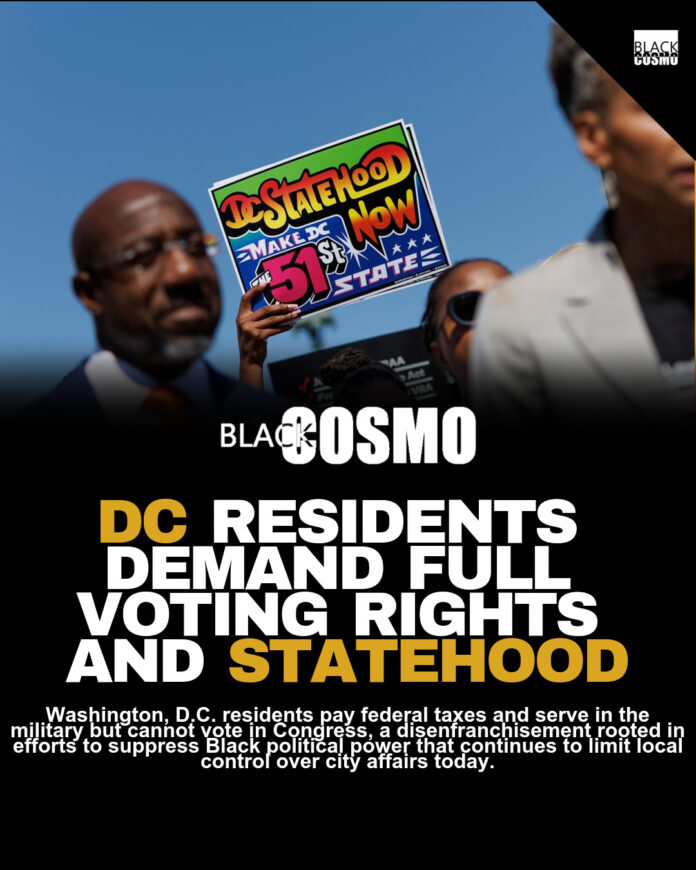
How can the cradle of American democracy be a colony? Washington DC statehood isn’t some abstract political debate. Nearly 700,000 people live here. We work. We raise children. We bury our dead. We serve in the armed forces. We pay federal taxes at a higher rate per capita than any state resident. And not one of us can cast a meaningful vote in Congress.
The answer sits rooted in the city’s history. Before the Civil War, Washington housed one of the largest free Black communities in the country. By the time war arrived, free Black residents outnumbered the enslaved. When Congress granted Black men voting rights here in 1867—over a president’s veto—Black Washingtonians organized quickly, building real political power. Congress responded in 1874 by dismantling the city’s elected government entirely, handing control to three presidential appointees. Budget scandal was the official excuse. The real fear, stated openly in Capitol hallways and city newspapers, was Black political power.
Direct federal rule lasted a century. The Home Rule Act of 1973 finally returned limited self-governance to DC residents. But Congress kept the ultimate weapon: the power to veto any law the city passes. It has never relinquished it.
Related: 13 Powerful Photos That Captured Black Resistance and Resilience Throughout History
Washington didn’t drift into disenfranchisement. It was disenfranchised deliberately, at the precise moment its Black residents gained political traction.
That history isn’t ancient. It shapes everything now. Congress has blocked the District from funding abortion care and clean-needle programs. It overturned taxes residents voted for. It reversed criminal justice reforms. Armed troops patrol the streets. Masked federal agents seize neighbors—teachers, coworkers, parents, friends—and hold them in detention. Mass federal layoffs gutted the local economy. A single line removed from a spending bill created a $1.1 billion budget hole in a city that funds itself entirely through its own tax dollars. Our money, frozen by a Congress we cannot vote out. No state would accept this arrangement. No state would have to.
The risk extends beyond DC. Federal agents have swept through American neighborhoods, separating families. What distinguishes other cities from Washington is one word: statehood. When ICE conducted militarized raids through Los Angeles last summer, California’s leadership and civil rights groups sued and won restrictions on those operations. When an immigration agent shot and killed a woman in her car in Minneapolis this January, the governor mobilized the National Guard, activated emergency operations, deployed state patrol, and told the president and homeland security secretary directly that it had to stop. Washington has no governor to mobilize. No senator to summon. No vote to withhold. When federal power comes here, nobody holds the authority or accountability to intervene.
And this is what should concern every American across all fifty states. In any democracy, people with the least power function as an early-warning system. Washington is the canary. But movements don’t succeed because the harmed cry out. They succeed when enough people outside the harm zone decide the problem belongs to them too. That’s what the Together for DC campaign does—led by Washingtonians, calling on Americans from Montana to Maine to hold their representatives accountable and support Washington DC statehood.
If you come to Washington this summer to honor what 1776 promised, know that the people living here are still waiting. In the nation’s capital, residents haven’t forgotten the country’s founding principles. Their government has. Call your member of Congress. Tell them DC residents are fellow Americans deserving full citizenship rights. Tell them this is everyone’s fight.
Will you join us?
Dorian Warren is co-president of Community Change and Community Change Action, co-founder of the Economic Security Project, and a resident of Washington, D.C.
★TR★