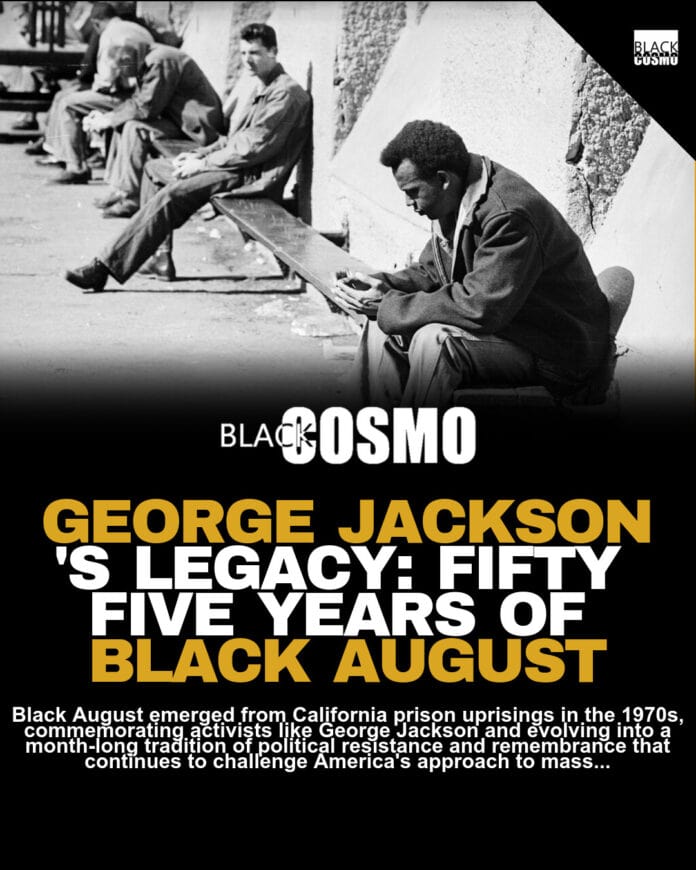
Photo of Black activist George Jackson (R), Attica Correctional Facility inmates protest (L). Bettman/ Getty Images
This Friday (Aug. 21) marks a historic milestone for one of the country’s most controversial Black liberation protests. Black August has been nearly 55 years in the making, beginning inside California’s San Quentin State Prison. But this isn’t simply a date on the calendar.
Black August grew from a turbulent chapter in history marked by prison uprisings, political radicalism, racial injustice and the deaths of men, including Black Panther member George Jackson, who became symbols of resistance. What began within prison walls eventually reached far beyond them. We’re going back to where it all started, following the people, confrontations and controversies that shaped the movement and the legacy of prison reform in America.
California’s Prison System in the ’60s and ’70s
To understand the origins of Black August, you have to go back further than George Jackson’s arrest. In the 1960s, California prisons were tense, racially divided places where incarcerated people challenged guards, prison policies and one another. In 1970, three Black prisoners – Cleveland Edwards, Alvin Miller and W.L. Nolen – were killed at Soledad Prison by a guard. Many prisoners saw the killings as racially motivated. Their deaths ignited a broader prison movement and set the stage for everything that followed.
The Arrest of George Jackson
George Jackson entered California’s prison system at 18 after pleading guilty to a $70 gas-station robbery in 1960. He expected a relatively short sentence. Instead, he received one year to life, leaving his release largely in the hands of the parole system. Prison changed him. He spent years in solitary confinement, studied revolutionary political theory and emerged as a powerful voice for incarcerated people and the Black liberation movement.
While inside, Jackson became a respected author and co-founded the Black Guerrilla Family in 1966 along with W.L. Nolen. His most famous works are “Soledad Brother: The Prison Letters of George Jackson,” published in 1970, and “Blood in My Eye,” which he reportedly finished days before his death.
The Soledad Brothers

The Soledad Brothers – George Jackson, Fleeta Drumgo and John Clutchette – were accused of killing a correctional officer after three Black prisoners were killed at Soledad. Their supporters saw the prosecution as part of a racist prison system targeting politically active Black prisoners. Their case attracted international attention, with activists including Angela Davis rallying behind them. After Jackson’s death, Drumgo and Clutchette were ultimately acquitted of the murder charges.
Jonathan Jackson’s Murder

On August 7, 1970, George Jackson’s 17-year-old brother Jonathan walked into a Marin County courthouse carrying guns. He and several others took hostages, seeking freedom for the Soledad Brothers. Police opened fire as the group attempted to leave. Jonathan, a defendant and a judge were all killed. The confrontation made Jackson’s case even more explosive, turning Jonathan into another symbol of resistance for supporters of the prison movement.
George Jackson’s Murder

One year after his brother’s death, Jackson was killed on Aug. 21, 1971, during a violent incident at San Quentin Rehabilitation Center. Officials described it as an escape attempt and uprising. Six people died, including Jackson and three officers. But the official account was never the only version of the story.
Supporters argued Jackson had been deliberately targeted and that authorities had created circumstances that made his death inevitable. The competing narratives transformed Jackson from a controversial prisoner into a martyr for a growing movement. His death became the final catalyst that led to Black August.
The San Quentin Six

After the prison revolt, six incarcerated men were charged in connection with the violence and became known as the San Quentin Six. Their trial became a national spectacle, lasting 16 months and producing competing theories about what really happened inside the prison that day.
Khatari Gaulden Enters the Story

Khatari Gaulden helped turn the growing movement into something organized. A prominent Black prison activist and member of the Black Guerrilla Family, Gaulden died in August 1978 after suffering a head injury during a football game at San Quentin. Accounts from supporters say he died due to a lack of medical attention. His death became another powerful part of the tradition’s origin story and helped push incarcerated organizers to create Black August.
Why Choose August?
August already carried a remarkable history of Black resistance. George Jackson died on Aug. 21. His brother was killed on Aug. 7. Later, activists connected Black August to other moments of rebellion, liberation and Black political history that happened during the month.
August also has a broader significance for Black Americans. It marks the recorded start of chattel slavery in America in 1619, Dr. Martin Luther King Jr.’s “I Have a Dream” speech in 1963 and the anniversary of the brutal murder of Emmett Till in 1955. More recently, the month took on new light after Barack Obama accepted the Democratic nomination for president in August 2008.
Black August means something bigger than remembering two brothers. It continues to be a way to connect generations of resistance and ask what freedom means from inside a prison cell, particularly for Black Americans.
The 1979 Black August Protest Begins

In 1979, Black August began inside San Quentin as a disciplined prison observance built around fasting, exercise, political study and sacrifice. Participants wore black armbands, avoided television and radio, and fasted during daylight hours. A protest march accompanied the observance.
More than a remembrance of fallen activists, the protest sought to transform grief into preparation while demonstrating that incarceration could not completely control their minds, bodies or political identities.
It Wasn’t Just One Day

There wasn’t a single nationwide “Black August demonstration” on Aug. 21, 1979. The story is more interesting than that. Before Black August officially began, activists had already been organizing August 21 demonstrations outside San Quentin. In 1977 and 1978, the August 21 Coalition brought different groups together to protest imprisonment and demand attention to prison conditions in Jackson’s honor.
The 1979 observance grew from that political atmosphere and from inside the prison itself. When we talk about Black August becoming national, we’re really talking about something that spread over time, building momentum with each passing year.
Who Were the Players?

Although George Jackson was the central figure whose death gave August 21 its emotional weight, no single founder took credit for the movement. Jonathan Jackson represented another chapter of the struggle. Khatari Gaulden helped shape the emerging tradition. The Black Guerrilla Family played an important organizing role inside San Quentin, while outside activists, lawyers and supporters connected prison struggles to the larger Black liberation movement.
Black August Grows

Black August gradually spread through California prisons and into activist communities beyond the state. Its meaning expanded as well. It became a month for political education, remembering incarcerated activists and studying the history of Black resistance. The practice remained deliberately disciplined rather than celebratory: fasting, reading, exercising and reflecting were all ways of turning remembrance into action.
National Response to Black August

Coming on the heels of former President Richard Nixon’s War on Drugs and in the middle of the Black liberation movement, Black August never became a mainstream national holiday. For decades, it remained largely underground. That was partly the point.
Its association with prison radicalism, the Black Guerrilla Family and revolutionary politics made it controversial outside activist circles. Critics saw a tradition that risked glorifying violence. Supporters saw something else: a challenge to a prison system they believed criminalized political resistance and erased the people who fought it.
The Legacy of Black August in 2026

Black August forced America to reckon with who is considered a criminal, who is a political prisoner and whose version of history survives. Its themes now intersect with conversations about mass incarceration, police violence and Black Lives Matter. Over five decades later, the tradition remains deliberately uncomfortable. It asks Americans to look behind prison walls and consider whether remembrance itself can be an act of resistance.
What Has Changed in 55 Years?

Black August has also become a month to remember events such as the Haitian Revolution, Nat Turner’s rebellion, the Watts uprising and, decades later, the Ferguson unrest of 2014. It has connected different generations of resistance, from enslaved people to prisoners to modern movements against police violence and mass incarceration.
In 2026, when debates over policing and federal intervention remain especially visible, civil rights and prison activists are continuing the legacy of one of the greatest prison demonstrations in history. The original questions still hang there: Who gets remembered? Whose version of history survives? And what happens when the people writing that history are the ones the system has locked away?
★TR★