The November 2026 midterms are shaping up to be as much about Black political power as they are about which party controls Congress. From potential historic firsts to redistricting battles threatening incumbents, Black midterm races across the country could reshape policy and opportunity for Black America. Here’s what’s at stake in some of the most consequential contests.
Black midterm races reveal how representation and who gets a seat at the table matter. Some candidates are pursuing historic firsts. Others are fighting against redistricting designed to weaken their power. All of them are testing what Black voters want from their elected officials.
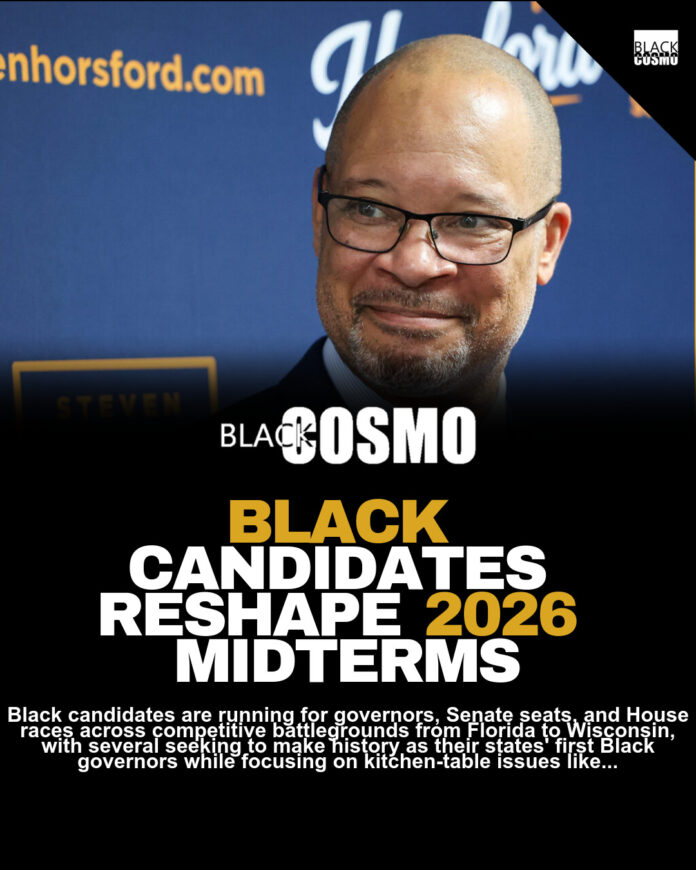
Aaron Ford
Nevada Attorney General Aaron Ford is making a play for the governor’s mansion, pitching affordability, public education and defending residents against federal overreach as the centerpiece of his campaign. The challenge for Ford is convincing voters that his record in the attorney general’s office translates to governing a state. Since he’s term-limited, this is an open-seat race rather than a reelection bid, which changes the political calculus considerably.
Keisha Lance Bottoms
Former Atlanta Mayor Keisha Lance Bottoms is pursuing a breakthrough that would make her Georgia’s first Black woman governor. History alone won’t win this race, though. Her pitch centers on the kitchen-table issues: lowering household costs, strengthening schools and expanding Medicaid. She’s emphasizing these bread-and-butter concerns over identity politics as she navigates a challenging statewide landscape where Republicans hold a structural advantage.
Maxwell Frost

Incumbent Rep. Maxwell Frost is running for reelection with no opposition. That puts him among the safer candidates this cycle, but his unopposed status itself sends a message: younger Black and Latino progressive leadership is becoming central to the fight over Congress’s future. Frost’s focus on gun violence, climate action and economic justice speaks to voters demanding more than symbolic representation. Florida’s shifting political map means his district boundaries are still worth monitoring.
Byron Donalds

MAGA Republican Byron Donalds is campaigning to become Florida’s first Black governor, a historic possibility that raises sharp ideological questions. Who benefits from his version of conservative leadership? Donalds is promising tax cuts, insurance reform and greater health-care transparency. Democrat David Jolly offers a contrasting vision, setting up a consequential test of whether Florida voters want continuity with the DeSantis era or a change in direction.
Priscilla Williams-Till
Priscilla Williams-Till, cousin of Emmett Till, is bringing an education, public-health and community-advocacy background to Mississippi’s governor’s race. After losing the Democratic Senate primary, she pivoted to the gubernatorial contest, where the stakes for Black families are enormous. Her message emphasizes justice, opportunity and making government work for communities too often left behind.
Christian Menefee

Texas Rep. Christian Menefee defeated longtime incumbent Rep. Al Green in a high-stakes Democratic runoff after redistricting reshaped the district. Now the focus shifts to the general election and whether he can defend the seat against Republican Ronald Whitfield. For Black Texans, this contest is about representation, voting power and who gets to speak for Houston’s historic Black political stronghold.
Everton Blair

Everton Blair brings an educator’s lens to Congress, highlighting teacher pay, student services and working families as he builds a political identity. His special-election victory following the death of David Scott gave him a place in Washington, but the question now is whether voters will grant him a full term. For Black Georgians, his rise expands the conversation about representation, LGBTQ+ inclusion and whose experiences shape federal policy.
Wes Moore
Maryland Gov. Wes Moore’s reelection fight is about proving that historic representation can coexist with measurable results. He’s campaigning on affordability, public safety, jobs and stronger schools, while Republican Dan Cox offers a sharp ideological contrast. Moore is currently the only Black governor in the country, a fact that adds weight to this race beyond state boundaries.
Don Davis
North Carolina Rep. Don Davis is fighting for political survival in one of the clearest examples of how redistricting threatens Black representation. Republican lawmakers reshaped his district to favor the GOP, setting up another showdown with Laurie Buckhout, whom Davis narrowly defeated in 2024. The new district leans substantially more Republican, making this a genuine toss-up rather than a safe incumbent seat.
Jermaine Johnson

Rep. Jermaine Johnson is trying to make South Carolina history while campaigning on economic opportunity and support for working families. The state representative and former professional basketball player is running to become the state’s first Black governor. That breakthrough would carry significance far beyond one election. But Republicans hold a powerful statewide advantage, so Johnson must persuade voters that his agenda offers a credible alternative, not just a historic candidacy.
Angie Nixon
Angie Nixon is taking a grassroots, working-class message into a Florida Senate race where Democrats face steep statewide headwinds. Her focus on rent, gas prices and housing costs puts everyday economic pressure front and center. A win would make her Florida’s first Black U.S. senator, though her challenge to party insiders raises questions about whose voices get prioritized within Democratic politics.
David Crowley

Milwaukee County Executive David Crowley would make history as Wisconsin’s first Black governor if elected. His race has been shaped by crime, affordability and the state’s deep partisan divide. Republican Tom Tiffany is attacking Crowley’s record on public safety and taxes, while Crowley is challenging Tiffany’s ties to Trump. Fact-checks have pushed back on some of the sharpest crime claims, but the contest remains close and could reshape Wisconsin’s political future.
N’Kiyla “Jasmine” Thomas
N’Kiyla “Jasmine” Thomas is bringing a nurse’s perspective to Oklahoma’s Senate contest, emphasizing health care, accountability and the struggles of families navigating disability services and economic insecurity. Her candidacy offers a different voice in a state where Democrats face a steep climb. The immediate question is whether her grassroots appeal can build enough support to compete in a Republican stronghold.
Letitia James

Letitia James is seeking another term as New York’s attorney general, defending a record built on consumer protection, civil rights and high-profile legal battles with powerful interests. Republican challenger Saritha Komatireddy is trying to turn public-safety concerns and criticism of James’s national profile into an opening. For Black voters, the stakes include how aggressively the state uses its legal power to defend civil rights and how it balances that mission with everyday concerns about safety and accountability.
Juliana Stratton
Juliana Stratton is trying to turn her tenure as Illinois lieutenant governor into a seat in the U.S. Senate, with affordability and health care at the center of her campaign. She’s promising a $25 federal minimum wage, Medicare for All and stronger protections for working families. Her fiery anti-Trump ads energized the primary, but the general election against Republican Don Tracy will test whether that message can hold a broad coalition together.
★TR★