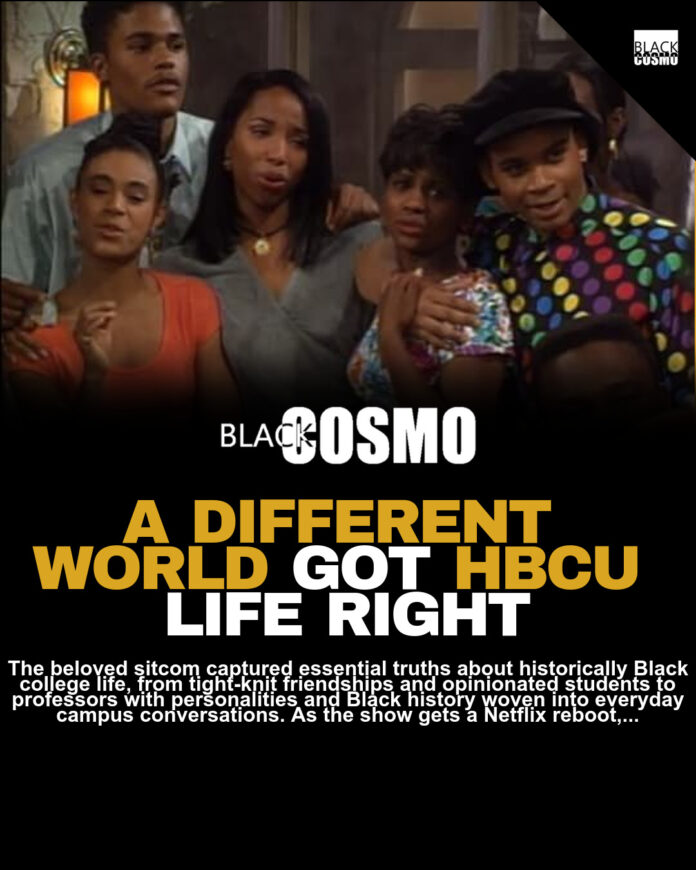
Hillman College wasn’t real, but tell that to anybody who attended an historically Black college or university. For all its sitcom exaggerations, A Different World understood the rhythms of Black college life: the students with big personalities, the professors with even bigger opinions, the campus romances, the parties, the politics and the debates that could turn a casual conversation into a full-blown symposium.
It showed HBCUs as places where students were learning about the world and themselves while surrounded by a community that could challenge them, celebrate them and occasionally get on their last nerve. As folks tune in for the A Different World reboot on Netflix, here’s a look back at the original and everything Hillman got surprisingly right about our HBCUs.
Attending an HBCU Is Its Own World
Hillman College worked because it felt like more than a fictional campus. It had traditions, rivalries, personalities, politics, parties, classrooms and inside jokes. That same philosophy is also part of what makes HBCUs distinctive. Walk onto a Black campus and you’ll hear students or professors joke about being in their own little “HBCU bubble.” College life isn’t simply about earning a degree. It’s about entering a community with its own history, language and culture.
Everybody Knows Everybody

At Hillman, anonymity was basically impossible. Professors knew students beyond their grades, friends knew everybody’s business, and campus personalities became unofficial celebrities. That familiarity captures something many HBCU graduates recognize: a campus can feel like a university, neighborhood and extended family all at once. And sometimes that means there’s nowhere to hide.
Friendships Are the Real Curriculum

Whitley, Dwayne, Freddie, Ron, Kim and the rest of the Hillman crew showed how friendships become central to the college experience. They argued, dated, competed, supported each other and occasionally drove one another crazy. The show understood that your people often become the most memorable part of your education.
At our HBCUs, the same concepts exist. When you spend four years with the same folks, you see them in your classes, at the cafe and at off-campus functions. You build long-standing bonds with students from all over the world. That is the real prize of attending an HBCU.
Professors Have Lives Too

Hillman’s professors weren’t just casual figures who appeared when someone needed an assignment explained. They had personalities, opinions, expectations, complicated relationships with students and most importantly, they had lives outside of school. The same applies to HBCU professors. Beyond being educators and mentors, they are human beings with families, second jobs and their own storylines.
Black History Is Not Just an Elective

Hillman treated Black history, politics and culture as parts of everyday intellectual life, not decorations reserved for February. Characters debated race, identity, economics, gender and social responsibility. The show understood something fundamental about HBCU education: studying Black people’s experiences means questioning the world around you, not memorizing historical dates.
HBCU Students and Strong Opinions
HBCU students are taught to be opinionated, passionate, assertive and driven. The same can be said for Hillman students. Whether debating politics, Africa, feminism, environmentalism, entrepreneurship or social justice, the show captured the argumentative energy of campus life. Young adults are figuring out what they believe while discovering that everyone else has an opinion too.
HBCU Campus Turned Fashion Runway

Hillman understood that campus style was communication. Characters arrived in bold colors, statement pieces, professional looks and unmistakably late-’80s and early-’90s fashion. From Dwayne Wayne’s flip-up glasses and Jordans to Whitley’s preppy suits, the clothes weren’t just costumes. They reflected personality, ambition and cultural confidence, showing how HBCU campuses have long been spaces where students experiment with identity.
HBCU Pride Is Bigger Than School Colors
At Hillman, rivalries, traditions and campus identity mattered. That exaggerated-but-familiar devotion is part of HBCU culture: your institution becomes something you carry with you. Years later, saying where you went to school can instantly create a connection, spark a conversation or ignite a debate on which school is the best.
Dating at an HBCU
Hillman’s romantic entanglements were complicated, messy and often public. Couples broke up, got back together, caught feelings and tried to remain friends. Meanwhile, their friends provided unsolicited commentary. The show captured the particular chaos of dating in a close-knit college community where your relationship status can become campus news remarkably quickly, which many HBCU students know all too well.
With Dwayne and Whitley, the show also depicted what a long-lasting HBCU love story looks like. You probably know of at least one real-life example of a married couple who found love at their HBCU.
HBCU Students and Their Many Hobbies

Hillman students weren’t simply trying to pass their classes. They were figuring out careers, relationships, politics, identity and adulthood. That ambition is one of the show’s strongest reflections of HBCU life. The campus is a launchpad. Students are encouraged to imagine themselves as professionals, leaders, artists, entrepreneurs and community builders.
Black Excellence Is the Standard
One of Hillman’s most important details was that Black achievement didn’t have to be explained or treated as extraordinary. Brilliant students, professors, doctors, lawyers and future leaders existed throughout the community. The show made intellectual ambition feel ordinary, and that is precisely the point. Excellence isn’t an exception on HBCU campuses. It is part of the environment.
HBCU Life Could Be Messy Too
“A Different World” never suggested that Black college communities were perfect. Students could be immature, professors could be difficult, friendships could implode and serious disagreements could divide people. That representation and honesty were key to the show’s success. Celebrating HBCUs doesn’t require pretending they are flawless. The show made room for conflict, contradiction and growth alongside pride and community, just as it exists in real life.
Having Difficult Conversations on Campus

Hillman frequently used comedy to tackle subjects that could otherwise become lectures: racism, sexism, class, politics, relationships and cultural identity. That balance felt authentic. Comedy is a historic tool Black folks have used to deal with the toughest of times.
While there is no built-in laugh track at Bowie State University or Xavier University, HBCUs create environments for students to have heated debates and difficult discussions about the world around them. College students can have a serious debate about society at noon and spend the evening clowning their roommate. Humor isn’t separate from serious conversations. It’s often how people survive them.
Celebrity Appearances
Throughout the series, countless celebrity guest stars from Tupac Shakur and Heavy D to Gladys Knight and Halle Berry showed up on our screens. Believe it or not, that wasn’t as far-fetched as it sounds. HBCU campuses have long been magnets for celebrities, entertainers and cultural icons who regularly stop by to perform, speak, recruit, celebrate and occasionally cause a little campus chaos. As we inch closer to homecoming season, you can expect the stars to show up across the 107 Black colleges in the U.S.
Are Campus Parties Really Part of Your Grade?

Let’s be honest: nobody remembers college exclusively for office hours. Hillman’s parties, dances, step shows and social gatherings reflected how campus culture extends far beyond academics. HBCU social life has its own traditions and rituals, creating spaces where music, fashion, flirting, friendship and school pride all collide.
HBCUs Feel Like Home
Ultimately, Hillman’s greatest achievement was simple: creating a space that feels like home. It showed college as a place where students could discover themselves while surrounded by people who understood pieces of their experience. That feeling of being challenged, celebrated, corrected, entertained and occasionally humbled by your community is why “A Different World” still resonates with generations of HBCU students and alumni.
★TR★