
DORTMUND, GERMANY – JUNE 22: former president of Liberia Ellen Johnson-Sirleaf laughs during the German Protestant Kirchentag on June 22, 2019 in Dortmund, Germany. (Photo by TF-Images/Getty Images)
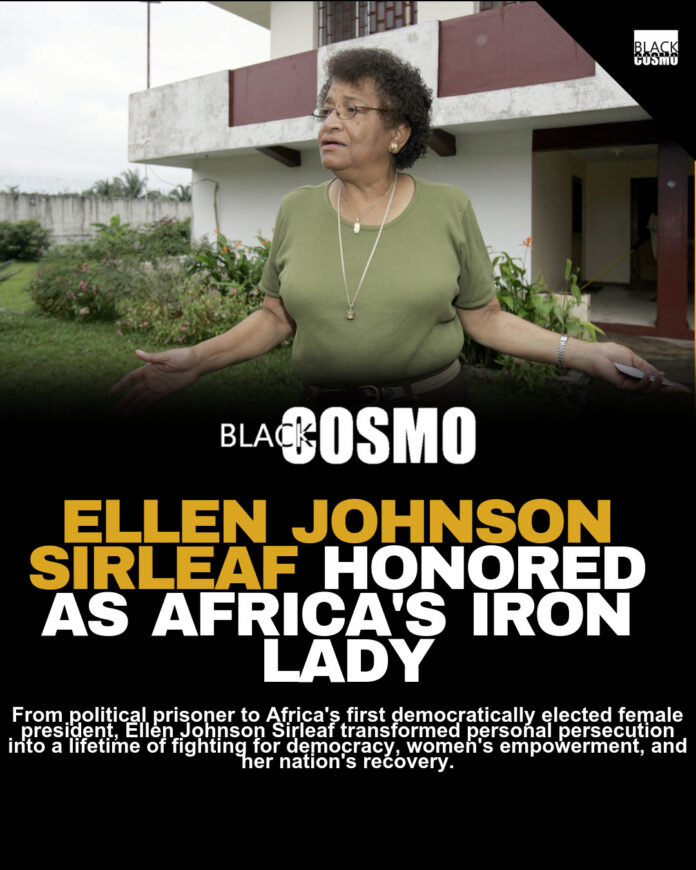
Long before Ellen Johnson Sirleaf made history as Africa’s first elected female president, she was a political prisoner who faced severe persecution. Yet every trial only sharpened her resolve. Around this time in 2011, her tireless fight for democracy earned her the Nobel Peace Prize—just days before Liberians overwhelmingly re-elected her to lead them into an era of stability. Today, her legacy stands as a testament to courage, women’s empowerment, and freedom. As she approaches her 88th birthday on Oct. 29, Ellen Johnson Sirleaf continues to inspire generations of leaders across the continent.
Born in Monrovia, Bound for History
At 17, she married James Sirleaf, a teacher, in Monrovia. By 32, she was a Harvard graduate ready for the world stage. The mother of four sons worked as a bookkeeper for an auto-repair shop before launching her career in Liberia’s Treasury Department. She had studied accounts and economics at the College of West Africa in Monrovia.
She traveled to America in 1961 and continued her studies at the University of Colorado and Harvard University from 1969 to 1971, earning a master’s degree in public administration.
Uncompromising Integrity
She became the Assistant Minister of Finance in 1972 under President William Tolbert but clashed with government officials over spending. That decision to leave for the World Bank proved prescient, positioning her to rescue a shattered nation’s economy from the ashes of war years later.
Speaking the Truth

While in that position, she gained attention with a bombshell speech in 1972, when she told the Liberian Chamber of Commerce that the country’s corporations were harming the economy by sending their profits overseas.
The Refusal to be Silent
When Master Sergeant Samuel Doe seized power in a brutal military coup in April 1980, Ellen Johnson Sirleaf was one of the few government leaders who refused to fall in line. She was one of only four cabinet ministers spared execution, but Doe’s grip on power tightened. After he declared himself president in 1984, she made the risky decision to return and challenge his dictatorship.
During the 1985 elections, Johnson Sirleaf campaigned against Doe and was placed under house arrest after she repeatedly blasted his regime for corrupt fiscal policy and human rights abuses.
Violent Intimidation
Facing constant death threats for speaking truth to power, she was forced to flee into exile in Kenya, where she served as vice president of Citicorp’s Africa Regional Office in Nairobi. She later moved to Washington, D.C., to take on roles as senior loan officer at the World Bank and vice president for Equator Bank.
Sentenced to Prison

In September 1985, she spoke out against the military regime once again. She was placed under house arrest before being found guilty of sedition—conduct that incites people to rebel against an established government—and sentenced to 10 years in a prison camp.
International pressure forced the regime to release her early. She fled the country in secret to survive.
Political Exile
Fleeing Liberia under cover of darkness, Sirleaf spent the next two decades mobilizing global support from Washington, Nairobi, and Geneva. She took massive political risks, including a failed 1997 presidential bid against warlord Charles Taylor, refusing to let two civil wars destroy her homeland.
The Road to the Presidency
By the time Taylor was forced out in 2003, Sirleaf was the only leader left standing with the credibility, international stature, and iron resolve to rebuild Liberia. She became known as “Africa’s Iron Lady” for good reason.
The Ballots That Made World History

In November 2005, following the end of Liberia’s fourteen-year civil war, Ellen Johnson Sirleaf did what once seemed impossible: she defeated soccer icon George Weah in a democratic runoff election to become president of Liberia. Her victory marked a seismic turning point for the continent, making her Africa’s first democratically elected female head of state.
A Historic Win
Her inauguration on January 16, 2006, in front of world dignitaries was more than a transfer of power. It was a global triumph for female representation and democratic governance. But the win didn’t come without enormous hurdles.
A Country’s Rebirth
Facing billions in foreign debt and destroyed infrastructure, President Sirleaf immediately rolled up her sleeves. During her two terms, she attracted over $16 billion in foreign direct investment and more than $5 million in private resources to rebuild schools, clinics, and markets while funding scholarships.
She also successfully negotiated $4.6 billion in external debt forgiveness and the lifting of UN trade sanctions, allowing Liberia to access international markets again. The national budget jumped from $80 million in 2006 to over $672 million in 2012.
Well-Deserved Global Acclaim

In 2011, President Sirleaf was awarded the Nobel Prize for Peace, recognized as a global leader for women’s empowerment. She’s also the recipient of the United States’ highest civilian award, The Presidential Medal of Freedom, for her personal courage and unwavering commitment to expanding freedom and improving the lives of Africans.
Honoring an Icon

Today, the grandmother to six children continues to champion female leadership across Africa. Through her foundation, The Ellen Johnson Sirleaf Presidential Center for Women and Development, she mentors the next generation of women leaders while advocating globally for public health and democratic governance.
★TR★