
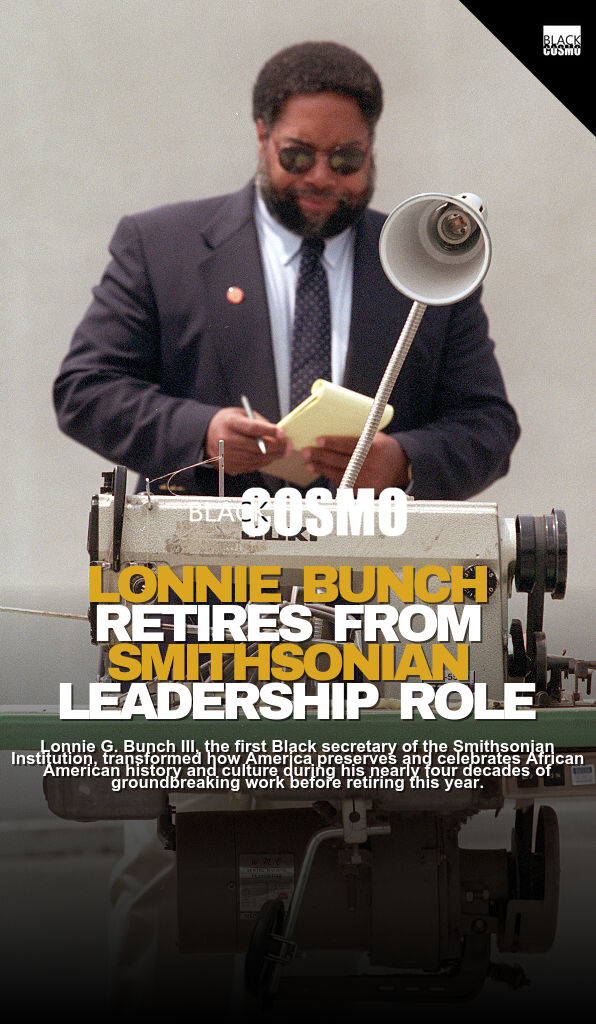
As the first Black secretary of the Smithsonian, Lonnie G. Bunch III is a visionary who spent nearly four decades reshaping how America confronts its history. This week, he announced he will retire by the end of the year, marking the close of a transformative era. He made it his life’s work to give Black culture the institutional recognition it always deserved. The Root recently looked back at the legacy of Lonnie G. Bunch III and what his departure means for the future of American museums.
From New Jersey to Washington, D.C.
Bunch grew up in Belleville, New Jersey, the only Black family in his neighborhood. His parents were public school teachers—his mother taught third grade, his father taught science and chemistry. The racism he encountered from white teenagers during his childhood could have hardened him. Instead, he channeled those painful experiences into purpose.
“I was in junior high, and we were reading biographies of historic figures. I remember one on Gen. ‘Mad Anthony’ Wayne, and one on Clara Barton, and Dorothea Dix,” he recalled in a 2011 interview with NJ.com. “I thought, ‘Were there no histories of Black people?’ One day, I was going through my grandfather’s trunk and I found a book about Black soldiers in the First World War. I devoured it.”
The Calling Takes Shape

After attending Howard University, Bunch joined the National Air and Space Museum in 1978 as an education specialist. He was hired by Michael Collins, the former Apollo 11 astronaut who directed the museum at the time. Bunch’s early career took him to the California African American Museum as its first curator, then to the National Museum of American History from 1989 to 1994, where he continued building his expertise in exhibition design and curatorial practice.
173 Years in the Making

On May 28, 2019, the Smithsonian Board of Regents shattered a 173-year-old ceiling when they named Bunch as its 14th Secretary. For the first time in the Institution’s history, a Black man was chosen to lead one of the world’s largest museum complexes—overseeing 19 museums, 21 libraries, and the National Zoo.
Building From Nothing

When Bunch was appointed director of the National Museum of African American History and Culture in 2005, the vision existed on paper only. No building. No collection. Skeptics insisted that significant African American artifacts simply didn’t exist in sufficient quantity. Bunch refused to accept that premise.
He launched “Save Our African American Treasures,” a nationwide grassroots initiative that asked Black families to open their attics, basements, and trunks. Starting in Chicago in 2008, museum teams traveled to cities across America, hosting day-long workshops where families could bring out heirlooms and family artifacts. The effort surfaced sacred pieces of history—Harriet Tubman’s personal 1876 hymnal, Emmett Till’s original glass-topped casket, and countless other treasures that had been preserved in private hands for generations.
Eight Months to History

Before his work on the African American museum, Bunch demonstrated his curatorial prowess with “The American Presidency: A Glorious Burden,” an exhibition at the National Museum of American History that he curated, built, and opened in just eight months. The permanent exhibition opened in November 2000 and spanned more than 900 historical objects, including Thomas Jefferson’s portable writing desk and Abraham Lincoln’s inkstand used to sign the Emancipation Proclamation. The speed and quality of execution established his reputation as someone who could realize ambitious visions under pressure.
A Champion for the Excluded

As secretary, Bunch didn’t limit his vision to Black history alone. He championed the creation of both the Smithsonian American Women’s History Museum and the National Museum of the American Latino, leveraging his authority to ensure that stories long excluded from the National Mall found permanent institutional homes. His tenure expanded what the Smithsonian considered worthy of preservation and display.
The End of an Era

After 38 years reshaping how America remembers its past, Bunch announced on Tuesday, September 8, that he will step down from his position before the year’s end.
“I have spent nearly half of my life working at and being part of the Smithsonian family, and what a privilege it has been,” Bunch said, according to NBC News. “There is no place like the Smithsonian—it has been one of the great loves of my life, and I am extraordinarily proud of what we have accomplished together.”
In his statement, he reflected on his retirement “with very mixed emotions and heartfelt gratitude,” acknowledging the weight of stepping away from work that has defined his professional life and shaped American cultural memory.
★TR★