
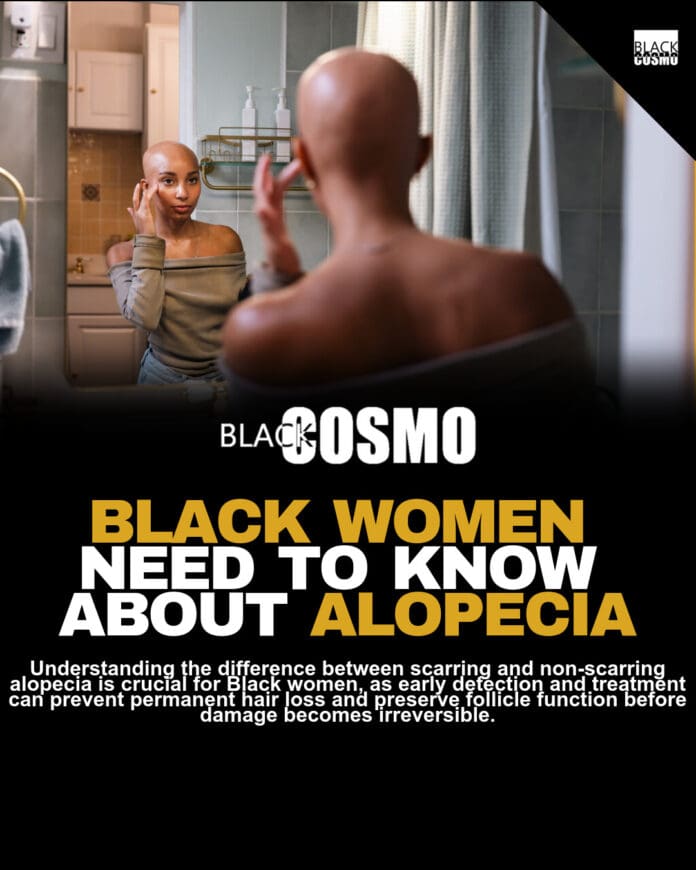
August is Hair Loss Awareness Month, and for many Black women, the reality of alopecia is deeply personal. Public figures like U.S. Congresswoman Ayanna Pressley and actress Jada Pinkett Smith have helped raise awareness by speaking openly about their diagnoses. But alopecia isn’t a single condition. It encompasses scarring and non-scarring forms, each with different causes, symptoms, and treatment approaches. Understanding the distinction matters, especially for Black women, who face particular risks with certain types.
Metro-Detroit dermatologist Dr. Bobbi Edwards recently spoke about what Black women should know regarding alopecia diagnosis and care. Her insights offer practical guidance for anyone concerned about hair loss.
Scarring Versus Non-Scarring Alopecia
Scarring alopecia involves inflammation that can permanently damage hair follicles, preventing regrowth. The main types include Central Centrifugal Cicatricial Alopecia (CCCA), Lichen Planopilaris (LPP), and Frontal Fibrosing Alopecia (FFA), which is considered a variant of LPP. According to the Cleveland Clinic, CCCA is the most common scarring form among Black women, typically starting as a small spot on the crown, though it can also affect the forehead, temples, or lower scalp.
Non-scarring alopecia, including alopecia areata, involves different mechanisms. Genetics play a significant role here, but inheritance patterns can be complex. The condition can come from either parent, skip generations, and vary in severity. Other non-scarring types include traction alopecia, drug-related hair loss, and loss tied to metabolic or hormonal changes.
Edwards emphasized the connection between CCCA and trauma specific to Black hair care practices. “Everything that we do is traumatic, and we do it at a frequency that is very high,” she noted. Relaxers carry particular risk since they’re typically reapplied every six to eight weeks. Permanent color, high-heat styling, and tension from braids, weaves, and wigs all contribute. Glue-based extensions can trigger dermatitis and subsequent hair loss during removal.
Why Scarring Alopecia Can Go Undetected
One major challenge with scarring alopecia is its slow progression. Edwards explained that women can lose 30 to 40 percent of their hair before noticing visible changes. Early on, the scalp may resemble “pegs missing from a pegboard,” with scattered strands missing before a larger patch becomes apparent.
Some people experience scalp tenderness, but many have no symptoms at all. Edwards recommends regular scalp checks by a stylist or trusted friend or family member, since early changes are often easier for someone else to spot than for the person experiencing it.
How Different Forms of Alopecia Appear
Scarring alopecia presentations vary by type. CCCA typically begins at the crown but can affect the forehead, temples, or back of the scalp. Lichen planopilaris may cause redness, hyperpigmentation, and thinning across the scalp. Frontal fibrosing alopecia starts at the hairline and gradually moves backward, often leaving smooth skin behind. FFA has a distinctive marker called the “lonely hair sign,” where a single strand remains along a receding hairline.
Non-scarring alopecia looks different. Alopecia areata frequently creates smooth, round patches that appear as though someone placed a quarter on the scalp and shaved beneath it. It can range from a single patch to complete hair loss across the scalp and body. Other non-scarring forms include traction alopecia and hair loss tied to hormonal or metabolic conditions.
What to Expect During a Hair Loss Evaluation
Edwards recommends arriving at an evaluation with freshly washed, unstyled hair and no styling products so the scalp can be thoroughly examined. The appointment typically includes questions about styling habits, hair products, and family history, followed by photographs, blood work, and sometimes a punch biopsy. The biopsy involves numbing the scalp, removing a small tissue sample, and placing a couple of stitches. Results usually arrive within about ten days.
Why Early Treatment Matters
Treatment options for alopecia areata have shifted considerably in recent years. Traditionally, care included topical or oral minoxidil and injectable or topical corticosteroids. Edwards noted that FDA-approved JAK inhibitors have expanded options for people with more severe disease.
For scarring alopecia, the goal is stopping inflammation before follicles are permanently destroyed. There’s often a window when follicles are damaged but not yet irreversibly gone, making early diagnosis and intervention critical. Depending on disease stage, treatment may reduce inflammation, promote some regrowth, or stabilize hair loss.
For permanent loss, options are case-specific but may include hair transplantation or scalp micropigmentation, sometimes called a hair tattoo. Edwards emphasized that people shouldn’t assume current treatment options mirror what was available even a decade ago.
For women who feel embarrassed, isolated, or reluctant to seek help, Edwards offered reassurance: “You are not alone.” She encouraged anyone concerned to see a dermatologist with special expertise in hair loss, ideally an MD or DO experienced in diagnosing and treating alopecia.
★TR★