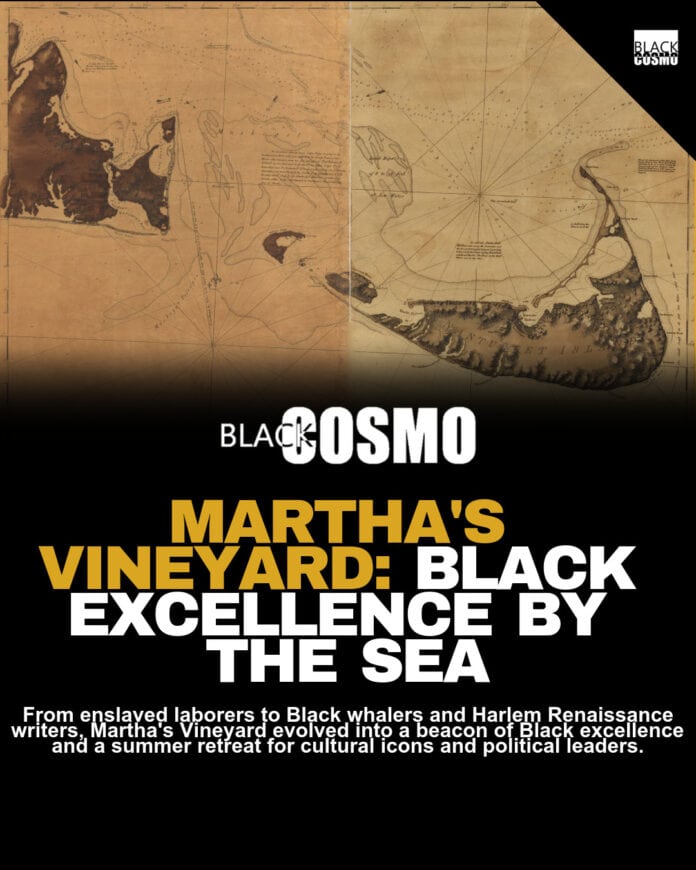
UNITED STATES – JANUARY 11: Cottages, Oak Bluffs, Martha’s Vineyard, Massachusetts (Photo by Carol M. Highsmith/Buyenlarge/Getty Images)
If you think Martha’s Vineyard is just about yachts and lobster rolls, think again. As thousands prepare to gather in Oak Bluffs this month for the 24th Annual Martha’s Vineyard African American Film Festival (MVAAFF), the island’s real story emerges—one built on centuries of Black resilience, creativity, and economic power.
From Black whalers who commanded ocean voyages to Harlem Renaissance writers who transformed a cottage into a literary sanctuary, Martha’s Vineyard has been the go-to summer capital of Black excellence long before the red carpets rolled out. The island’s gorgeous, historic landscape tells a story that deserves far more than a passing glance.
Before the Red Carpets
The vibrant energy in Oak Bluffs—Martha’s Vineyard’s historic and community-centered town—wasn’t curated overnight. It was forged over two centuries of unbroken Black heritage and deliberate resistance.
The island itself, made up of six distinct towns, each with its own personality and local culture, holds deep roots. To the indigenous Wampanoag people who inhabited it for thousands of years, it’s known as Noepe, which translates to “land amid the waters.” The Wampanoag farmed, fished, and thrived in unified community long before European settlement changed everything.
How the Island Got Its Name

In 1602, English mariner and explorer Captain Bartholomew Gosnold sailed across the Atlantic aboard the Concord to explore the New England coast. When he came across the 96-square-mile island, he was immediately struck by the abundance of wild grapevines covering the land.
He named it “Martha’s Vineyard”—”Vineyard” for the lush vines, and “Martha” in honor of his infant daughter, though some historians argue it honored his mother-in-law, Martha Golding. Either way, the English name erased the Wampanoag identity in a single gesture.
Enter Colonization

The right to settle on the island was purchased from aristocrats in England by settler Thomas Mayhew Sr. in 1641—without the consent or knowledge of the Wampanoag people who actually lived there. Mayhew declared himself “Governor for Life” and “Lord of Tisbury Manor,” and his descendants controlled island politics, land sales, and trade for decades.
Slavery’s Roots on Martha’s Vineyard

While Martha’s Vineyard is celebrated today as a haven of Black joy, its earliest Black residents didn’t arrive as vacationers. They arrived in chains.
Beginning in the late 1600s, wealthy English colonists relied on enslaved African labor to clear fields and work the island’s farms. Though the scale was small compared to Southern plantations, by the 1700s, enslaved individuals were listed in island probate records as property alongside livestock and furniture.
Rebecca Amos
Yet extraordinary stories emerged even from forced labor. Rebecca Amos, an enslaved West African woman in Chilmark, survived the Middle Passage, married a Wampanoag man named Elisha, and inherited his land in 1757. She became one of the first Black property owners on the Vineyard, establishing a bloodline that produced the island’s first Black whaling captain, Captain William A. Martin.
The Rise of Black Whalers and Farmers

When racism on land prohibited Black men from conventional careers, the whaling industry became the ultimate equalizer. Black whalers, who were elite craftsmen and navigators, spent years on multi-ocean voyages. When they returned to island ports with cash wages, they used that money to buy homes and fund local businesses—building wealth in ways that most Black Americans couldn’t.
Black farmers leveraged land purchases, grants, and marriage alliances with local Wampanoags to establish economic security. Together, these maritime captains and agricultural leaders flipped the narrative from forced labor to economic power on the Vineyard.
The Birth of Black Hospitality
Well-to-do Black Americans traveling to Martha’s Vineyard faced a harsh reality: white-owned inns and hotels routinely turned them away. Charles and Henrietta Shearer changed that narrative.
Charles, a formerly enslaved man who became a tailor, and his wife transformed their Oak Bluffs laundry business into the island’s first Black-owned inn, Shearer Cottage, in 1912. The inn quickly became an elite, safe sanctuary for affluent Black vacationers and trailblazing artists barred from staying elsewhere. It remains a significant historical landmark today.
Shearer Cottage’s Iconic Guest List
Over the decades, Shearer Cottage welcomed a legendary lineup of Black luminaries. Bass-baritone singer and activist Paul Robeson rehearsed songs on the porch. Musical powerhouses like Ella Fitzgerald, Ethel Waters, and Lionel Hampton stayed during their New England tours.
Political trailblazers came too: Adam Clayton Powell Jr., Madam C.J. Walker (the first woman to become a self-made millionaire in America), and Harriett Tubman’s descendant, Michelle Jones Galvin.
Oak Bluffs & The Origin of “The Inkwell”
As more Black families purchased Victorian gingerbread homes and settled in Oak Bluffs throughout the 1920s and 1930s, leisure became a quiet act of revolution. Nowhere was this more evident than at a small strip of shoreline near Town Beach, affectionately dubbed “The Inkwell.”
White locals originally used the term as a slur, mocking the segregated “colored” beach. Black vacationers boldly reclaimed the name with pride. If it sounds familiar, thank ’90s cinema. The iconic beach inspired the 1994 cult classic movie “The Inkwell,” starring Larenz Tate, Joe Morton, Suzzanne Douglass, Glynn Turman, Morris Chestnut, and Jada Pinkett Smith. The film brought Oak Bluffs’ summer magic and Black beach culture straight to the silver screen.
The Harlem Renaissance by the Sea
While the Harlem Renaissance took New York by storm, that creative energy migrated north to the shores of Oak Bluffs in the mid-to-late 1920s. At the center was novelist Dorothy West, one of the youngest members of the Harlem Renaissance movement, nicknamed “The Kid” by Langston Hughes.
West transformed her family’s cottage in the Highlands neighborhood into a legendary literary salon. She created an island oasis where Black writers could create and recharge without racial tensions weighing them down. Her guests included Langston Hughes, Zora Neale Hurston, Countee Cullen, and Maya Angelou.
In her 1995 bestselling novel “The Wedding,” West immortalized the nuances and social dynamics of the island’s Black elite. The book was later adapted into an ABC miniseries produced by Oprah Winfrey and starring Halle Berry, Eric Thal, and Lynn Whitfield.
Civil Rights and a Paradise Fit for a President

During the civil rights movement, prominent activists utilized the privacy and security of Oak Bluffs to organize and fundraise away from the volatile front lines of the Deep South. Dr. Martin Luther King Jr. and Coretta Scott King visited the island during the 1950s and 1960s. Adam Clayton Powell Jr. and NAACP leaders also frequented Martha’s Vineyard.
Former President Barack Obama and Michelle Obama made Martha’s Vineyard their annual family retreat during his presidency, eventually purchasing a permanent residence on the island.
The Modern Era
Today, the legacy of Black Martha’s Vineyard continues as a playground for Hollywood power players and political royalty. Now in its 24th year, The Martha’s Vineyard African American Film Festival has solidified Oak Bluffs as the summer capital of Black cinema. Founded by Stephanie and Floyd Rance, MVAAFF brings film screenings, panel discussions, and red-carpet premieres that draw A-listers and visionaries alike.
Bravo captured the island’s allure with its reality series “Summer House: Martha’s Vineyard.” For two seasons in 2023 and 2024, the show showcased the lives of a young, affluent group of Black professionals navigating life and tradition in Oak Bluffs, introducing the island’s history to a new generation of viewers.
★TR★