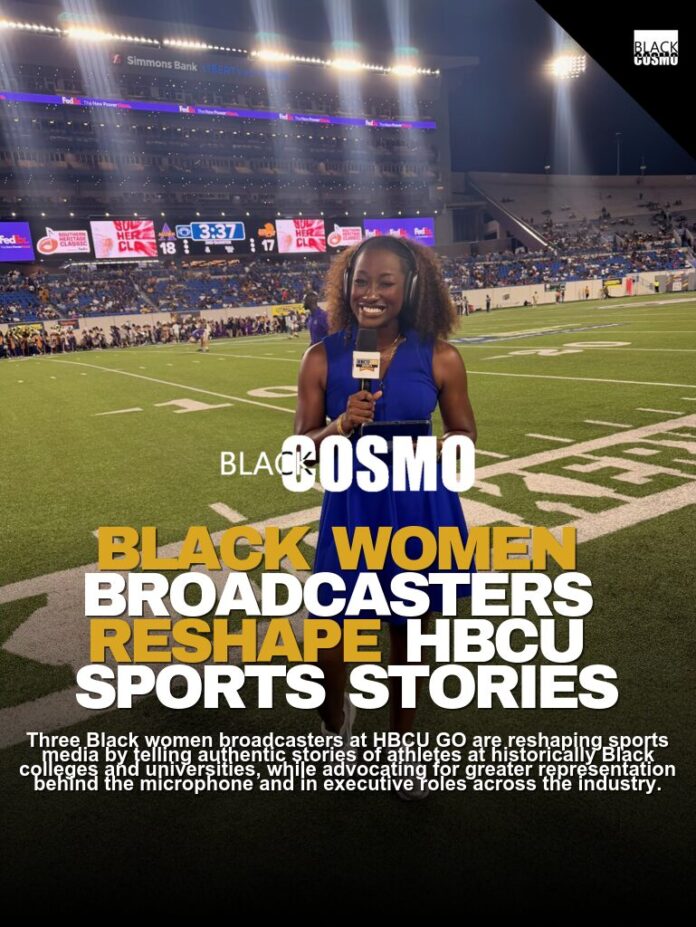
In a sports media industry where race and gender still shape whose voices are heard, HBCU GO broadcasters Nia Symone, Lawrencia Moten and Nicole Hutchison are reshaping how the stories of athletes at historically Black colleges and universities are told. These three Black women are bringing their perspectives to national audiences, telling stories that go far beyond the final score.
For HBCU GO broadcasters, the work takes on special significance during homecoming season, where bold fashion, alumni reunions and generations of Black pride intersect with the games themselves. It’s about capturing culture, honoring the communities behind it and ensuring HBCU sports are seen in all their depth.
“It’s one of those things you just have to experience,” Symone told The Root about homecoming. “You can watch it on TV, you can watch it on TikTok, but being able to actually live it in real time is very special. It’s one of a kind.”
Symone, an Alabama State University graduate and former college basketball player, sees homecoming as more than athletics. For her, it means reuniting with people and places that shaped Black identity. “You don’t realize how much of a safe space we are a part of until you leave it,” she said.
That sense of belonging informs her broadcasting. Symone credits ASU’s communications department, professors and alumni with preparing her for the industry. Now, she sees mentorship as a responsibility. “It would just be doing a disservice to myself if I did not pour in,” she said. “It would do the next generation a disservice and even the generation who poured into me, to not be able to help the next generation.”
Moten’s journey began courtside as well. The daughter of late NBA player Lawrence Moten, she remembers watching her father play for the Washington Wizards and asking her mother why there were no women on the broadcast side of the court. As a Division I basketball player, she discovered another gap: the stories of women athletes often went untold.
“I felt like my calling was to tell athletes’ stories. Being in a locker room, there were so many amazing women that I had the chance to be connected to,” Moten said. Back then, women’s basketball did not receive the attention it does today. “There wasn’t anyone who I felt like truly tried to push the stories of our team,” she added. So she stepped up.
At the University at Buffalo, Moten created a Facebook Live show interviewing teammates and coaches. Her first game assignment at the University of Hartford led to an ESPN sideline opportunity. Today, she works across play-by-play, color commentary and sideline reporting, making her an anomaly among women’s sports journalists.
And she takes that responsibility seriously. “For us to truly get an authentic understanding, you need to be speaking to people who are closely related to them,” she said. Moten also wants more women calling games. “The fact that I’m the first person many viewers have heard ever… That’s an issue to me.”
Hutchison knows firsthand what it takes to build a career in an industry where Black women remain underrepresented. As a 2019 Howard University graduate, she entered broadcasting through internships with Washington’s NFL team and a Houston radio station. After early-career stops in Louisiana and Kentucky, she built her career in Dallas, working with HBCU GO and hosting for the Cowboys.
Her experience has reinforced the pressure Black women face to be exceptional. “They always expect you to be on 10,” she told The Root, calling the difference between a male broadcaster’s mistakes and hers a “totally different ballgame.”

She told The Root that the solution starts with representation. “We need more execs that look like us,” she said. But more than that, Hutchison believes progress requires decision-makers who can open doors and advocate for people of color and women in broadcasting.
All three broadcasters see HBCU sports as deserving greater attention, particularly given resource disparities between programs. For Moten, storytelling can show athletes as people beyond a headline. For Symone, it can expose those inequities. These narratives matter.
Their advice to aspiring broadcasters is grounded in persistence. “This industry, I love it to death, but it can take a toll on you,” Symone explained. “Find your own voice. For Black girls, Black boys, if you say you want to be on air and that’s always been your goal, go for it.”
★TR★