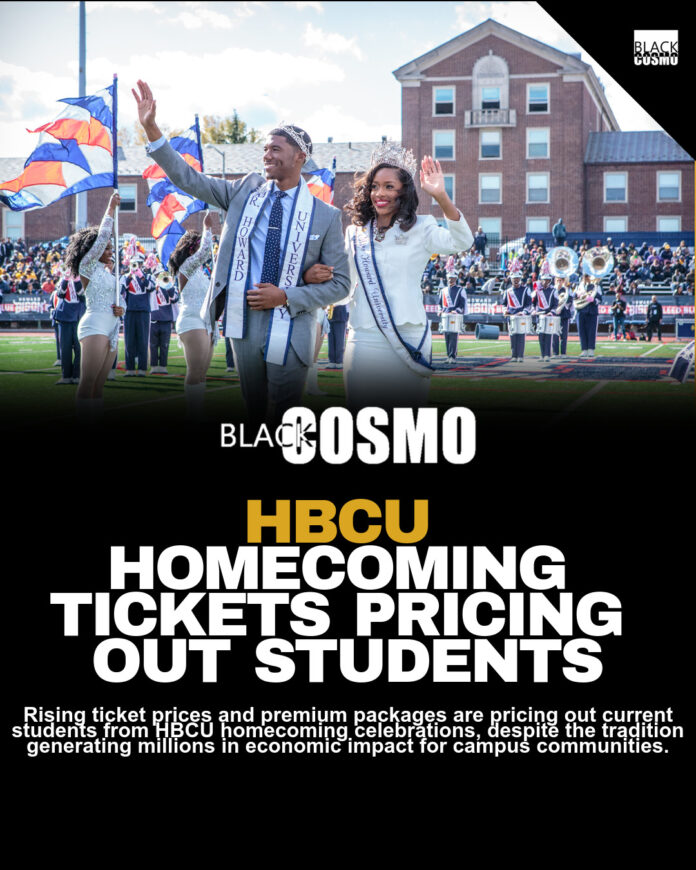
Howard University’s marching band performs during halftime of the school’s 93rd annual Homecoming game against North Carolina A&T on Saturday, October 22, at Greene Stadium in Washington, DC. (Photo by Cheriss May/NurPhoto via Getty Images)
HBCU Homecoming used to mean something specific: everybody coming home. Students, alumni, family, old classmates, even that one friend of somebody’s cousin who somehow scored a tailgate pass. The whole community showed up. But that image is shifting fast, and a hard look at pricing tells the story. What was once an accessible tradition is increasingly becoming something only certain people can afford.
A 2026 pricing survey from HBCU Gameday reveals the scale of the shift. Alabama A&M’s Legacy Club package sits at $1,875. Delaware State’s VIP box suites range from $1,000 to $1,800. Tennessee State offered a $15,000 package last year. And that’s just the football game itself. Parking, tailgating, food, parties, hotels—the weekend bill compounds quickly, and with Americans already stretched financially, many people are priced out before they even walk through the gate.
Some schools are trying to keep things accessible. Morgan State has early-bird general admission at $70. North Carolina Central’s Lawn Season pass runs $72. Allen University’s digital pass is $83. Fort Valley State tops out their general option at $95. These feel reasonable until you realize tickets vanish in minutes, which sends people scrambling to resale markets where those same seats go for $400 or more.
The tiers exist. Morgan State’s reserved seating is $150. North Carolina Central, $169. Delaware State, $200. Once you hit premium packages, prices spike hard. What emerges isn’t a single homecoming experience but a hierarchy based on what you can spend.
For a working alum with a steady paycheck, that math might work out. For a student on a meal plan trying to make it to payday? Different story entirely.
HBCU Homecoming exists on a campus full of students carrying real financial weight. According to Sallie Mae and Ipsos’ 2024 How America Pays for College report, 88% of HBCU students depend on grants and scholarships. Forty-three percent use student loans, compared with 30% across all college students. That context matters when evaluating whether a $95 ticket plus parking plus everything else is reasonable for the people the tradition is supposed to celebrate most.
The money generated is real. Morgan State’s 2025 Homecoming produced nearly $19 million in economic output for Baltimore. Thirty-five thousand people attended events that week, spending over $15 million locally. That’s substantial, and HBCUs need that revenue, especially in today’s economy. Nobody’s arguing schools shouldn’t benefit from their biggest weekends.
But there’s a tension worth acknowledging. When a current student can’t afford to attend their own school’s homecoming, something feels off. The tradition loses its center. You’re left with alumni and outsiders experiencing what should feel like a community moment.
Homecoming can be big business—tourism, alumni engagement, national visibility for campuses that deserve it. Those things matter. But critics have a point: it should still feel like home. And home shouldn’t require a VIP ticket to experience it.
★TR★