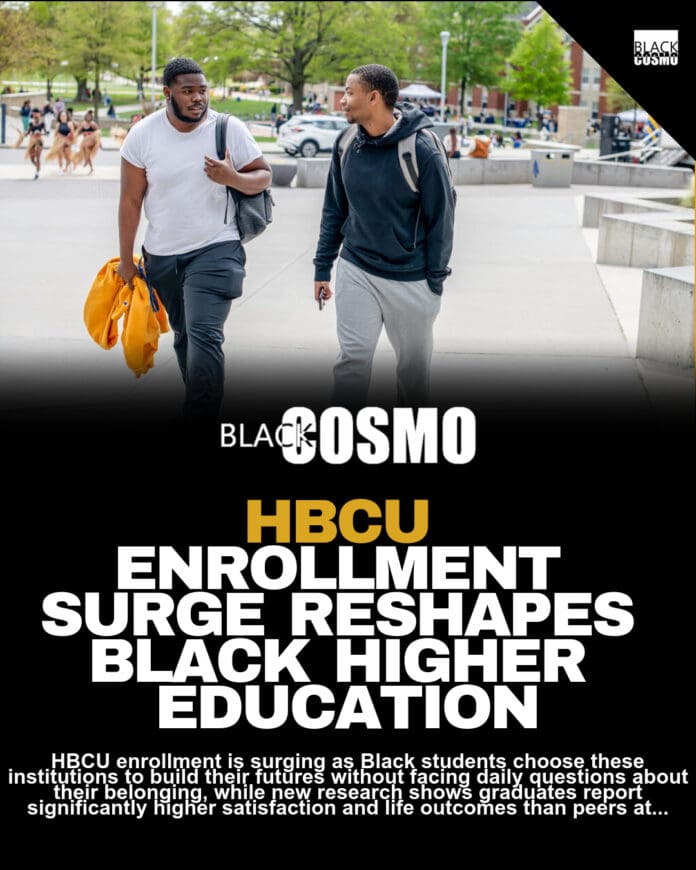
Our students are not running from. Our students are running toward.
They are running toward Historically Black Colleges and Universities (HBCUs) to belong — before defending their belonging in the larger world becomes a daily test. That is the story of HBCU enrollment surging, and it’s a story that deserves to be told without a foil. I say that as a man who holds no HBCU degree at all. Two of mine come from a predominantly white university — a campus that once made me prove I belonged — and one from a minority-serving institution in the heart of New York. At both, teachers, Black and white alike, bet on my promise before the proof. I am grateful to everyone and everything that shaped my academic journey.
What follows is not tribalism. It is testimony.
Let’s begin with the record because the affirmative action policy this country buried in 2023, with the Supreme Court decisions in Students for Fair Admission (SFFA) v. President and Fellows of Harvard College and SFFA v. University of North Carolina, was slandered at its own funeral. In Regents of the University of California v. Bakke (1978), the Supreme Court struck down racial quotas and ordered Allan Bakke admitted to medical school. But Justice Lewis Powell’s controlling opinion held something the 2023 eulogies forgot: race, Powell wrote, “may be deemed a ‘plus’ in a particular applicant’s file” — and in the very same sentence, it “does not insulate the individual from comparison with all other candidates.” Read it twice. The ‘plus’ accompanied the qualified. It did not preempt qualifications. Powell described the “otherwise qualified” student whose “ethnic, geographic, culturally advantaged or disadvantaged” background enriches a community. There was never a lesser-than clause. For forty-five years, reaffirmed in Grutter v. Bollinger (2003), that was the law: individualized review among equally capable candidates for the benefit of the whole.
Affirmative action was only ever decisive at a selective sliver of schools. A majority of America’s roughly 3,000 four-year colleges admit most of those who apply; when the Court ended the practice, Black enrollment shifted at those few campuses and barely registered anywhere else.
Generations who won those seats fair and square carried the burden of a false accusation into every seminar room: you didn’t earn your place here. My answer has always been direct: given the enduring homogeneity of those institutions — by wealth, by geography, by legacy, by everything but merit — neither did you.
Our schools, meanwhile, were proving the story more powerfully. Historically Black Colleges and Universities, according to the United Negro College Fund (UNCF), are the primary engine moving Black Americans from poverty into the middle class, at double the national rate. The crown of the Black middle class was forged on HBCU campuses. My colleague Dr. Melissa Harrington, a Stanford-trained neuroscientist who chose to build her career at an HBCU, and I recently completed research using U.S. Department of Education data. It shows that the doctoral record is just as stark. HBCUs award barely one percent of the nation’s research doctorates; however, in the disciplines for which we offer those programs, HBCUs produce nearly 20 percent of the Black doctoral graduates. For example, one small forestry program accounts for nearly 80 percent of Black PhDs in its field, and more than a third of Black veterinarians finish at an HBCU. The National Science Foundation reports that eight of the ten colleges most likely to have granted a Black PhD holder their bachelor’s degree are HBCUs. They started with us. They finished anywhere they pleased. And now, they anchor Black leadership in laboratories and courtrooms, within classrooms and operating rooms, on the biggest screens and the smallest stages.
And now the children of that record are voting with their futures. While American college enrollment shrank over the past decade, HBCU enrollment grew seven percent in just three years — a surge the National Center for Education Statistics measures against fourteen percent across the entire previous half-century. Applications across our sister institutions have climbed by a third and more; record-breaking incoming classes have become an annual ritual from one campus to the next; and admission to several of our schools is now more competitive than at most colleges in America. At Delaware State, we have set new student records in four of the last five years — 6,623 students strong, drawn from 44 states and more than 30 countries.
Understand who is coming: valedictorians carrying acceptance letters to some of the most prestigious schools in one hand and tickets to HBCU belonging in the other; under-resourced or first-generation students who still need a door opened to a system that may otherwise lock them out; future engineers, physicians, founders, and poets all electing the path that validates their worth. They are not settling for us; they are selecting us. They have watched this country turn their belonging into a debate, and they are declining to spend four years as the subject of it. At an HBCU, no one asks them to justify the seat. Every ounce of genius once spent proving goes, instead, to becoming. That is the surge. Not an escape from America’s argument but four years of freedom from it, building strength for the fights surely to follow.
And now the proof has caught up with the testimony. Days ago, the Thurgood Marshall College Fund’s Payne Research Center and Gallup released the largest study of HBCU alumni ever conducted, and its central finding is the one our students already knew: 83 percent of recent HBCU graduates felt they belonged at their institution, nearly twenty points above the national average. That belonging holds steady across income, gender, field of study, and first-generation status. As the study itself puts it, belonging at HBCUs “is not a privilege for the few. It is the culture.” And belonging compounds. Seven in ten HBCU alumni are thriving in their everyday lives, against 48 percent of American adults and 46 percent of Black adults nationally, and nearly three in four would send the next generation back to the source. The study’s title says it plainly: Proof of Promise.
This generation knows that record, and it is demanding that we meet the next generation even more decisively. Our students emerge now at the front of a second industrial revolution, powered by artificial intelligence. Delaware State was chartered in 1891, and thus, the first industrial revolution was built without us. This time, we are ready. Amazon Web Services named our university one of five national lead institutions for its Machine Learning University, and three of the five are HBCUs. This year, Malcolm Coley became our first doctoral student in data science and artificial intelligence, pursuing the degree that defines the second industrial revolution at the university chartered in answer to the first. And through eHBCU.edu, the first national online HBCU learning consortium, sister institutions now teach together, so that any student, anywhere, can claim this inheritance.
Ours is a legacy and an inheritance — a story still being written. At our university, Razia Khan Sharme, a graduate student in applied optics, took first place in physics at a national research conference for work she is doing with NASA in Dover, Delaware, at a public HBCU. She is the newest name in an old book. Du Bois sharpened his mind at Fisk. Bethune built a college on faith and a dollar and change. And the line runs unbroken: Katherine Johnson calculated spaceflight out of West Virginia State; Ronald McNair carried North Carolina A&T into orbit; Patricia Bath, Howard-trained, restored sight to the blind with a patented laser; David Satcher went from Morehouse to Surgeon General of the United States; Rosalind Brewer advanced from Spelman to the chief executive’s chair; Janice Bryant Howroyd excelled from North Carolina A&T to building the first billion-dollar business founded by a Black woman; Toni Morrison wrote her way from Howard to the Nobel and the Pulitzer; Thurgood Marshall graduated from Lincoln and Howard before serving on the U.S. Supreme Court; and Ruth Simmons, a daughter of Dillard, proceeded to the presidency of an Ivy League university. To name just a few.
All of our students know exactly what they are choosing: a place that has never asked them to prove they belong. They get straight to the work of becoming.
Let the record reflect. They earned it. So did we.
Tony Allen, Ph.D., is the 12th President of Delaware State University, the nation’s most diverse contemporary HBCU. He also chairs eHBCU.edu, the first national online HBCU learning consortium.
★TR★